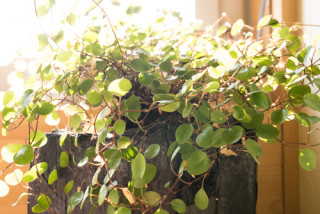
Muehlenbeckia axillaris
Creeping muelenbeckia
Description
Source: leafsnapMuehlenbeckia axillaris, commonly known as creeping wire vine or maidenhair vine, is a low-growing evergreen shrub in the Polygonaceae family. Native to New Zealand and Australia, it has gained popularity as an ornamental plant worldwide due to its appealing foliage and ease of cultivation. The plant features wiry stems that can reach up to 3 feet in length, adorned with small, glossy green leaves. These leaves are oval-shaped with pointed tips and grow in pairs along the stems. In late spring or early summer, clusters of small white flowers emerge at the base of each leaf, adding to its visual charm. Muehlenbeckia axillaris is highly versatile and can be used as ground cover or trained to climb trellises or walls for added vertical interest. It thrives in well-drained soil and full sun but can also endure partial shade. Although drought-tolerant once established, it benefits from regular watering during dry periods. Overall, Muehlenbeckia axillaris is an excellent choice for gardeners seeking an attractive, low-maintenance shrub with year-round appeal.
Care Guide
💧 Water Every 7 days
The creeping wire vine thrives in moist soil and dappled sunlight, needing regular watering while avoiding waterlogging. During the growing season, it's best to water it twice a week. This plant is also well-suited for container growth, which helps manage watering and prevent over-saturation.
☀️ Light Full sun
The creeping wire vine performs best in full, unblocked sun but will tolerate spots with alternating sun and shade, reflecting its origin in a naturally bright habitat. Too much or too little sunlight can affect its healthy development, altering its growth habits or causing changes in color.
🌡️ Temperature 15–35°C
Creeping wire vine is native to areas with moderate temperatures, growing best between 59 to 95 °F (15 to 35 ℃). It may require seasonal temperature adjustments to replicate its native climate conditions.
💨 Humidity
🪴 Soil 5-7
🌱 Fertilizer
Fertilize your Creeping wire vine in early spring to encourage healthy growth. Regular feeding improves overall health, producing vigorous growth, greater tolerance of harsh conditions, and enhanced resistance to diseases and pests. Keep to a consistent fertilization schedule for your Creeping wire vine to maintain vibrant, deeply colored foliage and a lush appearance.
🪴 Pot & Repot 2-3 years
Repot creeping wire vine every 2-3 years in the spring, using a slightly larger pot to encourage growth. Choose well-draining soil and keep the moisture consistent, being careful not to overwater. Keep an eye on its wandering stems to ensure an optimal display and to maintain its vitality after repotting.
✂️ Pruning
Creeping wire vine is a thick ground cover with wiry stems and small leaves. To manage its spread and improve air circulation, prune it from early to late winter using clean, sharp shears. Moderate pruning enhances the plant's health and encourages denser growth, while avoiding overly aggressive trimming.
🌿 Propagating
🐛 Diseases & pets
☠️ Toxicity
The only edible part of the Creeping Wire Vine is its fruit. This sweet and juicy fruit can be eaten either raw or cooked and is very small – only 3mm in diameter.
Characteristics
- Plant Type
- Shrub
- Life Cycle
- Perennial
- Genus
- Muehlenbeckia
- Family
- Polygonaceae
- Hardiness Zone
- 7-10
- Mature Height
- 10 cm
- Mature Spread
- 91 cm
- Leaf Color
- Green
- Leaf Type
- Evergreen
- Flower Color
- White
- Flower Size
- 2.54 cm
- Bloom Time
- Summer
- Planting Time
- Spring, Summer, Autumn
- Harvest Time
- Late summer, Early fall, Mid fall
- Native Area
- New Zealand