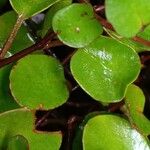
Muehlenbeckia complexa
Maidenhair-vine · Wireplant · Lacy wirevine · Mattressvine · Necklace vine
Description
Source: leafsnapMuehlenbeckia complexa, commonly known as wire vine or maidenhair vine, is a flowering plant in the Polygonaceae family. Native to New Zealand and Australia, it has gained popularity worldwide as an ornamental plant due to its appealing foliage and delicate appearance. The wire vine is a fast-growing evergreen climber that can reach lengths of up to 10 feet. Its slender stems are adorned with small, glossy green leaves shaped like hearts or circles. These leaves grow densely along the stems, giving the plant a lush, full appearance. In late spring or early summer, the wire vine produces small clusters of tiny white flowers. These blooms are followed by small, black berries that attract birds. Wire vines thrive in well-draining soil and partial shade, although they can also tolerate full sun if provided with sufficient water. They require relatively low maintenance but may need occasional pruning to prevent them from becoming too unruly. Overall, Muehlenbeckia complexa is an attractive and versatile plant that can be used as ground cover or grown on trellises to create vertical interest in gardens or indoor spaces.
🌳 Maidenhair vine is a resilient and versatile climbing shrub that offers multiple uses in the garden, adapting well to nearly any location. It can serve as a twining climber, ground cover, or be shaped into topiary or wall-side borders, making it ideal for courtyard, city, or cottage gardens. Additionally, it is excellent for covering banks and slopes. Thanks to its high salt tolerance, maidenhair vine can flourish in coastal gardens, even right on the beach.
🎭 Conveying mistrust and solitude
Care Guide
💧 Water Every 7 days
Native to temperate regions, the maidenhair vine flourishes in consistently moist soil and cannot endure extended periods of dryness. It needs to be watered weekly and is typically grown outdoors to benefit from natural rainfall and changes in seasonal temperatures.
How should I water my Maidenhair vine?
To properly water the Maidenhair vine, use filtered water that is at room temperature or slightly warmer. Filtered water is best because tap water may contain harmful particles. Since the Maidenhair vine is adapted to warm environments, cold water can be a shock to its system. Avoid overhead watering as it can harm the foliage. Instead, water the plant by applying filtered room temperature water directly to the soil until it is thoroughly soaked. This will benefit the plant by keeping the roots moist and helping them spread through the soil to gather nutrients.
What should I do if I give my Maidenhair vine too much water or too little water?
Overwatering is a more common issue than underwatering for the Maidenhair vine. When the plant receives too much water, its stems and leaves may wilt and turn yellow. Overwatering for a long time can also cause diseases like root rot, mold, and mildew that can kill the plant. While underwatering is less common for the Maidenhair vine due to its drought tolerance, it can still happen, resulting in brittle and brown leaves. It is important to notice the signs of overwatering early on, as some diseases like root rot may be irreversible if not addressed promptly. If you see early signs, reduce watering immediately and check the drainage of the soil. If it drains poorly, replace it with a well-draining potting mix. On the other hand, if the plant is showing signs of insufficient water, increase watering until the signs disappear.
How frequently should I water my Maidenhair vine?
If your Maidenhair vine is in a pot, the most precise way to determine if it needs water is by checking the moisture level of the soil. Plunge your finger into the soil and if you find that the top two to three inches are dry, it's time to water the plant. For Maidenhair vines grown outdoors in the ground, you can use a similar method to check the soil. When the top few inches of soil have dried out, it's time to water the plant. During the spring and early fall, you'll generally need to water this plant about once a week using this method. However, during extremely hot weather, you may need to increase your watering frequency to twice or more per week. It's worth noting that mature and well-established Maidenhair vines have a remarkable ability to tolerate drought.
How much water should I give my Maidenhair vine?
To water your Maidenhair vine effectively, don't hold back on the amount of water you give. Wait until the top few inches of soil are dry, and then thoroughly soak the entire soil. Be sure to add enough water that it flows through the drainage holes at the bottom of the pot. If you don't see any excess water draining, it's a sign that you haven't given enough water. On the other hand, be careful not to let water accumulate in the soil, as this can harm the plant. If you notice a lack of drainage, it may indicate that the soil is not draining properly, which can negatively impact the plant's health. If the plant is outside, about 1 inch of rain per week is adequate.
How should I water my Maidenhair vine when it is growing at different stages?
Depending on its growth stages, the water requirements of the Maidenhair vine can vary. In the first few years of its life or after being transplanted, it will need more water because it is focusing on growing new roots to support future growth. These roots perform best with a bit more moisture. However, after a few seasons, the vine will require less water. Another stage that may require more water is the bloom period, as flower development uses a significant amount of moisture.
☀️ Light Partial sun
Maidenhair vine does best with plenty of sunlight but can also do well in low-light conditions. It tolerates a range of light levels typical of its native habitats. Too little light can curb its vigorous growth, while too much exposure may scorch the leaves.
What are the sunlight requirements for Maidenhair Vine?
Maidenhair vine requires partial sun, which means about 3-6 hours of sunlight per day, but it can also thrive in conditions of full sun or full shade, which involves receiving more than 6 hours of sunlight daily. It's important to observe how sunlight moves through your garden to find spots that offer the right balance of light and shade, ensuring your plants stay healthy and happy.
How does Maidenhair Vine respond to different light conditions?
Maidenhair vine adapts well to a broad spectrum of light conditions, from generous sun exposure to minimal light. In its native habitat, it has shown resilience across various light environments. While it can grow robustly with enough light, too little may restrict its growth, and too much can cause leaf scorching. Artificial lighting, like LED lights that can be adjusted to provide specific wavelengths, can support its growth indoors, especially in winter or less sunny locations. Depending on the type of plant (full sun, partial sun, or full shade plants), the wattage of artificial light required varies.
What are the symptoms of light deficiency or overexposure in Maidenhair Vine?
Maidenhair vine displays several symptoms when light conditions are not optimal. Indicators of light deficiency include premature leaf drop, a halt in new growth, lighter-colored new leaves, leggy growth, and overall sparse appearance. Overexposure to light can cause chlorosis, sunscald, leaf curling, wilting, and leaf scorching. These symptoms either indicate a struggle with adapting to low light or damage from too much sunlight, impacting the plant's ability to conduct photosynthesis effectively.
What solutions can help Maidenhair Vine adapt to indoor and outdoor light changes?
To assist Maidenhair vine in adapting to light conditions both indoors and outdoors, gradually shift it to sunnier spots each week to achieve 3-6 hours of direct sunlight daily. For large or immovable plants indoors, consider supplementing with artificial light for at least 8 hours daily or invest in professional grow lights. Outdoors, it's crucial to avoid sudden, drastic changes in light to prevent sunburn. If insufficient sunlight is a concern, methods such as reducing obstructions (like pruning trees) or transplanting during the plant's dormant period to a sunnier location can encourage healthier growth.
🌡️ Temperature 15–35°C
The maidenhair vine is native to cool-temperate zones that do not have high-heat days, such as New Zealand. It does best in temperatures from 59 to 95 ℉ (15 to 35 ℃). In summer it should be kept out of direct sunlight to avoid heat damage.
What is the indigenous region of the Maidenhair vine?
The Maidenhair vine, known botanically as Muehlenbeckia complexa, is indigenous to cool-temperate regions that do not experience high-heat days, such as New Zealand. It is well-suited to temperatures ranging from 59 to 95 ℉ (15 to 35 ℃), thriving in these conditions.
What are the ideal temperature conditions for Maidenhair vine?
Maidenhair vine thrives in temperatures ranging from 59 to 95 ℉ (15 to 35 ℃). During summer, it's crucial to protect it from direct sunlight to avoid heat damage. The plant has some cold tolerance and can generally withstand temperatures above -5°C. However, additional protection is needed if temperatures are expected to fall below -5°C.
How do you protect Maidenhair vine from extreme cold?
In anticipation of temperatures dropping below -5°C, it's necessary to implement temporary cold protection measures for the Maidenhair vine. You can wrap the plant with plastic film, fabric, or other suitable materials. Once the temperature rises, these protective coverings should be removed to avoid overheating or suffocating the plant.
What are the symptoms of low temperature damage to Maidenhair vine, and how can it be addressed?
When exposed to temperatures below -10°C, the leaves of the Maidenhair vine may droop. In mild cases, the plant can recover, but in severe cases, leaves will wilt and fall off. To address frost damage, trim off the damaged parts. Protect the plant from future cold exposure by wrapping it with non-woven fabric or cloth and constructing a wind barrier.
How does high temperature affect Maidenhair vine, and what are the solutions?
High temperatures, especially above 41°C, can cause the Maidenhair vine's leaves to lighten in color, dry and wither at the tips, curl, and increase susceptibility to sunburn. Addressing this involves trimming away sunburned and dried up parts, moving the plant to a shaded location or using a shade cloth, and ensuring the soil remains moist by watering in the morning and evening.
💨 Humidity high (>60%)
This plant needs special care because it loves high humidity levels of 60-80% or more. The best way to achieve this is by placing a humidifier near the plant. Daily misting is also essential! Make sure the room has good ventilation.
🪴 Soil 6-7
🌱 Fertilizer
Usually one fertilizer application in spring is enough for Maidenhair vine, though several feedings can increase growth. Apply fertilizer about once every month to a month and a half. Feeding improves the leaves’ appearance and function, helping maintain even color and a healthy texture. It also encourages root development and nutrient uptake, supporting the plant’s long-term health.
Why is it important to fertilize my Maidenhair vine?
The Maidenhair vine relies heavily on its leaves for support and structure. Fertilizing it properly is crucial for maintaining the health and appearance of these leaves. Adequate fertilization ensures that the leaves retain their color and texture. Moreover, fertilization also has a positive impact on the vine's root system. It helps generate new roots and maintains the existing ones, enabling the plant to absorb nutrients from the soil effectively in the long run. So, by fertilizing your Maidenhair vine, you not only keep it healthy in the present but also increase its ability to absorb nutrients in the future.
When should I fertilize my Maidenhair vine?
If you grow your Maidenhair vine outdoors each year, you'll notice new growth emerging in early spring. This is a signal that it's time to start fertilizing the plant. Typically, a single application of fertilizer in the spring will be sufficient for the vine to thrive. However, if you want to promote its maximum growth, you can choose to fertilize it multiple times during the spring and early summer. In this case, you can feed the vine about once every month to a month and a half.
When is not a good time to fertilize my Maidenhair vine?
During the late fall and winter, your Maidenhair vine goes into a dormant phase and stops producing new growth. During this time, it's best not to fertilize it. In the spring and summer, if you choose to fertilize, start decreasing the frequency as summer approaches because the growth rate slows down. It's generally not a good idea to fertilize your Maidenhair vine when it's extremely hot or when the soil is very dry. Doing so can stress the plant and lead to premature death.
What kind of plant food does my Maidenhair vine need?
Choosing the best fertilizer for a Maidenhair vine is fortunately quite simple. These plants thrive on a garden fertilizer that has equal amounts of nitrogen, phosphorus, and potassium, such as a ratio of 10-10-10. It is important to avoid fertilizers with high nitrogen content when in doubt. Granular fertilizers in a slow-release form are generally recommended for Maidenhair vines, as they are easy to apply to the soil. Additionally, using an organic soil amendment like compost can be beneficial for feeding the plant.
How should I fertilize my Maidenhair vine?
To ensure optimal growth of your Maidenhair vine, wait until early spring when you see the first leaves emerging from the soil's surface. Once you notice this, apply a granular slow-release fertilizer with a balanced formula to the soil surrounding the base of the plant. You can choose to repeat this process later in the season. Remember to apply the fertilizer to the soil at the base of the plant rather than directly on the plant itself. This may require moving some leaves aside to access the soil above the roots. It's also recommended to water your Maidenhair vine before and after fertilizing.
🪴 Pot & Repot 2-3 years
Repot the Maidenhair vine in early spring, selecting a pot only slightly larger than the current one and with good drainage. Use a well-draining potting mix and make sure the root ball is positioned at the same level as before. Gently loosen any root-bound roots. After repotting, water thoroughly and place the plant in a warm, shady spot. Regular pruning will keep its size in check and encourage new growth.
✂️ Pruning
The Maidenhair vine is a vigorous, twining perennial plant with heart-shaped leaves. To control its growth and shape, prune it from early to late spring, taking care to remove any dead or tangled branches. Regular pruning encourages dense foliage, but avoid heavy pruning late in the season to help maintain its cold hardiness.
🌿 Propagating
🐛 Diseases & pets
☠️ Toxicity
Both humans and pets have not been known to become ill after eating it. If too much food is consumed, it could cause nausea, vomiting, and appetite loss. Boston, maidenhair, bird's nest, and staghorn are considered to be "genuine ferns," albeit they should not be consumed.
Characteristics
- Plant Type
- Vine, Herb
- Life Cycle
- Perennial
- Genus
- Muehlenbeckia
- Family
- Polygonaceae
- Hardiness Zone
- 8-10
- Mature Height
- 0.49 m to 4.88 m
- Mature Spread
- 6.1 m to 9.14 m
- Leaf Color
- Green
- Leaf Type
- Evergreen
- Flower Color
- White
- Flower Size
- 0.51 cm to 3.05 cm
- Bloom Time
- Late spring, Early summer, Mid summer
- Planting Time
- Spring
- Harvest Time
- Mid summer
- Native Area
- New Zealand