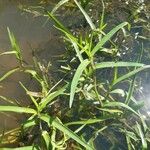
Murdannia keisak
Marsh dewflower · Asian-spiderwort · Wart-Removing-Herb · Wartremoving herb · Wart-removing herb
Description
Source: leafsnapMurdannia keisak, the marsh dewflower, is an annual, emergent plant in the family Commelinaceae. It is known by several other common names, including aneilema, wart-removing herb, Asian spiderwort, and marsh dayflower. The alternate-leaved plant has succulent, prostrate stems 12 to 20 inches long, and forms new roots at the lower nodes. Three-petaled, perfect flowers, white to bluish-purple or pink, are found in the upper leaf axils and at the ends of stems. The fruit is a capsule with several small seeds. A plant of freshwater marshes and the edges of ponds and streams, Murdannia keisak is associated with the growing of rice in east Asia, where it is native to China, Japan, Korea, and Tibet.Murdannia keisak is an introduced species in the United States. First records in Louisiana and South Carolina date from the 1920s and 1930s. It is most likely that Murdannia keisak accompanied rice imported for agriculture. Evidence also suggests that the plant was present decades before its first collection. Populations are established in the mid-Atlantic and southeastern US, from New Jersey to Florida and west to Arkansas and Louisiana; it is also known from the Columbia River estuary between Washington and Oregon.Murdannia keisak can spread aggressively, crowding out other vegetation and forming a solid mat. It can disperse by its small seeds, which are a preferred food of ducks and other waterfowl; it can also reproduce vegetatively.
Care Guide
💧 Water
The wart-removing herb thrives in moist environments and benefits from consistent hydration. Watering it weekly helps promote its growth, and when grown outdoors, it benefits from natural rainfall. The herb flourishes best when the soil moisture mimics its native humid conditions. While it is adaptable, it responds well to brief dry spells.
☀️ Light Full sun
Wartremoving herb grows best in full sunlight. It can also tolerate lower light levels, enduring areas that experience shifting shadows during the day. Originating from habitats exposed to direct sun, it reduces the likelihood of disease and promotes healthy, unrestricted growth. However, excessive light or inadequate light can cause harm.
What are the sunlight requirements for Wartremoving herb (Murdannia keisak)?
Wartremoving herb requires full sunlight for optimal growth, thriving with more than 6 hours of direct sunlight each day. It can also endure conditions of partial sun, which means about 3-6 hours of sunlight. It is essential to watch how sunlight moves through your garden to ensure the plants are placed in locations that provide a perfect balance of light and shade.
What are the essentials for growing Wartremoving herb?
The Wartremoving herb thrives best under full exposure to daylight but can tolerate lower light levels and areas with shifting shadows. Originating from environments with ample sunlight helps to decrease the likelihood of disease and promotes unrestricted healthy growth. However, exposure to extreme daylight or inadequate light can be detrimental. When natural sunlight is insufficient, especially in winter or less sunny locations, artificial lighting can be crucial. LED lights are recommended for their ability to offer the specific wavelengths plants need. Full sun plants need 30-50 watts per square foot of artificial light, partial sun plants need 20-30 watts per square foot, and full shade plants need 10-20 watts per square foot.
What symptoms indicate insufficient or excessive sunlight for Wartremoving herb?
Symptoms of light deficiency in Wartremoving herb include new leaves growing smaller, leggy or sparse growth, faster leaf drop, and a stop in new growth, indicating the plant has entered survival mode due to poor light. Insufficient light also causes new leaves to appear pale, pointing to a lack of chlorophyll. Excessive sunlight can lead to chlorosis, where leaves turn yellow, sunscald with pale or necrotic areas on plant tissue, leaf curling as a defense mechanism against sunlight, wilting from increased water loss, and leaf scorching seen as brown, dry edges on leaves.
What solutions can alleviate the symptoms of poor lighting for Wartremoving herb?
To combat insufficient sunlight, gradually move the plant to sunnier spots to ensure at least 6 hours of direct sunlight daily. If artificial light is needed, keep a desk or ceiling lamp on for at least 8 hours a day or consider professional plant grow lights. For outdoor plants, moving them gradually to sunnier locations can prevent shock and sunburn. Pruning obstructing branches and transplanting smaller plants during their dormant period to sunnier locations can also improve exposure. Note that while parts of the plant that have suffered from poor lighting may not recover, new growth should be healthy following these adjustments.
🌡️ Temperature 20–37.8°C
The wartremoving herb thrives in warm climates and prefers temperatures from 68 to 100 °F (20 to 38 ℃). In colder months, it's important to keep temperatures above 68 °F (20 ℃) to promote optimal growth.
What is the ideal temperature range for growing Wartremoving herb?
The ideal temperature range for growing Wartremoving herb, also known as Murdannia keisak, is between 68 to 100 °F (20 to 38 °C). It thrives in balmy climates and requires warmth to grow optimally. During the chillier months, it's important to keep the temperature above 68 °F (20 °C) to ensure the plant's health. Wartremoving herb is very sensitive to cold temperatures; therefore, when autumn arrives, it's recommended to bring outdoor plants indoors and place them near a bright window, away from direct heat sources, to maintain a suitable temperature.
How does low temperature affect the Wartremoving herb and what are the solutions?
Wartremoving herb is not tolerant of low temperatures and performs best when the temperature remains above 20°C. Exposure to temperatures below 0°C is harmful, and if temperatures fall below -5°C, the plant's leaves may lighten in color. Following frost damage, leaves can turn brown or black, and the plant might show signs of wilting and drooping. To manage frost damage, affected parts should be trimmed off, and the plant should be moved to a warmer location indoors. Placing the plant near a south-facing window ensures it receives ample sunlight, but it should be kept away from heaters or air conditioning vents to avoid air dryness.
How to care for Wartremoving herb in high temperature conditions?
In high temperatures, particularly during the summer when temperatures can exceed 38°C, care should be taken to prevent the Wartremoving herb from getting too hot. Exposure to temperatures above 43°C may result in lighter leaf color and increased susceptibility to sunburn. To mitigate damage from high temperatures, trim away sunburned and dry parts of the plant, and relocate it to a shaded area that protects it from the intense midday and afternoon sun. Additionally, watering the plant in the morning and evening can help keep the soil moist and cool, further aiding in the plant's health during hot weather.
💨 Humidity
🪴 Soil 5-7
🌱 Fertilizer
The wart-removing herb needs the most fertilizer during its active growth phase, which takes place mainly in spring, summer, and early fall. Fertilization is required to supply essential nutrients the soil may lack, supporting healthy root and stem growth and producing attractive foliage, a key feature of this plant.
🪴 Pot & Repot
✂️ Pruning
To ensure the wart-removing herb grows healthily and is kept under control, it's important to prune it regularly from early to late spring. Regular trimming helps maintain its shape, remove dead stems, and encourage dense foliage. This not only enhances air circulation but also reduces the risk of disease, promoting optimal health and appearance.
🌿 Propagating
🐛 Diseases & pets
☠️ Toxicity
Characteristics
- Plant Type
- Herb
- Life Cycle
- Perennial, Annual
- Genus
- Murdannia
- Family
- Commelinaceae
- Hardiness Zone
- 9-11
- Mature Height
- 5 cm to 20 cm
- Mature Spread
- 20 cm to 40 cm
- Leaf Color
- Green, Dark Green
- Leaf Type
- Semi-evergreen
- Flower Color
- Lavender
- Flower Size
- 1.02 cm
- Bloom Time
- Mid summer, Late summer, Early fall, Mid fall
- Planting Time
- Spring, Summer
- Harvest Time
- Fall
- Native Area
- Russia, Nepal, Vietnam, Japan, Koppen, Laos, South Korea, China