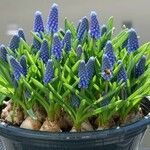
Muscari armeniacum
Garden Grape-hyacinth · Armenian grape hyacinth · Grape Hyacinth
Description
Source: leafsnapMuscari armeniacum, commonly known as grape hyacinth, is a perennial bulbous plant belonging to the Asparagaceae family. Native to the eastern Mediterranean, it has been widely cultivated as an ornamental plant in gardens and parks worldwide. Grape hyacinth produces dense spikes of small, bell-shaped flowers, typically blue or purple, though they can also be white or pink. These flowers are surrounded by narrow, strap-like leaves that can grow up to 30 cm long. This plant blooms in early spring and can reach a height of up to 20 cm. Grape hyacinth prefers well-drained soil and thrives in full sun or partial shade. It is relatively easy to grow and requires minimal maintenance once established. For optimal growth, grape hyacinth bulbs should be planted in autumn at a depth of around 10 cm, with a spacing of about 5-8 cm between bulbs. In addition to its ornamental value, Muscari armeniacum has been used for medicinal purposes for centuries due to its anti-inflammatory properties. Its bulbs contain compounds such as muscimol, which have been shown to have sedative effects on the nervous system. Overall, Muscari armeniacum is an attractive, spring-flowering bulbous plant with easy cultivation requirements, making it a popular choice for gardeners seeking low-maintenance plants. Its beautiful blooms add vibrant color to early springtime displays in gardens and landscapes alike.
💡 Grape hyacinth is part of the genus Muscari. The name "Muscari" is derived from the Latin adaptation of the Greek word for musk, μόσχαρι (móschari). This name reflects the pleasant, musky fragrance that many flowers in this genus emit.
🌳 Aside from its visual appeal, grape hyacinth is recognized for its role as a bioindicator, especially for detecting zinc in soil. Researchers appreciate the plant for its capacity to mirror the local mineral composition of the habitats where it grows. That capability makes grape hyacinth useful for ecological and environmental evaluations, offering important insights into soil health without the need for sophisticated laboratory apparatus.
🎭 Strength, self-assurance, enigma and inventiveness
Care Guide
💧 Water Every 7 days
Grape hyacinth, a plant native to temperate regions, thrives best with moderate moisture and consistently hydrated soil. To maintain its health, it is important to water it weekly. As an ornamental bulbous plant, grape hyacinth flourishes outdoors during the growing season and needs less water during its dormant period after flowering.
☀️ Light Full sun
Grape hyacinth does best with plentiful sunlight for most of the day. It can also grow reasonably well with moderate sun, though that may limit its vigorous growth. Because it comes from a habitat that requires strong sunlight, unsuitable light levels can harm the plant's health and reduce its ability to flower.
What are the sunlight requirements for grape hyacinth?
Grape hyacinth (Muscari armeniacum) flourishes best under conditions of full sun, meaning it should receive more than 6 hours of sunlight daily. However, it can also perform reasonably well in partial sun, with about 3-6 hours of sunlight. Observing how sunlight moves through your garden will help you find spots that offer a perfect balance of light and shade, ensuring your plants thrive. It's important to provide the right amount of sunlight to avoid harmful effects on the plant's health and its flowering process.
How does artificial lighting support grape hyacinth growth indoors?
When natural sunlight is inadequate, especially during winter or in less sunny spaces, artificial lighting can be crucial for the growth of indoor grape hyacinth plants. Artificial lights, particularly LED lights, can be tailored to provide specific wavelengths of light that plants need. For full sun plants, 30-50 watts per square foot is suggested, while partial sun plants benefit from 20-30 watts per square foot, and full shade plants need 10-20 watts per square foot. The light source should be placed 12-36 inches above the plant, simulating natural sunlight as closely as possible, with most plants needing 8-12 hours of light per day.
What symptoms indicate grape hyacinth is getting insufficient sunlight?
Symptoms of insufficient sunlight in grape hyacinth include lighter-colored new leaves, indicating a lack of chlorophyll and essential nutrients, which may also affect future flowering and fruiting. Leggy or sparse growth, with longer spaces between leaves or stems, can result in a plant appearing thin and stretched. Other symptoms include chlorosis, where leaves lose color and turn yellow; sunscald, causing damage to leaves or stems from intense sunlight; leaf curling as a defense mechanism to minimize water loss; wilting from excessive water loss through transpiration; and leaf scorching, seen as brown, dry edges or patches on leaves due to excessive sunlight.
What solutions can help grape hyacinth get adequate sunlight?
To ensure grape hyacinth receives adequate sunlight, indoor plants can gradually be moved to sunnier locations, ideally near a south-facing window, or supplemented with artificial light for at least 8 hours daily. Outdoor and ground plants should be moved gradually to sunnier spots to avoid sunburn, taking care to make these changes slowly to allow the plants to adapt. Reducing obstructions, such as pruning trees that block sunlight, and transplanting smaller plants during their dormant period to locations with ample sunlight, can also enhance light exposure. In all cases, parts of the plant that have been affected by insufficient sunlight may not recover fully, but new growth should be healthy with improved light conditions.
🌡️ Temperature 5–35°C
Grape hyacinth, native to temperate climates, does best in temperatures of 68 to 95 °F (20 to 35 ℃). In hotter conditions it benefits from partial shade, while in cooler conditions full sun is preferable.
What are the ideal temperatures for grape hyacinth?
Grape hyacinth, scientifically known as Muscari armeniacum, thrives in moderate climates with ideal temperatures ranging from 68 to 95 °F (20 to 35 °C). It possesses strong cold resistance and typically doesn't require special frost protection measures. However, during hot weather, it benefits from partial shade, while in cooler conditions, full sun supports its growth better. If winter temperatures are expected to drop below -30°C, it's crucial to protect the plant by covering it with soil or straw to safeguard against frost.
How should you care for grape hyacinth during winter?
For grape hyacinth, winter care involves ensuring the plant is well-hydrated before the first freeze. It's recommended to water the plant abundantly to keep the soil moist and prevent drought during the colder months. This preparation helps the soil enter a frozen state ready to support the plant through winter and early spring without requiring special frost protection measures, unless temperatures are forecasted to fall below -30°C.
What are the symptoms of low and high temperature stress in grape hyacinth?
Grape hyacinth shows different symptoms under temperature stress. During low temperatures, especially below -30°C, the plant might not exhibit immediate visual signs but could struggle with reduced or no sprouting in spring. At high temperatures, above 35°C and particularly past 38°C, the plant's leaves may lighten in color, curl, become prone to sunburn, and in severe cases, wilt and dry out. It's crucial to remove non-sprouting parts in spring and trim away sunburned or dried parts, provide shade, and ensure soil moisture through targeted watering in warmer temperatures.
💨 Humidity normal (40-60%)
This plant will thrive in moderate humidity, which is probably the level in your home. However, misting it a few times a week can be very beneficial. Make sure the room has good ventilation.
🪴 Soil 6-7
🌱 Fertilizer
For Grape hyacinth, the best time to fertilize is in early spring as the flowers are forming. The proper fertilizer promotes stronger blooms and helps Grape hyacinth produce attractive flowers. Fertilizing in early spring ensures excellent flowers during the season and provides energy for dormant growth phases.
🪴 Pot & Repot 2-3 years
Repot grape hyacinths every few years, ideally after they have finished blooming in late spring or early summer. Choose well-draining pots that are slightly larger than the previous ones, and fill them with enriched compost. Water the plants sparingly and place them in bright, indirect light to aid their recovery. Grape hyacinths thrive with minimal care.
✂️ Pruning
Grape hyacinth displays striking blue flowers and grass-like leaves, and it requires minimal pruning to thrive. After the plant blooms in spring, trim the flower stalks and remove any faded leaves to encourage further growth. By cutting off spent flowers, you prevent seed formation, which allows the plant to direct more energy to the bulbs. It's also important to promptly remove any dead leaves to promote healthy blooms and maintain a neat appearance.
🌿 Propagating
🐛 Diseases & pets
☠️ Toxicity
Not only is the grape hyacinth a stunning addition to your garden, but it is also non-toxic. These bulbs are completely safe to have around your children and pets.
Characteristics
- Plant Type
- Herb
- Life Cycle
- Perennial, Annual
- Genus
- Muscari
- Family
- Asparagaceae
- Hardiness Zone
- 4-9
- Mature Height
- 15 cm to 20 cm
- Mature Spread
- 8 cm to 15 cm
- Leaf Color
- Green
- Leaf Type
- Deciduous
- Flower Color
- Blue, Purple
- Flower Size
- 2.54 cm
- Bloom Time
- Spring
- Planting Time
- Winter, Spring, Autumn
- Harvest Time
- Late spring, Early summer
- Native Area
- Turkey, Bulgaria, Armenia, Azerbaijan, Iran, Greece, Serbia