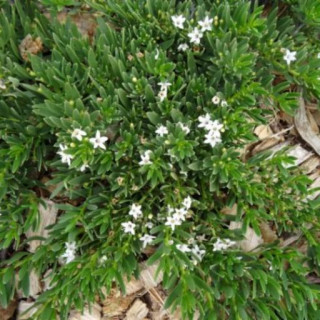
Myoporum parvifolium
Dwarf native-myrtle · Slender myoporum · Creeping boobialla · Creeping myoporum
Description
Source: leafsnapMyoporum parvifolium, commonly known as creeping boobialla, creeping myoporum, dwarf native myrtle or small leaved myoporum is a plant in the figwort family, Scrophulariaceae. It is a low, spreading shrub with long, trailing stems and white, star-shaped flowers and is endemic to southern Australia including Flinders Island.
Care Guide
💧 Water
Creeping myoporum is a drought-tolerant plant that thrives with minimal moisture and occasional rainfall. In cultivation, it benefits from weekly watering and requires well-draining soil to prevent root rot. Often used as ground cover, creeping myoporum needs a careful balance of hydration to support its growth.
☀️ Light Full sun
Creeping myoporum comes from open environments, such as sunny meadows and forest edges, where light is plentiful. It flourishes in Full Sun but can also tolerate Partial Sun, adapting well to different sunlight conditions.
🌡️ Temperature 20–37.8°C
Creeping myoporum shows good adaptability to temperature, tolerating high heat and considerable temperature fluctuations. In hot conditions, attention should be paid to watering and providing appropriate shade to avoid sunburn. Conversely, creeping myoporum is fairly intolerant of low temperatures; while it can endure some cold, excessively low temperatures may cause frost damage.
💨 Humidity
🪴 Soil 6-8
🌱 Fertilizer
The timing of fertilizing Creeping myoporum is important. Apply fertilizer in early spring and repeat monthly until early summer. Fertilizer promotes attractive blooms and supplies energy during both dormant and active growth phases.
🪴 Pot & Repot 2-3 years
For optimal growth, repot your creeping myoporum every 2-3 years in the spring. Use a wide pot and make sure the soil is well-draining, with consistent moisture after repotting. Repotting in the spring allows the roots to recover before the active growing season. Overall, creeping myoporum is generally low-maintenance.
✂️ Pruning
Creeping myoporum is a ground-cover plant known for its dense foliage and star-shaped flowers. To maintain its shape and promote growth, prune it from early to late winter. Be sure to remove any leggy stems and damaged branches. Use clean, sharp tools for the best results, and avoid heavy pruning when the plant is actively growing to protect the blooms.
🌿 Propagating
🐛 Diseases & pets
☠️ Toxicity
Characteristics
- Plant Type
- Shrub
- Life Cycle
- Perennial
- Genus
- Myoporum
- Family
- Scrophulariaceae
- Hardiness Zone
- 11
- Mature Height
- 15 cm
- Mature Spread
- 76 cm
- Leaf Color
- Green
- Leaf Type
- Evergreen
- Flower Color
- White
- Flower Size
- 0.51 cm to 1.02 cm
- Bloom Time
- Mid spring, Late spring, Summer, Early fall
- Planting Time
- Spring, Autumn
- Harvest Time
- Mid summer, Late summer, Early fall, Mid fall