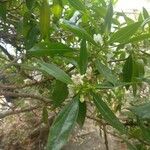
Myoporum tenuifolium
Manatoka · Boobialla · Pointed boobialla · Waterbush · Mangrove boobialla
Description
Source: leafsnapMyoporum tenuifolium is a plant in the figwort family, Scrophulariaceae and it is endemic to New Caledonia and the Loyalty Islands. It can be distinguished from Myoporum crassifolium, (the only other member of the genus to occur in New Caledonia) by its very thin leaves and its glabrous flowers.
Care Guide
💧 Water
Originating from arid regions, the waterbush is highly drought-tolerant and thrives with minimal moisture. It requires watering only every 2 to 3 weeks. This plant prefers full sunlight when grown outdoors and benefits from well-draining soil, which is essential to prevent waterlogging and maintain a healthy root system.
How should I water my Waterbush plant?
Watering your Waterbush is quite easy and you have various options for how to water it. You can use traditional watering tools such as watering cans, hoses, or even cups. The key is to apply the water directly to the soil, making sure to evenly moisten all areas of the soil. It's best to use filtered water instead of tap water, as tap water may contain harmful particles. Additionally, it's helpful to use water that is at or slightly above room temperature to avoid shocking the Waterbush. However, the Waterbush usually responds well to any type of water you provide.
What should I do if I give my Waterbush plant too much water or not enough water?
Newly planted outdoor plants, especially seedlings, are susceptible to lack of watering. So, remember to water them regularly for the first few months. Once the roots are established, the plants can rely on rain most of the time. When Waterbush plants are in pots, overwatering is more common. If you accidentally overwater your Waterbush, act quickly. Stop watering it immediately to minimize the effects. Take the plant out of its pot and check the roots. If there is no root rot, you can return the plant to the pot. If you find any signs of root rot, trim the affected roots and use a fungicide to prevent further damage. Repot the Waterbush in well-draining soil. If your Waterbush is underwatered, simply water it more frequently. Underwatering is easy to fix. When the plant lacks water, its leaves will droop, dry out, and fall off. Once sufficient watering is done, the leaves will bounce back quickly. Adjust your watering frequency promptly when underwatering occurs.
How often do I need to water my Waterbush?
If you live in an area with enough rainfall, most outdoor plants can grow naturally without additional watering. However, if your area doesn't get much rain, it's important to water your plants regularly. In the spring and fall, watering every 2 weeks should be sufficient. During the summer, when plants need more water, you may need to water them more often. In the winter, when plants grow slower and need less water, you can water them sparingly or not at all. If your Waterbush plant is young or newly planted, it's important to water it more frequently to help it establish and grow. For potted plants, you have two options for determining watering frequency. You can set a predetermined schedule, but keep in mind that this may not always be suitable for your specific plant's needs. Another option is to check the soil moisture and wait until the top 2 to 4 inches have dried out before watering again.
How much water does my Waterbush plant need?
To water your Waterbush, you don't always need to use a lot of water. If only a few inches of soil have dried since your last watering, you can give it about five to ten ounces of water. You can also base the amount of water on how dry the soil is. If more than half of the soil is dry, it's a good idea to give it extra water. Keep adding water until you see excess water draining from the pot's holes. If your Waterbush is outdoors and gets plenty of rain, it may not need extra watering. When it's young or establishing, give it 1-2 inches of rain each week. Once it's grown, it can survive on rainwater alone, except in hot weather with no rain for 2-3 weeks. In those cases, give it a full watering to prevent stress.
How do I know if I am watering my Waterbush plant enough?
The Waterbush is more often affected by overwatering, and there are several signs to watch out for if this happens. When a Waterbush is overwatered, its leaves turn yellow and it may even lose some leaves. Overwatering can also lead to the plant becoming shriveled and promote root rot. Conversely, if a Waterbush is underwatered, it will start to wilt and its leaves may turn brown or become brittle. In both cases, you should be ready to take action and restore the health of your Waterbush.
☀️ Light Full sun
The Waterbush plant flourishes in places with ample sunlight, which echoes its natural tendency to grow in areas with unobstructed and clear sunshine. Although it can tolerate lower levels of light, it favors a location where sunlight is abundant. An excess or lack of light could hinder its robust growth and progress.
What are the sunlight requirements for Waterbush (Myoporum tenuifolium)?
Waterbush (Myoporum tenuifolium) thrives under conditions of full sun, which means it prefers to be in sunlight for more than 6 hours daily. It can also grow in partial sun, which constitutes about 3-6 hours of sunlight. It's important to observe how sunlight moves through your garden to ensure that you place your plants in locations that provide an ideal balance of light and shade, as this will significantly affect their health and growth.
How does sunlight affect the growth of Waterbush?
Sunlight plays a crucial role in the health and development of the Waterbush, with the plant preferring abundant light exposure to mimic its natural habitat. While it can tolerate lower light levels, optimal growth is achieved in places where the sunlight is extensive. Inadequate light can hinder its growth, but too much direct light may also be detrimental. During periods of insufficient natural sunlight, using artificial lighting such as LEDs, which can be tailored to the needs of the plant, proves beneficial. For full sun plants, 30-50W/sq ft of artificial light is needed, for partial sun plants, 20-30W/sq ft, and for full shade plants, 10-20W/sq ft. It's also important to consider the distance of the light source from the plant (12-36 inches) and the duration of exposure (8-12 hours per day).
What symptoms indicate Waterbush is not receiving enough sunlight?
When Waterbush does not receive enough sunlight, several symptoms might appear, signaling its struggle. These include smaller new leaves compared to older ones, leggy or sparse growth indicating a search for light, premature dropping of older leaves as a conservation effort, halted or very slow new growth, paler new leaves due to the lack of chlorophyll and essential nutrients, and various signs of distress such as chlorosis (yellowing leaves), sunscald, leaf curling, wilting, and leaf scorching. These symptoms reflect the plant's inability to perform photosynthesis effectively in suboptimal light conditions.
What solutions can help Waterbush thrive in terms of lighting?
To aid the growth of Waterbush, adjusting its exposure to sunlight is key. For indoor plants, gradually increase their exposure to direct sunlight to at least 6 hours a day by moving them closer to a south-facing window or utilizing artificial grow lights if natural sunlight is insufficient. For outdoor plants, a gradual adjustment to sunnier spots over several weeks is recommended to avoid shock and sunburn. Additionally, for plants established in the ground with obstructed sunlight, pruning nearby foliage or transplanting the plant during its dormant period to a sunnier location with good drainage can also prove effective. It's important to note that while adjusting the lighting conditions can promote new healthy growth, parts of the plant that have already been negatively affected may not recover.
🌡️ Temperature 20–37.8°C
Waterbush demonstrates significant resilience towards temperature, having the capacity to endure elevated temperatures as well as substantial temperature fluctuations. It is crucial to ensure suitable watering and shading when the temperatures are high, to avert potential sunburn. Conversely, Waterbush's resistance towards colder temperatures is notably inferior. Although it can handle a certain level of cold, extremely frigid conditions may result in damages from frost.
💨 Humidity
🪴 Soil 6-7
🌱 Fertilizer
Timing plays a critical role in fertilizing Waterbush. It is recommended to fertilize it during the beginning of spring and continue this process on a monthly basis until the early summer. The use of fertilizer aids in the production of beautiful blossoms and acts as an energy source during periods of both dormancy and active growth.
🪴 Pot & Repot
✂️ Pruning
To maintain the shape and health of a waterbush, it's beneficial to prune it annually, ideally between early and late winter. Start by removing any dead branches and thinning out crowded areas to improve air circulation. This process encourages new growth and helps prevent diseases. For detailed pruning techniques, consult reliable horticultural resources.
🌿 Propagating
🐛 Diseases & pets
☠️ Toxicity
Characteristics
- Plant Type
- Shrub
- Life Cycle
- Perennial
- Genus
- Myoporum
- Family
- Scrophulariaceae
- Hardiness Zone
- 9-11
- Mature Height
- 10.06 m
- Mature Spread
- 1.52 m to 3.05 m
- Leaf Color
- Dark Green, Forest Green
- Leaf Type
- Evergreen
- Flower Color
- White
- Flower Size
- 0.51 cm to 0.76 cm
- Bloom Time
- Spring, Summer
- Planting Time
- Spring, Autumn
- Harvest Time
- Summer, Early fall, Mid fall
- Native Area
- Australia