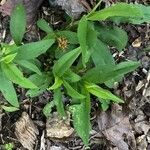
Myosotis macrosperma
Large-Seed Forget-Me-Not · Largeseed forget-me-not · Southern forget-me-not
Description
Source: leafsnapMyosotis macrosperma, commonly known as the large-seeded forget-me-not, is a species of flowering plant in the Boraginaceae family. Native to Europe and western Asia, it has also been introduced to North America. This plant typically grows up to 30 cm tall, featuring hairy stems with clusters of small blue flowers that bloom from spring to summer. Its lance-shaped leaves, pointed at the tip, are arranged alternately along the stem. The large-seeded forget-me-not thrives in moist soils found in shaded areas such as woodlands, meadows, or along streams. Due to its attractive blue flowers that attract pollinators such as bees and butterflies, it is often used as an ornamental plant in gardens. Distinctively, the seeds of Myosotis macrosperma are larger than those of other forget-me-not species, making them easier to handle for propagation. The plant can also self-seed readily under favorable conditions. In traditional medicine, Myosotis macrosperma has been valued for its anti-inflammatory properties and has been used to treat respiratory ailments such as coughs and bronchitis. Overall, Myosotis macrosperma is a beautiful flowering plant that adds color to shaded areas while providing ecological benefits by attracting pollinators.
Care Guide
💧 Water Every 7 days
The largeseed forget-me-not originates in moist habitats and thrives in conditions with consistent moisture, without being waterlogged. It needs to be watered weekly to maintain this balance. Typically grown outdoors, this plant benefits from natural light and rain during its growing season, which perfectly aligns with its hydration needs for optimal health and growth.
How should I water my Largeseed forget-me-not plant?
There are several ways to water Largeseed forget-me-not plants. You can use a garden hose with a spray nozzle, a watering can, or any other common watering tool. These plants are not too picky about their water source and can survive with rainwater, tap water, or filtered water. However, it is best to avoid watering them from above as it can harm their leaves and flowers and potentially cause disease. A drip irrigation system is often the most effective method for watering these plants, as it distributes water evenly and directly to the soil. If you have a Largeseed forget-me-not in a container, you can still use a similar watering technique. Use a cup, watering can, or your tap to water the plant directly at the soil level.
What should I do if I give too much or too little water to my Largeseed forget-me-not plant?
If your Largeseed forget-me-not is underwatered, the solution is simple - just water it more often. However, overwatering can be a serious problem, leading to diseases and possible death for your plant. To avoid this, make sure your plant is located in an area with good sunlight to help dry out the soil, and ensure that the soil has proper drainage to prevent water from pooling. If you have been overwatering a potted Largeseed forget-me-not, you may need to transfer it to a new pot with better drainage. Use loose soil and a pot that drains effectively when repotting to avoid further issues.
How often do I need to water my Largeseed forget-me-not?
The Largeseed forget-me-not requires regular watering during its growing season. In the spring, watering once a week is sufficient. As the season progresses and gets warmer, increase the watering to two or three times a week. However, avoid overwatering as it can harm the plant. It is important to keep the soil moist but not wet. When watering a Largeseed forget-me-not in a pot, you may need to water more frequently compared to one planted in the ground. Generally, watering a potted plant a few times per week is recommended, while in-ground plants only need watering once a week.
How much water does the Largeseed forget-me-not plant need?
Determining how much water to give your Largeseed forget-me-not can be approached in a few ways. One method is to feel the soil to check for moisture and water until the first six inches feel moist. Another option is to use a set measurement, such as two gallons per week, depending on temperature and soil dryness. However, strict guidelines may result in overwatering if the plant requires less. For container-grown forget-me-nots, you can check moisture levels by sticking your finger in the soil or water until you see water coming out of the drainage holes.
How can I tell if I'm giving enough water to my Largeseed forget-me-not plant?
Avoiding overwatering your Largeseed forget-me-not can be a bit challenging. On one hand, these plants have deep roots that need to be watered on a weekly basis. On the other hand, they are highly prone to root rot, which can cause browning. Underwatering is less of a concern as these plants can survive without much watering. However, if you neglect to water them for too long, they will start to wilt and you may notice dry leaves.
☀️ Light Full sun
Largeseed forget-me-not thrives in abundant sunlight yet remains hardy in partly shaded or completely unlit environments. Native to locales with plentiful light, it has adapted to tolerate the harmful effects of both overexposure and underexposure. At every stage of its growth, abundant light remains advantageous.
What are the sunlight requirements for Largeseed forget-me-not?
Largeseed forget-me-not requires full sun, meaning it thrives in areas that receive more than 6 hours of sunlight daily. It can also tolerate partial sun to full shade, which equates to approximately 3-6 hours of sunlight. It's crucial to observe the movement of sunlight in your garden to ensure plants receive the ideal balance of light and shade for optimal growth.
How does Largeseed forget-me-not adapt to different light conditions?
Largeseed forget-me-not thrives in abundant sunshine but demonstrates resilience in partially shaded or entirely unlit conditions, thanks to its evolution in regions with ample light exposure. Although it can withstand the impacts of overexposure or underexposure to light, abundant light remains favorable throughout various growth stages.
What are the recommendations for using artificial lighting with indoor Largeseed forget-me-not plants?
For indoor Largeseed forget-me-not plants where natural sunlight is insufficient, artificial lighting is vital for optimal growth, especially during winter or in less sunny locations. LED lights, recommended for their customizability to specific light wavelengths, should provide 30-50W/sq ft for full sun plants, 20-30W/sq ft for partial sun plants, and 10-20W/sq ft for full shade plants. Place the light source 12-36 inches above the plant and mimic natural daylight hours, typically 8-12 hours per day.
What are the symptoms of inadequate light in Largeseed forget-me-not?
Symptoms of inadequate light in Largeseed forget-me-not include smaller new leaves, leggy or sparse growth, faster leaf drop, reduced or halted new growth, lighter-colored new leaves, chlorosis, sunscald, leaf curling, wilting, and leaf scorching. These symptoms indicate the plant's struggle with too little or too much light exposure.
How can light exposure be improved for Largeseed forget-me-not?
To improve light exposure for Largeseed forget-me-nots, gradually move them to sunnier locations each week until they receive at least 6 hours of direct sunlight daily. For indoor plants, use south-facing windows or artificial light, ensuring at least 8 hours of light daily. For outdoor plants, avoid sudden light intensity changes to prevent sunburn. Minimizing obstructions, such as pruning trees, and transplanting smaller plants to sunnier spots with good drainage can also enhance light exposure.
🌡️ Temperature 5–32.2°C
Largeseed forget-me-not can tolerate a wide range of temperatures, but its distribution may still be restricted by different combinations of water and heat conditions. It performs best in warm summer climates with adequate rainfall or regular watering. Extended periods of cloudy, rainy weather or prolonged high temperatures can increase the probability of Largeseed forget-me-not dying. In winter, appropriate protection from cold can enhance the plant’s chances of survival.
💨 Humidity
🪴 Soil 6-7
🌱 Fertilizer
When most of the Largeseed forget-me-not's blooms have opened to full size, resume fertilizing. Around the time the flowers reach peak output, begin fertilizing every three to four weeks, as weather permits. Then, once the plant starts producing fewer new blooms, stop fertilizing; there is no need to fertilize when it can no longer produce more blooms.
🪴 Pot & Repot
✂️ Pruning
The largeseed forget-me-not is known for its delicate blue flowers and sizable seeds. To ensure healthy growth, it is beneficial to perform regular pruning in early spring. After the blooming period, shaping the plant can help prevent diseases and pests. When making cuts, use sharp and clean tools to avoid infections. Additionally, it is recommended to follow timing and techniques from reliable horticultural sources.
🌿 Propagating
🐛 Diseases & pets
☠️ Toxicity
Characteristics
- Plant Type
- Herb
- Life Cycle
- Annual
- Genus
- Myosotis
- Family
- Boraginaceae
- Hardiness Zone
- 4-8
- Mature Height
- 61 cm
- Mature Spread
- 15 cm to 30 cm
- Leaf Color
- Green
- Leaf Type
- Semi-evergreen
- Flower Color
- White
- Flower Size
- 0.20 cm
- Bloom Time
- Spring
- Planting Time
- Spring
- Harvest Time
- Late spring, Early summer, Mid summer