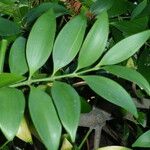
Nageia nagi
Kaphal · Asian bayberry · Broad-leaf podocarpus · Nagi
Description
Source: leafsnapNageia nagi, commonly known as the Nagi tree, is a species of coniferous tree native to Southeast Asia. It belongs to the family Podocarpaceae and can grow up to 30 meters tall. The Nagi tree features a straight trunk, a conical crown, and dark green needle-like leaves arranged in spirals along the branches. Its bark is smooth and grayish-brown. The Nagi tree is widely valued for its timber, which is renowned for its durability and resistance to decay. For centuries, this wood has been utilized in construction, furniture making, boat building, and as fuelwood. In traditional medicine practices across Southeast Asia, various parts of the Nagi tree are used for their medicinal properties, such as treating fevers and coughs. The Nagi tree prefers well-drained soils rich in organic matter but can also grow in rocky or sandy soils. It thrives in warm tropical climates but can tolerate cooler temperatures at higher elevations. However, due to habitat loss caused by deforestation activities across Southeast Asia in recent decades, Nageia nagi populations have been declining rapidly. Consequently, it has become an endangered species that requires urgent conservation efforts from governments worldwide to prevent its extinction.
Care Guide
💧 Water Every 7 days
The Asian bayberry, native to subtropical regions, thrives in environments with moderate humidity while also being able to withstand short periods of dryness. For optimal growth, water the plant every 2-3 weeks, ensuring that the soil is well-drained. Using mulch can help retain moisture, especially during the plant's active growing phase. This makes the Asian bayberry ideal for outdoor cultivation, particularly in areas with seasonal rainfall.
☀️ Light Full sun
Asian bayberry performs best in conditions similar to its native habitat, with sunlight for most of the day, though it can tolerate somewhat filtered light. Too much or too little sun can harm the plant’s health and growth.
What are the sunlight requirements for Asian bayberry?
Asian bayberry thrives best in environments that closely mimic its original habitat, requiring areas where it can bask in the sun for most of the day, though it also manages well in slightly filtered sunlight scenarios. It is crucial for the health and growth of Asian bayberry to receive the right amount of sunlight; both over-exposure and under-exposure could have detrimental effects. The plant benefits from full sun, which entails more than 6 hours of direct sunlight daily, but it can also tolerate partial sun, meaning about 3-6 hours of sunlight. Observing the movement of sunlight through your garden is significant to find places that offer an optimal mix of light and shade to ensure your plants thrive.
How do I use artificial lighting for indoor Asian bayberry plants?
When natural sunlight is insufficient, especially during winter or in areas of your home that do not get much sunlight, artificial lighting becomes crucial for maintaining the health of your indoor Asian bayberry plants. LED lights are recommended due to their ability to be customized to provide specific wavelengths needed for plant growth. For full sun plants, 30-50W per square foot is adequate; partial sun plants require 20-30W per square foot, and full shade plants should get 10-20W per square foot. The artificial light source should be positioned 12-36 inches above the plant to simulate natural sunlight conditions. Moreover, aligning the light exposure to mimic natural daylight hours, typically 8-12 hours per day, is beneficial for the plant's growth.
What symptoms indicate insufficient light for Asian bayberry?
Indoor Asian bayberry plants may show several symptoms when they do not receive adequate sunlight. These include the development of smaller new leaves compared to older ones, leggy or sparse growth due to elongated spaces between leaves or stems, accelerated leaf drop as the plant tries to conserve resources, halted or completely stopped growth as the plant enters survival mode, lighter-colored or irregularly patterned new leaves indicating a lack of chlorophyll, and conditions such as chlorosis where leaves lose their green color and turn yellow. Additionally, symptoms like sunscald, which damages plant tissue through intense sunlight exposure, leaf curling as a defense mechanism against excessive sunlight, wilting due to loss of turgor pressure, and leaf scorching characterized by brown, dry edges on leaves can also indicate poor lighting conditions.
What are the solutions for Asian bayberry suffering from inadequate sunlight?
For Asian bayberry plants suffering from inadequate sunlight, several strategies can be employed to mitigate the issue. For indoor plants, gradually moving them to a sunnier position each week until they receive at least 6 hours of direct sunlight daily helps. Using a south-facing window and keeping curtains opened during the day maximizes sunlight exposure. Artificial light sources, such as desk or ceiling lamps, should be used for at least 8 hours daily, or professional plant grow lights can be considered for substantial light provision. For outdoor plants, gradual relocation to sunnier spots prevents sunburn, which might result from sudden exposure changes. Additionally, reducing obstructions to sunlight, such as by pruning trees, or transplanting smaller plants to sunnier locations during their dormant periods in late winter or early spring, enhances light accessibility. It’s important to note, however, that parts of the plant previously affected by insufficient light may not recover, but new growth following improved light exposure will be healthy.
🌡️ Temperature 20–37.8°C
Asian bayberry naturally occurs in habitats where temperatures usually range from 68 to 100°F (20 to 38°C). The species favors warmer conditions. Making seasonal temperature adjustments can be helpful, especially in colder regions.
What is the native climate for Asian bayberry?
Asian bayberry is natively found in environments with temperatures ranging from 68 to 100°F (20 to 38°C), indicating its preference for warmer climates. It is an extremely heat-loving species, and exposure to cold temperatures can cause significant harm. To ensure its health, particularly in regions experiencing colder climates, seasonal temperature adjustments are advised. For example, it is recommended to bring outdoor-grown Asian bayberry plants indoors during autumn to protect them from colder temperatures, placing them near a bright window yet away from direct heat sources like heaters. Maintaining an ambient temperature above 20°C during the winter months is beneficial for the plant's growth while ensuring temperatures do not approach freezing point, as this can be detrimental.
How should you care for Asian bayberry in low temperatures?
Asian bayberry plants thrive best in temperatures above 20°C and are not tolerant of low temperatures. During winter, it is crucial to keep them above 0°C to prevent damage. Exposure to temperatures below -5°C can lead to discoloration of the leaves, turning them lighter initially, before eventually becoming brown or black. These color changes are accompanied by wilting and drooping, indicative of frost damage. To care for a plant affected by low temperatures, the frost-damaged parts should be trimmed off and the plant moved indoors to a warmer setting immediately. Placing the plant near a south-facing window ensures ample sunlight while avoiding excessive dryness caused by heaters or air conditioning vents.
What steps should be taken if Asian bayberry experiences high temperatures?
During the summer, ensuring that the environment around Asian bayberry plants does not exceed 38°C is crucial for their health. When temperatures rise above 43°C, the plants are more likely to experience sunburn, identified by a lightening in the color of the leaves and increased susceptibility to damage. To mitigate the effects of high temperatures, sunburned and dried-up parts of the plant should be trimmed away. Relocating the plant to provide shade during the peak midday and afternoon sun can help, as can watering the plant in the morning and evening to maintain moist soil conditions. These steps help in protecting the plant from the stress of high temperatures.
💨 Humidity
🪴 Soil 5-6
🌱 Fertilizer
Asian bayberry has specific nutrient needs and does not require heavy fertilization. Spring is the best time to apply fertilizer for optimal growth. Providing nutrients improves its health, enhances resistance to pests and diseases, and helps preserve its long lifespan.
🪴 Pot & Repot Every 12 months
✂️ Pruning
Asian bayberry is an ornamental evergreen known for its dense foliage. To maintain its shape and health, it's best to prune the plant from early to late winter. During pruning, remove any dead or diseased branches. Additionally, thinning out crowded areas can improve air circulation and light exposure. Be cautious not to prune too heavily, as this can stress the plant and hinder its healthy growth.
🌿 Propagating
🐛 Diseases & pets
☠️ Toxicity
Characteristics
- Plant Type
- Tree
- Life Cycle
- Perennial
- Genus
- Nageia
- Family
- Podocarpaceae
- Hardiness Zone
- 9-11
- Mature Height
- 14.94 m to 20.12 m
- Mature Spread
- 4.57 m to 7.62 m
- Leaf Color
- Green
- Leaf Type
- Evergreen
- Flower Color
- Yellow, Green
- Bloom Time
- Late spring, Early summer
- Planting Time
- Spring, Autumn
- Harvest Time
- Mid summer, Late summer
- Native Area
- Japan, China