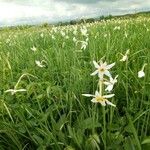
Narcissus angustifolius
Description
Source: leafsnapNarcissus poeticus, the poet's daffodil, poet's narcissus, nargis, pheasant's eye, findern flower or pinkster lily, was one of the first daffodils to be cultivated, and is frequently identified as the narcissus of ancient times (although Narcissus tazetta and Narcissus jonquilla have also been considered as possibilities). It is also often associated with the Greek legend of Narcissus. It is the type species of the genus Narcissus and is widely naturalized in North America.
🌳 Beyond its decorative appeal, the poet's narcissus shows promise in perfumery. Its strong, pleasant aroma has made it a favored component for perfume bases. The essential oil derived from poet's narcissus is prized in aromatherapy and can be employed to scent indoor spaces, offering a natural alternative to synthetic air fresheners. The potential of poet's narcissus within fragrance-related industries is a compelling area for further investigation and use.
🎭 Self-importance, Formality
Care Guide
💧 Water
☀️ Light Full sun
The Poet's narcissus flourishes under significant sunlight, which stimulates its robust growth. Nevertheless, it can adapt to places where the sun's intensity is lower. While it initially prospers in settings with abundant sunlight, lack of light can lead to stunted growth and poor leaf health. On the other hand, excessive light can also put too much pressure on it.
🌡️ Temperature 0–35°C
The Poet's narcissus is comfortable in temperatures ranging from 32 ℉ (0 ℃) to 95 ℉ (35 ℃). It originates from cooler climates and can withstand winter frosts. In hotter weathers, it needs to be kept in partial shade with regular watering to avoid heat-induced stress. During hot summers, it might need extra watering or relocation to a chiller spot if the heat becomes too intense.
💨 Humidity
🪴 Soil 6-7
🌱 Fertilizer
The ideal period to fertilize Poet's narcissus is early in the spring as the flowers start to develop. Applying the appropriate fertilizer not only promotes superior blooms but also assists Poet's narcissus in generating beautiful flowers. Fertilization in the onset of spring guarantees outstanding blossoms throughout the season and provides necessary fuel for periods of latent growth.
🪴 Pot & Repot
✂️ Pruning
🌿 Propagating
🐛 Diseases & pets
☠️ Toxicity
Characteristics
- Plant Type
- Herb
- Life Cycle
- Perennial
- Genus
- Narcissus
- Family
- Amaryllidaceae
- Hardiness Zone
- 3-10
- Mature Height
- 20 cm to 40 cm
- Mature Spread
- 10 cm
- Leaf Color
- Green, Blue
- Leaf Type
- Deciduous
- Flower Color
- White, Yellow
- Flower Size
- 5.08 cm to 7.62 cm
- Bloom Time
- Mid spring, Late spring
- Planting Time
- Spring, Autumn, Winter
- Harvest Time
- Late spring, Early summer