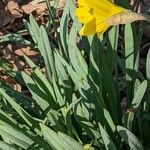
Narcissus pseudonarcissus
نرجس · گل نرگس · نرگس · گوڵە نێرگز · Daffodil
Description
Source: leafsnapNarcissus pseudonarcissus (commonly known as wild daffodil or Lent lily) (Welsh: Cennin Pedr) is a perennial flowering plant.This species has pale yellow tepals, with a darker central trumpet. The long, narrow leaves are slightly greyish green in colour and rise from the base of the stem. The plant grows from a bulb. The flowers produce seeds, which when germinated, take five to seven years to produce a flowering plant. (Sexual seed reproduction mixes the traits of both parent flowers, so if garden hybrid cultivars are planted close to wild populations of Narcissus pseudonarcissus, there is a danger that the new seedlings, having hybrid vigour, could out-compete the wild plants.)
💡 The wild daffodil (Narcissus pseudonarcissus) is the national flower of Wales. Unfortunately, its native populations in the British Isles have been declining since the 19th century. This decline is primarily due to the intensification of agriculture and the destruction of woodland habitats.
🌳 The wild daffodil is not only admired for its beauty but also plays an environmental role. It is seen as an indicator species, useful to ecologists when evaluating the health of an ecosystem. A thriving population of wild daffodil might indicate a well-preserved, undisturbed habitat, helping conservation efforts and informing environmental monitoring practices.
🎭 Consideration, One-sided Love, Esteem, a new life, fresh starts
Care Guide
💧 Water Every 1-2 weeks
The wild daffodil is well-suited for temperate climates. It thrives in conditions with moderate moisture and can withstand short periods of drought. This plant prefers soil that remains consistently moist but not waterlogged, so it typically needs watering every 1-2 weeks. After blooming in the spring, the wild daffodil enters a dormant phase, during which it requires less water. This change reflects its natural adaptation to the seasonal patterns of rainfall.
When Should I Water My Wild Daffodil?
Timely and appropriate watering is key to the growth and health of wild daffodil. The plant thrives in well-drained soil, and watering is ideally done when the top 1-2 inches of soil feel dry. Observing the plant for signs such as wilting or drooping leaves and flowers can also indicate it's time for watering. Depending on the season, watering frequency may vary. In hot, dry seasons, more frequent watering may be necessary, whereas in cooler months, the plant requires less water. It's essential to avoid both over-watering and under-watering to prevent stress, withering, or diseases like root rot.
How Should I Water My Wild Daffodil?
Wild daffodil's watering needs are specific. It requires moist but not waterlogged soil, achieved by striking a balance to prevent overwatering. Bottom-watering is an effective technique that allows the plant to absorb moisture from the bottom up, ensuring the roots are well-hydrated without saturating the surface. Using a watering can with a narrow spout helps direct water to the base of the plant, minimizing leaf wetness and reducing the risk of diseases.
How Much Water Does Wild Daffodil Really Need?
The optimal watering amount for wild daffodil depends on factors like pot size and plant size, with a mature plant generally needing 250-500 milliliters of water per session. Ensuring the water reaches the bottom of the pot to hydrate the roots properly is critical. Signs of adequate hydration include lush green foliage and vibrant flowers, whereas over or underwatering signs include yellowing leaves, wilting, and stunted growth. Regular monitoring and adjusting water based on soil moisture and environmental conditions are crucial for the plant's health.
What Kind of Water is Best for Wild Daffodil?
Wild daffodil thrives with rainwater, thanks to its balanced pH and absence of chemicals. If unavailable, distilled or filtered water are good alternatives, with tap water being the last option due to potential chlorine and fluoride content. Wild daffodil is sensitive to chlorine and somewhat to fluoride; thus, letting tap water sit out for 24 hours can evaporate the chlorine, making it safer for watering. Room temperature water is preferred to avoid shocking the plant.
How Do Wild Daffodil's Watering Needs Change with the Seasons?
Watering needs for wild daffodil vary with the seasons. In spring, during active growth, maintaining consistent soil moisture is key. Summer may demand more frequent watering to counter higher evaporation rates, while autumn requires reduced watering as the plant prepares for dormancy. Winter watering should be minimal, focusing on preventing the bulbs from drying out, with careful monitoring for drying caused by indoor heating. Each season's specific watering approach helps maintain the plant's overall health.
☀️ Light Full sun
Wild daffodil thrives in abundant sunlight but can tolerate somewhat shaded sites. Native to sun-rich habitats, the plant reaches its best health and growth under these conditions. Excessive light can scorch the foliage, while too little light may limit its flowering.
What are the sunlight requirements for wild daffodil?
Wild daffodil, known botanically as Narcissus pseudonarcissus, thrives best in full sun, which means it needs more than 6 hours of direct sunlight daily. It can also grow in partial sun, getting about 3-6 hours of sunlight. It's important to observe the way sunlight moves through your garden to find spots that offer a good balance of light and shade, ensuring the plants' well-being and promoting robust growth.
Can wild daffodil grow in shaded areas?
Yes, wild daffodil can tolerate somewhat shaded locations despite its preference for abundant sunshine. Originating in sunny environments, its health and flowering are optimal when it receives sufficient sunlight. However, it is adaptable and can withstand lower light levels, although excessive shade may limit its blooming and lead to foliage damage.
How can artificial lighting be used for wild daffodil?
In conditions where natural sunlight is inadequate, especially during winter or in less sunny spaces, artificial lights provide an essential solution for supporting wild daffodil's growth. LED lights are recommended due to their ability to offer specific wavelengths needed by plants. Full sun plants require 30-50W per square foot, partial sun plants need 20-30W per square foot, and full shade plants should get 10-20W per square foot. The light source should be placed 12-36 inches above the plant, mimicking natural sunlight as much as possible, and it's necessary to provide 8-12 hours of light per day.
What are the symptoms of insufficient light in wild daffodil?
Wild daffodil may not immediately show signs of light deficiency, but inadequate sunlight can affect its future flowering and fruiting. Symptoms include lighter-colored new leaves, indicating a lack of chlorophyll and essential nutrients; leggy or sparse growth, making the plant appear stretched-out and weak; and chlorosis, where leaves lose their green color and turn yellow due to insufficient sunlight. Additionally, excessive sunlight can result in sunscald, leaf curling, wilting, or leaf scorching, indicating too much direct exposure.
How can you solve the issue of insufficient sunlight for wild daffodil?
To combat insufficient sunlight for wild daffodil, gradually move the plant to a location with at least 6 hours of direct sunlight daily, utilizing a south-facing window indoors and keeping curtains open for maximum exposure. If moving the plant isn't feasible, consider using artificial lighting, keeping lamps on for at least 8 hours daily. Outdoors, carefully transition plants to sunnier spots, avoiding abrupt changes to prevent sunburn. For plants blocked by obstructions, prune trees or transplant smaller plants during their dormant period to areas with better sunlight and drainage. Note that parts of the plant already affected may not recover, but new growth should be healthy with increased light exposure.
🌡️ Temperature 5–35°C
The wild daffodil's native habitat is temperate, with temperatures ranging from 5 to 35 ℃ (41 to 95 ℉). This plant favors cooler conditions and does not do well in hot climates. To accommodate seasonal temperature shifts, it is advisable to plant wild daffodil in full sun or partial shade in spring and to keep it in a cool spot during summer.
What is the native growth environment for wild daffodil?
The native growth environment of wild daffodil is in temperate regions with temperatures ranging from 5 to 35°C (41 to 95°F). These plants thrive in cooler temperatures and struggle in hot climates. To accommodate temperature variations across seasons, it is recommended to plant wild daffodil in full sun or partial shade during spring and move them to a cooler location in the summer. They possess strong resistance to cold, thus special frost protection is typically unnecessary. However, if winter temperatures are expected to drop beyond the species' cold tolerance limit, providing protection with soil or straw coverage is important. Additionally, watering the plant abundantly before the first freeze of autumn to keep the soil moist can help prevent drought stress during the winter and early spring.
How does cold temperature affect wild daffodil and what are the solutions?
Wild daffodil is quite tolerant to cold and best performs when temperatures are maintained above its suitable growth minimum. Through the winter, it's crucial to keep it above its tolerable growing temperature minimum. Falling below its growth temperature limit won't show immediate effects in winter but may lead to decreased sprouting or a complete lack of sprouting in spring. The solution for this issue is to remove any parts of the plant that have failed to sprout in spring.
How does high temperature affect wild daffodil and what are the solutions?
During the summer, it's important to keep wild daffodil below its suitable growth temperature maximum. Exceeding its tolerable growing temperature maximum can cause the leaves to lighten in color, become prone to curling, suffer from sunburn, and, in severe cases, lead to the entire plant wilting and drying out. To mitigate these issues, trim away the sunburned and dried parts of the plant. Relocate the plant to an area with shade from the midday and afternoon sun or use a shade cloth. Also, water the plant in the morning and evening to maintain soil moisture.
💨 Humidity normal (40-60%)
This plant will thrive in moderate humidity, which is probably the level in your home. However, misting it a few times a week can be very beneficial. Make sure the room has good ventilation.
🪴 Soil 6-7
🌱 Fertilizer
For the wild daffodil, the primary time to apply fertilizer is in early spring when the flowers are forming. Using the proper fertilizer promotes better blooms and helps the wild daffodil produce attractive flowers. Fertilizing in early spring ensures excellent flowers throughout the season and supplies energy for dormant growth phases.
Why do I have to put fertilizer on my Wild daffodil?
There are a few important reasons why fertilizing a Wild daffodil is beneficial. One obvious reason is that it helps the daffodil produce beautiful blooms. Fertilizing in early spring is especially effective for ensuring the daffodil has excellent flowers during that season. Additionally, fertilizer provides the daffodil with extra energy that it can store in the ground during its dormant growth phases. Giving it nutrients during the fall planting or in late spring will help it store more energy to use once active growth resumes.
When should I fertilize my Wild daffodil?
To ensure healthy blooms on your Wild daffodils, it is recommended to fertilize them at a few specific times. In early spring, when the flowers are forming, the right fertilizer can greatly enhance the blooms. Additionally, after the flowers have faded in later spring, fertilizing can provide the plant with stored energy for the following year. If you are planting Wild daffodils for the first time in the fall, it is also beneficial to apply fertilizer during the planting process. This gives them the best opportunity to produce a healthy set of flowers during their initial growing season.
When should I not put fertilizer on my Wild daffodil?
To ensure the healthy growth of a Wild daffodil, it is important to fertilize it at specific times during the year. These times include the fall planting process, the early spring bloom period, and the late spring following the bloom period. Fertilizing at any other time is unnecessary and could potentially harm your plant. It is also important to note that the Wild daffodil goes through a dormant phase, during which it requires less water and no fertilizer. This dormant phase occurs during winter and summer. After the flowers fade, the leaves will remain for a short time before dying back to the ground. Once the leaves have died back, the plant has entered a dormant phase, and fertilization is no longer necessary.
What kind of plant food does my Wild daffodil need?
There are different types of fertilizer that can benefit Wild daffodils. To keep things simple, a balanced fertilizer with equal amounts of nitrogen, phosphorus, and potassium, like 10-10-10 or 5-5-5, works well. Using a granular fertilizer is usually better than a liquid one. If you want to be more specific, a fertilizer rich in all three main nutrients but higher in phosphorus can encourage better and longer-lasting flowers. Organic materials like bonemeal can also add the phosphorus needed for Wild daffodils to bloom effectively.
How can I make my Wild daffodil grow better?
To ensure healthy growth of your Wild daffodil, fertilization is important during two key periods. The first is when you plant the bulbs in the fall. Dig a small hole for the bulb and add some granular slow-release fertilizer before covering it with soil. During this process, remember to water consistently to keep the soil moist. The second fertilization should take place in early spring when the plant starts emerging and flowering. Use a balanced granular fertilizer and sprinkle it on the ground around the daffodil. It's important to water the soil gently while applying the fertilizer.
🪴 Pot & Repot 2-3 years
To promote bulb growth, it is important to repot wild daffodils every 2-3 years. The best time to do this is in late spring, after the daffodils have finished blooming. Be sure to choose a pot with proper drainage. Once you have repotted the bulbs, water them sparingly and place them in a location with bright, indirect light. This will help ensure that the vibrant yellow blossoms return each year.
✂️ Pruning
The wild daffodil is a perennial plant known for its vibrant yellow flowers. To help the bulbs store energy, you should prune the foliage after the flowers have bloomed, but be sure not to cut the green leaves. Removing the spent flowers, or deadheading, encourages better bulb growth, and cleaning up any diseased parts helps prevent infections. By following these proper pruning techniques, you'll promote healthier blooms in future growing cycles.
🌿 Propagating
🐛 Diseases & pets
☠️ Toxicity
Characteristics
- Plant Type
- Herb
- Life Cycle
- Perennial
- Genus
- Narcissus
- Family
- Amaryllidaceae
- Hardiness Zone
- 5-10
- Mature Height
- 25 cm to 61 cm
- Mature Spread
- 5 cm to 10 cm
- Leaf Color
- Green, Blue
- Leaf Type
- Deciduous
- Flower Color
- Yellow
- Flower Size
- 7.62 cm to 15.24 cm
- Bloom Time
- Early spring, Mid spring
- Planting Time
- Spring, Autumn, Winter
- Harvest Time
- Late spring, Early summer
- Native Area
- Western Europe; West Portugal, East Germany, and north of England and Wales