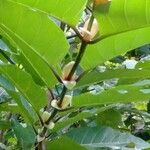
Nauclea orientalis
Leichhardt-pine · Leichhardt-tree · Burtree · Canary cheesewood · Canary-wood
Description
Source: leafsnapNauclea orientalis is a species of tree in the family Rubiaceae, native to Southeast Asia, New Guinea, and Australia. It has many common names, including bur tree, canary wood, Leichhardt pine and yellow cheesewood. It grows to a maximum of around 30 m (98 ft) in height and has large glossy leaves. It bears spherical clusters of fragrant flowers that develop into golf ball-sized edible but bitter fruits. The yellowish to orange soft wood is also used for timber and in woodcarving and folk medicine. Much recently in Australia, it has been called the coronavirus tree because its flowerhead resembles the virus.
Care Guide
💧 Water
The bur tree flourishes in humid tropical environments and needs watering every 2-3 weeks to mimic its natural habitat. As an evergreen, it retains moisture in its leaves, which helps it balance its tolerance to drought with its preference for humidity, ensuring healthy growth throughout the year.
☀️ Light Full sun
A bur tree grows best in full sun but can tolerate locations with reduced sunlight. Seasonal shifts in light may require moving potted plants. Inadequate light can stunt growth and lower vitality.
What are the sunlight requirements for a Bur tree?
The Bur tree, scientifically known as Nauclea orientalis, thrives under full sunlight, requiring more than 6 hours of sunlight per day. It can also tolerate partial sun, adapting well to about 3-6 hours of sunlight. To ensure your plants are happy, observe how sunlight moves through your garden, choosing spots that offer a good balance of light and shade.
How does artificial lighting support the growth of indoor Bur trees?
Indoor Bur trees require adequate lighting for optimal growth, especially when natural sunlight is inadequate, like during winter or in less sunny spaces. Artificial lights, particularly LED lights customized for specific wavelengths, provide an essential solution for faster, healthier plant growth. Full sun plants need 30-50W/sq ft, partial sun plants need 20-30W/sq ft, and full shade plants need 10-20W/sq ft of artificial light. Position the light source 12-36 inches above the plant to mimic natural sunlight and ensure 8-12 hours of light per day.
What are the symptoms of light deficiency in a Bur tree?
Bur trees exhibit several symptoms when exposed to suboptimal lighting, including smaller new leaves, leggy or sparse growth, faster leaf drop, slower or halted new growth, lighter-colored new leaves, and conditions such as chlorosis, sunscald, leaf curling, wilting, and leaf scorching. These symptoms reflect the plant's struggle with insufficient sunlight, affecting its growth and overall health.
How can I remedy light deficiency symptoms in indoor and outdoor Bur trees?
To address light deficiency in Bur trees, gradually move indoor plants to sunnier locations each week, aiming for at least 6 hours of direct sunlight daily. Utilize south-facing windows and consider artificial lighting, keeping lamps on for at least 8 hours daily for large or immovable plants. For outdoor plants, similarly gradually increase sun exposure to avoid sunburn. Observe the environment to reduce obstructions, and consider pruning or transplanting to sunnier locations with good drainage, especially during dormant periods. Remember, while parts of the plant affected by lack of sunlight may not recover, new growth after adjusting light exposure will be healthy.
🌡️ Temperature 20–37.8°C
The Bur tree comes from tropical areas, where the climate is generally warm and humid. As a result, it is adapted to high temperatures and humidity. It does not tolerate sudden temperature changes and prefers a stable temperature environment, so avoiding temperature fluctuations indoors is important. It typically cannot withstand cold temperatures and needs higher temperatures to grow. If the ambient temperature falls too low, the plant may stop growing or even die.
💨 Humidity
🪴 Soil 6-7
🌱 Fertilizer
The best time to fertilize a Bur tree is in early spring as it breaks dormancy. This encourages overall growth and flower development. Fertilization improves the foliage, stems, and branches, and supports the formation of large, vibrant, long-lasting flowers. It helps transport nutrients from the roots to the flowers and enhances the plant’s health and disease resistance.
🪴 Pot & Repot
✂️ Pruning
The Bur tree features large, glossy leaves and unique spherical flowers. To keep the tree healthy and well-shaped, prune it during early to late winter. Focus on removing dead branches, thinning the canopy to improve air circulation, and controlling the tree's size. This will encourage healthier growth, enhance flowering, and maintain a balanced structure for long-term health and aesthetic appeal.
🌿 Propagating
🐛 Diseases & pets
☠️ Toxicity
Characteristics
- Plant Type
- Tree
- Life Cycle
- Perennial
- Genus
- Nauclea
- Family
- Rubiaceae
- Hardiness Zone
- 10-12
- Mature Height
- 14.94 m to 29.87 m
- Mature Spread
- 10.06 m to 14.94 m
- Leaf Color
- Dark Green, Forest Green
- Leaf Type
- Evergreen
- Flower Color
- White
- Flower Size
- 2.03 cm to 3.05 cm
- Bloom Time
- Summer
- Planting Time
- Spring, Summer, Autumn
- Harvest Time
- Late summer, Fall
- Native Area
- Sri Lanka, Indonesia, Cambodia, Vietnam, Myanmar, Philippines, Bangladesh, Thailand