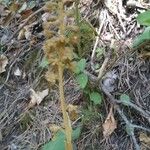
Neottia nidus-avis
Bird's-nest orchid · Mycoheterotrophic orchid · Goose Nest · Parastā Ligzdene (LVL)
Description
Source: leafsnapNeottia nidus-avis, commonly known as the bird's nest orchid, is a small and delicate plant in the Orchidaceae family. Native to Europe and Asia, it thrives in shady areas of forests, meadows, and wetlands. The plant has a distinctive appearance with its stemless leaves forming a rosette, resembling a bird's nest. The bird's nest orchid produces small greenish-yellow flowers arranged in spikes. Although the flowers are not particularly showy, they have an interesting structure: their lip forms an enclosed pouch that traps insects for pollination. Without chlorophyll, this plant relies on mycorrhizal fungi for nutrition. It forms symbiotic relationships with these fungi, which provide it with nutrients, while the plant supplies carbohydrates to the fungi. Habitat loss caused by human activities such as deforestation and land development has rendered the bird's nest orchid rare in some areas. However, it is not considered endangered globally due to its wide distribution range. Overall, Neottia nidus-avis is a fascinating species of orchid known for its unique appearance and its symbiotic relationship with mycorrhizal fungi.
Care Guide
💧 Water Every 7 days
The bird's-nest orchid thrives in moist woodland areas and requires consistent humidity and balanced watering, typically about once a week. As an indoor plant, regular misting is essential to maintain the ambient humidity. This helps support healthy growth by replicating the dew it experiences in its natural habitat.
How should I water my Bird's-nest orchid?
The way you water your Bird's-nest orchid depends on whether it's in an active growth phase or not. If it is, apply water to the soil and occasionally water from above when it's warm. In winter or cool, wet weather, stick to watering the soil directly. Signs that your orchid needs more water include thin and dry roots and leaves or discoloration. When it gets too much water, it will look mushy and limp. Grow your orchid in a pot with good drainage. During the growing season, water it multiple times per week, ensuring quick drainage. The size of the pot determines how much water it needs. Larger pots require less frequent watering, while smaller pots need watering more often. Use rainwater or distilled water, matching the temperature of the air as closely as possible.
What should I do if I give my Bird's-nest orchid too much water or too little water?
To keep your Bird's-nest orchid healthy, it's important to avoid keeping the soil too wet. While these plants need regular watering during active growth, they also require well-draining soil. Overwatering can lead to root rot, causing the plant to become mushy. If this happens, use sterilized pruning shears to remove any rotted roots and then repot the orchid in a container with good drainage and fast-draining potting mix. However, excessive repotting can be detrimental to these orchids, so it's important to find the right balance in watering. If the orchid starts to shrivel and feel dry to the touch, it may be underwatered, and you should increase your watering frequency.
How much should I water my Bird's-nest orchid?
To ensure the healthy growth of your Bird's-nest orchid, follow these watering guidelines. During the active growth stage in spring and summer, water it once or twice per week. If there is hot and dry weather, increase the watering frequency to three times per week or more. In winter, the orchid still needs water, but not as much. Water it two to three times per month to keep it alive during the coldest months. If you keep your orchid indoors, be aware that indoor growing locations can cause the soil to dry quickly, so you may need to water it more frequently. As fall approaches, gradually reduce the watering frequency from multiple times per week to the reduced winter watering schedule.
What do I need to think about when watering my Bird's-nest orchid at different times of the year and during different stages of growth?
When planning the watering schedule for your Bird's-nest orchid, it's important to take into consideration two growth phases. The first phase is the active growth period, which occurs in spring and summer. During this time, the plant needs to be watered multiple times per week. The second phase is the rest period, which happens during winter and lasts for about two to three months. During this period, the Bird's-nest orchid requires less water and fertilization. It is recommended to water the plant about once or twice per month. In the fall, you should gradually decrease the frequency of watering from multiple times per week to once or twice per month, which is appropriate for the winter season.
What do I need to do differently when watering my Bird's-nest orchid indoors?
The Bird's-nest orchid needs a relatively humid environment to thrive. However, indoor locations usually lack the desired level of air moisture, causing the plant and soil to dry out faster compared to outdoor growth. To address this, it's recommended to use a humidifier in the room where you have the orchid and water it more frequently. Despite the need for humidity, these orchids also require good air circulation to avoid excessive moisture buildup and potential diseases. To achieve this, consider adding a fan to the room where you grow the plant.
☀️ Light Full shade
Bird's-nest orchid is native to habitats such as forest understories or rocky areas that provide natural shade. It prefers Full Shade but can tolerate Partial Sun.
What are the sunlight requirements for Bird's-nest orchid?
Bird's-nest orchid prefers environments with full shade, which means it thrives in areas receiving less than 3 hours of sunlight daily. However, it can also tolerate partial sun, approximately 3-6 hours of sunlight. It's important to monitor the sunlight in your garden to ensure plants get the right balance of light and shade for optimal growth, keeping in mind the unique needs of the Bird's-nest orchid.
Where does Bird's-nest orchid naturally grow, and what are its lighting essentials?
The Bird's-nest orchid is native to environments like forest understories and rocky areas where natural shade is abundant. For indoor plants requiring more light, especially in less sunny spaces or during winter, artificial lighting can be crucial. LED lights are recommended because they can be adjusted to provide specific light wavelengths needed by the plant. Full sun plants require 30-50W/sq ft, partial sun plants need 20-30W/sq ft, and full shade plants need 10-20W/sq ft of artificial light. The positioning of the light source should be 12-36 inches above the plant, with an exposure of 8-12 hours per day.
What are the common symptoms of light deficiency in Bird's-nest orchid?
When Bird's-nest orchid is grown indoors or in insufficient light, it may display symptoms like small, less vigorously growing new leaves, leggy or sparse growth, faster leaf drop, slower or halted new growth, and lighter-colored or chlorotic leaves. Other signs include sunscald, leaf curling, wilting, and leaf scorching. These symptoms suggest that the plant is not receiving adequate light for photosynthesis and growth.
How can I address insufficient sunlight for Bird's-nest orchid?
For indoor Bird's-nest orchids, moving the plant to a spot that receives ample filtered light, including brief direct morning sunlight, is ideal. The plant should be placed 1-2 meters away from a window. If moving the plant is not feasible, consider using artificial light, such as a desk or ceiling lamp kept on for at least 8 hours a day or professional plant grow lights. For outdoor plants, transition them gradually to sunnier spots to avoid sunburn. You may need to prune trees or relocate plants to reduce sun obstructions. However, parts of the plant that have been severely affected by insufficient sunlight may not recover completely, but increasing light exposure can ensure new growth is healthy.
🌡️ Temperature 5–32.2°C
Bird's-nest orchid can adapt to a wide range of temperatures, but its distribution may still be restricted by various combinations of moisture and heat. It does best in warm summer conditions with sufficient rainfall or watering. Extended periods of cloudy, rainy weather or prolonged high temperatures can raise the chance of the Bird's-nest orchid dying. In winter, adequate protection from cold can increase the plant's survival.
What is the common name of Neottia nidus-avis?
The common name of Neottia nidus-avis is Bird's-nest orchid.
What is the botanical name of the Bird's-nest orchid?
The botanical name of the Bird's-nest orchid is Neottia nidus-avis.
💨 Humidity
🪴 Soil 5-5
🌱 Fertilizer
One application of fertilizer in spring is usually enough for Bird's-nest orchid, though multiple feedings can maximize growth. Feed once every month to a month and a half. Fertilizing improves leaf appearance and function, supporting uniform color and a healthy texture. It also encourages root growth and nutrient absorption for long-term plant health.
🪴 Pot & Repot
✂️ Pruning
The Bird's-nest orchid is a saprophytic plant with a unique root system. It requires minimal pruning, mainly in early to late spring. To encourage growth and maintain good air circulation, trim only the dead or diseased stems. Extensive cutting can harm its essential relationship with fungi, which it depends on for nutrient absorption.
🌿 Propagating
🐛 Diseases & pets
☠️ Toxicity
Characteristics
- Plant Type
- Herb
- Life Cycle
- Perennial
- Genus
- Neottia
- Family
- Orchidaceae
- Hardiness Zone
- 4-8
- Mature Height
- 10 cm to 30 cm
- Mature Spread
- 10 cm to 20 cm
- Leaf Color
- Brown
- Leaf Type
- Deciduous
- Flower Color
- Tan
- Flower Size
- 0.76 cm to 1.27 cm
- Bloom Time
- Mid spring, Late spring
- Harvest Time
- Early summer, Mid summer
- Native Area
- Turkey, Sweden, Austria, Slovakia, Montenegro, Slovenia, Croatia, Belarus, Russia, Germany, Estonia, Romania, Latvia, Belgium, Moldova, Portugal, Netherlands, France, Czech Republic, Bulgaria, Armenia, Poland, Greece, Ukraine, Serbia, Lithuania, Norway, Italy, Spain, Switzerland, Denmark, Finland, Iran, Albania, Ireland, United Kingdom, Hungary, Algeria, Azerbaijan