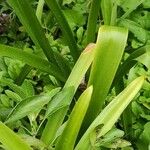
Nerine bowdenii
Bowden lily · Guernsey Lily · Bowden's Nerine · Pink Nerine · Cornish Lily
Description
Source: leafsnapNerine bowdenii is a species of flowering plant in the family Amaryllidaceae. It is an herbaceous bulbous perennial, growing to 45 cm (18 in) tall by 8 cm (3 in), with strap-shaped leaves and large umbels of lily-like pink flowers in late summer and autumn. The common names of the species are Cornish lily, Cape flower, Guernsey lily, and Bowden lily. However, it is neither a true lily nor from Cornwall or Guernsey, but originates from South Africa (Eastern Cape, KwaZulu Natal, Free State, Drakensberg Mountains). Confusingly the name “Guernsey lily” is also applied to a related species, Nerine sarniensis. The species was named in 1904 after Athelstan Cornish-Bowden who had sent bulbs of the plant to England from South Africa.
Care Guide
💧 Water
The Guernsey lily, originally from South Africa, thrives in regions with dry summers and wet winters. It is drought-resistant, needing only weekly watering and well-drained soil. When grown outdoors, natural rainfall is usually sufficient. As a deciduous bulb, its water requirements drop significantly during its dormant period after flowering.
☀️ Light Full sun
The guernsey lily thrives with abundant light but can also tolerate a less bright location. Its origin in a sun-rich habitat has influenced its health and growth. At different stages of growth, a generous amount of light is beneficial. However, too much or too little light can impede its prosperity.
What are the sunlight requirements for a Guernsey lily?
The Guernsey lily, or Nerine bowdenii, thrives best when it receives more than 6 hours of sunlight a day, classified as 'Full sun.' However, it can also grow in 'Partial sun,' which is about 3-6 hours of sunlight. It is essential to observe how sunlight moves through your garden to select spots that provide an ideal balance of light for the plant's health.
How does the amount of sunlight affect the Guernsey lily?
Originating from environments rich in sunlight, the Guernsey lily's health and growth are significantly influenced by light exposure. At various growth stages, ample sunlight is beneficial, promoting vibrant growth. However, both overexposure and underexposure to light can adversely affect the plant's development.
What should I do if my indoor Guernsey lily isn't getting enough light?
For indoor Guernsey lilies lacking natural sunlight, particularly during winter or in less sunny spaces, artificial lighting can be a crucial solution. LED lights, customizable to specific plant needs, can provide the necessary wavelengths of light. The light intensity needed varies with the plant type; full sun plants require 30-50W/sq ft, partial sun plants 20-30W/sq ft, and full shade plants 10-20W/sq ft. Position the light source 12-36 inches above the plant for 8-12 hours daily to mimic natural daylight conditions.
What are some symptoms of insufficient or excessive sunlight in Guernsey lilies?
Guernsey lilies show various symptoms when conditions are not ideal. Insufficient sunlight may cause smaller leaves, leggy or sparse growth, faster leaf drop, halted growth, or lighter-colored new leaves. Conversely, excessive sunlight can lead to chlorosis (yellowing leaves), sunscald, leaf curling, wilting, and leaf scorching. These symptoms help indicate whether the plant's lighting needs adjustments for optimal growth.
What solutions are recommended for Guernsey lilies not receiving adequate sunlight?
To address insufficient sunlight, for indoor plants, gradually move them to sunnier spots or use artificial light for at least 8 hours daily. For outdoor plants, move them to better-lit areas gradually to prevent sunburn. Pruning obstacles like trees can improve sunlight access. If a plant is small enough, consider transplanting it during its dormant period to a location with better light and drainage. Note that parts of the plant damaged by poor light might not recover, but new growth should be healthy with improved lighting conditions.
🌡️ Temperature 15–35°C
Guernsey lily comes from temperate areas and does best in mild climates. It prefers temperatures of 59 to 95 °F (15 to 35 ℃). In very hot or very cold weather, it may need protection or to be moved indoors.
What is the native climate of the Guernsey lily?
The Guernsey lily, also known as Nerine bowdenii, is native to temperate regions and thrives best in moderate climates. Its optimal temperature range is between 59 to 95°F (15 to 35°C). It possesses strong cold resistance, allowing it to withstand less rigorous winter conditions without special frost protection measures. However, in environments with intense heat or severe cold, the Guernsey lily may require protective measures, such as indoor repositioning or covering the plant with protective materials during winter if temperatures are expected to plummet below -15°C. For winter preparation, it is advisable to water the plant abundantly before the first freeze, ensuring the soil remains moist and enters a frozen state to help prevent drought and water scarcity.
How does the Guernsey lily respond to low temperatures?
The Guernsey lily is notably cold-tolerant and performs best when temperatures remain above 15°C. Throughout the winter season, it should ideally be kept above -10°C. However, if temperatures fall below -15°C, while there may not be immediate visible changes during the winter, a decrease in sprouting or a lack of sprouting might be observed once spring arrives. In such cases, it is recommended to remove any parts of the plant that have failed to sprout in the spring as a solution to foster new growth and ensure the health of the plant.
How does the Guernsey lily respond to high temperatures?
In the summer months, it's important to ensure that the Guernsey lily is not exposed to temperatures above 35°C. When temperatures exceed 41°C, the plant's leaves may begin to lighten in color, become prone to curling, suffer from sunburn, and in severe cases, the entire plant might wilt and dry out. To mitigate these effects, any sunburned or dried parts of the plant should be trimmed away. Moving the plant to a shaded location or utilizing a shade cloth to shield it from the midday and afternoon sun can also be beneficial. Additionally, watering the plant in the morning and evening can help keep the soil sufficiently moist, providing further protection from high temperature stress.
💨 Humidity
🪴 Soil 6-7
🌱 Fertilizer
For the Guernsey lily, the best time to apply fertilizer is in early spring when the flowers are forming. Using the proper fertilizer promotes stronger blooms and helps the Guernsey lily produce attractive flowers. Fertilizing in early spring ensures good flowering during the season and provides energy for periods of dormant growth.
🪴 Pot & Repot Every 12 months
✂️ Pruning
The Guernsey lily is known for its elegant, lily-like flowers and requires minimal pruning. To encourage blooming, you should trim away dead foliage from early to late spring. Avoid heavy pruning to minimize stress on the plant. Instead, cut the spent stems down to the base to encourage new growth. Additionally, make sure to clean your tools to prevent disease and help maintain the plant's vigor.
🌿 Propagating
🐛 Diseases & pets
☠️ Toxicity
No part of the Cape Flower is safe for consumption because it is toxic to humans, dogs, cats and horses. It contains highly toxic cardiac glycosides, which when ingested, can cause gastrointestinal disorders and also affect the heart rate and breathing. For safety, keep this plant away from household pets, horses and small children. Ensure to contact a veterinarian immediately if any member listed above ingests any part of this plant.
Characteristics
- Plant Type
- Herb
- Life Cycle
- Perennial
- Genus
- Nerine
- Family
- Amaryllidaceae
- Hardiness Zone
- 7-10
- Mature Height
- 46 cm
- Mature Spread
- 30 cm
- Leaf Color
- Green
- Leaf Type
- Deciduous
- Flower Color
- Pink
- Flower Size
- 2.54 cm to 7.62 cm
- Bloom Time
- Late summer, Early fall, Mid fall
- Planting Time
- Spring, Summer
- Harvest Time
- Late fall, Early winter, Mid winter