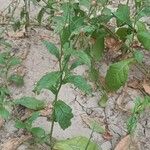
Nicotiana plumbaginifolia
Tex-Mex Tobacco · Curled-leaved tobacco · Leadwort-leaved tobacco
Description
Source: leafsnapNicotiana plumbaginifolia, commonly known as the tobacco plant, is a species of flowering plant in the nightshade family, Solanaceae. Native to South America, it has since spread to various parts of the world. The plant can grow up to 1 meter tall and features green, ovate-shaped leaves that can reach up to 20 centimeters in length. The flowers of the tobacco plant are either white or pale pink and exhibit a tubular shape with five flaring petal tips. These flowers bloom from summer through fall and are primarily pollinated by moths during the night. This plant contains nicotine, a highly addictive substance that can be harmful if consumed in large amounts. Despite its potential dangers, nicotine also has medicinal properties and has been used by indigenous peoples for centuries for purposes such as pain relief and as an insecticide. Nicotiana plumbaginifolia is frequently utilized in research due to its rapid growth rate and ease of cultivation. It is also a crucial model organism for studying gene expression patterns during development. In summary, Nicotiana plumbaginifolia is a fascinating species with significant historical and scientific importance, owing to its unique properties.
Care Guide
💧 Water Every 7 days
Tex-Mex tobacco thrives in moderate humidity and benefits from consistent moisture, ideally being watered once a week. Originally from regions with evenly distributed rainfall, this plant is adaptable to various climates and can endure occasional heavy rain. This demonstrates its resilience and versatility in terms of water needs.
☀️ Light Full sun
Tex-mex tobacco comes from bright, open environments and flourishes in full sun. It can tolerate partial sun but favors direct sunlight for best growth. This plant, which may be annual or biennial, is recognized for its sun-loving character.
What are the sunlight requirements for Tex-mex tobacco?
Tex-mex tobacco, scientifically known as Nicotiana plumbaginifolia, flourishes in environments that provide full sun, denoting above 6 hours of direct sunlight daily. It can also tolerate partial sun, which means about 3-6 hours of sunlight. However, it achieves optimal growth under conditions of full sunlight exposure. When planning to grow this plant, observe the movement of sunlight in your garden to find spots that offer a healthy balance of light and shade, ensuring the plants receive the adequate light they need for happiness and good health.
How should indoor Tex-mex tobacco plants be lit?
For indoor Tex-mex tobacco plants that don't get enough natural sunlight, artificial lighting becomes essential for their growth. During winter or in areas of your home that do not receive sufficient sunlight, consider using LED lights for your plants. LED lights can be customized to provide specific wavelengths needed by your plants. For plants that require full sun, they should have 30-50W/sq ft of artificial light, while those needing partial sun should get 20-30W/sq ft. It's important to place the light source 12-36 inches from the plant to mimic natural sunlight. Moreover, you should mimic the natural daylight duration your plant species requires, typically between 8-12 hours of light per day.
What are some symptoms of insufficient light in Tex-mex tobacco plants?
When Tex-mex tobacco plants are not receiving enough light, especially if grown indoors, they may exhibit several symptoms indicating light deficiency. These symptoms include smaller new leaves compared to previous ones, leggy or sparse growth with longer spaces between leaves or stems, early leaf drop to conserve resources, halted or slower new growth, lighter-colored new leaves indicating insufficient chlorophyll and nutrients, chlorosis or loss of green leaf color, sunscald characterized by pale or necrotic spots on leaves or stems, leaf curling as a sun protection mechanism, wilting due to excessive water loss, and leaf scorching seen as brown, dry edges on leaves due to too much sunlight.
What solutions are recommended for Tex-mex tobacco plants with insufficient light?
To address insufficient light for Tex-mex tobacco plants, several strategies can be applied based on the growth environment. Indoors, you can gradually move the plants to a sunnier spot each week until they receive at least 6 hours of direct sunlight daily, making use of south-facing windows and keeping curtains open. For large, immovable plants, consider using artificial grow lights for at least 8 hours daily. Outdoors, similarly, moving your plants to progressively sunnier spots each week can help them adapt without the risk of sunburn. If your plants are blocked from sunlight due to physical obstructions like trees, pruning to let sunlight through may be necessary. For smaller plants, transplanting during their dormant period to a sunnier location with good drainage can significantly improve their sunlight exposure. Note that parts of the plant already damaged by insufficient light may not recover, but with improved light conditions, new growth should be healthy.
🌡️ Temperature 20–37.8°C
Tex-mex tobacco can tolerate a wide range of temperatures, but its distribution may still be restricted by different combinations of moisture and heat. It performs best in warm summer conditions with enough rainfall or irrigation. Extended periods of cloudy, rainy weather or sustained high temperatures increase the chance of Tex-mex tobacco dying. In winter, shielding the plant from cold can improve its survival chances.
What is Tex-mex tobacco?
Tex-mex tobacco, known botanically as Nicotiana plumbaginifolia, is a species belonging to the tobacco genus. This particular variety differentiates itself from other tobacco plants with unique characteristics significant to its growth, appearance, and possibly its chemical properties.
💨 Humidity
🪴 Soil 6-7
🌱 Fertilizer
Tex-mex tobacco does well with regular, light applications of fertilizer to encourage healthy leaf development. Apply fertilizer roughly once per month during the summer. Nitrogen is essential for the foliage, and providing nitrogen-rich fertilizers helps Tex-mex tobacco prosper.
🪴 Pot & Repot
✂️ Pruning
Tex-Mex tobacco is a fast-growing, fragrant plant that produces tubular flowers. To encourage bushier growth, prune the plant in early to late spring by trimming back any overgrown branches. Regular pruning improves air circulation and promotes more abundant flowering. Be sure to use sterilized tools to prevent the spread of disease, and avoid excessive pruning to minimize plant stress.
🌿 Propagating
🐛 Diseases & pets
☠️ Toxicity
Characteristics
- Plant Type
- Herb
- Life Cycle
- Annual
- Genus
- Nicotiana
- Family
- Solanaceae
- Hardiness Zone
- 9-11
- Mature Height
- 30 cm to 91 cm
- Mature Spread
- 30 cm to 49 cm
- Leaf Color
- Green
- Leaf Type
- Semi-evergreen
- Flower Color
- White
- Flower Size
- 2.54 cm to 5.08 cm
- Bloom Time
- Late spring, Summer, Early fall
- Planting Time
- Spring, Summer, Autumn
- Harvest Time
- Mid summer, Late summer, Fall
- Native Area
- Cuba, Paraguay, Argentina, Honduras, Mexico, Guatemala, Bolivia, Peru, Brazil, Ecuador, Trinidad and Tobago, Jamaica