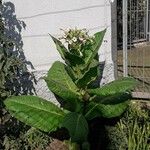
Nicotiana tabacum
Tobacco · Cultivated Tobacco · Igwayi · Tabacco · Virginische Tabak
Description
Source: leafsnapNicotiana tabacum, or cultivated tobacco, is an annually grown herbaceous plant of the Nicotiana genus. The plant is tropical in origin, is commonly grown throughout the world, and is often found in cultivation. It grows to heights between 1 and 2 meters (3' to 6'). Research is ongoing into its ancestry among wild Nicotiana species, but it is believed to be a hybrid of Nicotiana sylvestris, Nicotiana tomentosiformis, and possibly Nicotiana otophora. It is the most commonly grown of all plants in the genus Nicotiana, the plants' leaves commercially grown to be processed into tobacco.
🌳 Many people are unaware that tobacco waste can serve as a biopesticide. After useful alkaloids are extracted, the leftover biomass still contains compounds that can deter pests. This additional advantage suggests tobacco could play a role in sustainable, organic agriculture without relying on synthetic chemical pesticides.
🎭 Calm, recovery, and tranquility
Care Guide
💧 Water Every week
Tobacco plants thrive in tropical rainforests because they prefer consistent moisture but can also tolerate short periods of dryness. Watering them once a week is typically enough to meet their needs without causing overwatering. When grown outdoors, tobacco benefits most from a growing season that aligns with natural rainfall patterns, promoting optimal development.
How should I water my Tobacco plant?
You can water Tobacco using a variety of common tools like a garden hose with a spray nozzle or a watering can. It doesn't really matter what kind of water you use, as Tobacco can thrive with rainwater, tap water, or filtered water. Avoid watering from above, as it can harm the leaves and flowers and potentially cause disease. A drip irrigation system can be the best way to water Tobacco, as it delivers water evenly and right into the soil. If you have Tobacco in a container, you can use a cup, watering can, or tap water to directly water the soil.
What should I do if I give my Tobacco too much or too little water?
To remedy underwatered Tobacco, simply increase the frequency of watering when you notice it lacks moisture. However, overwatering can be a more serious issue that could lead to diseases and the decline of the plant, especially if not detected early. To prevent this, choose a suitable location for growing Tobacco, ensuring it receives ample sunlight to help dry the soil and has proper drainage to prevent water from pooling. If you overwater Tobacco in a pot, consider changing it to a new pot with better soil drainage and more drainage holes. When repotting the overwatered Tobacco, use loose soil and an efficiently draining pot.
How much water does my Tobacco plant need?
To properly care for tobacco plants, you should water them regularly during the growing season. In the spring, watering once a week should be sufficient. As the season progresses and it gets hotter, you may need to increase watering to two or three times a week. However, be careful not to over-water as it can harm the tobacco. It's important to keep the soil moist but not soaking wet, regardless of the watering frequency. When it comes to potted tobacco plants, you'll need to water them more often. Potted soil tends to dry out faster than ground soil, so watering a few times per week is recommended compared to just once a week for plants in the ground.
How much water does my Tobacco plant need?
Determining the optimal amount of water to give your Tobacco plants can be done in a few different ways. One approach is to gauge the moisture of the soil by using your intuition. In this method, you would water the plants until the top six inches of soil feel moist. Another option is to use a specific measurement for watering. As a general rule, giving your Tobacco plants around two gallons of water per week is recommended, taking into account factors such as temperature and how quickly the soil dries out. However, it's important to consider that these guidelines may result in overwatering if your plant doesn't require two gallons per week. When growing Tobacco in a container, the approach is slightly different. In this case, you should ensure all layers of dry soil are moistened when watering. You can check for moisture by sticking your finger into the soil or by observing a small amount of excess water draining from the pot's holes.
How do I know if I'm giving my Tobacco enough water?
Avoiding overwatering your Tobacco can be somewhat difficult. While these plants have deep roots requiring weekly soil moistening, they are also highly prone to root rot. Overwatering can cause browning in the tobacco plants. Underwatering, on the other hand, is less likely as tobacco plants can survive without supplemental watering for a while. However, if you wait too long to water them, they will start to wilt and develop dry leaves.
☀️ Light Full sun
Tobacco performs best with abundant sunlight, which fuels vigorous growth and enhances leaf development. It can also withstand moderate light levels. Excessive sun exposure may cause scorching, while inadequate light can impede growth. The sun's prevalence in its native habitat emphasizes the plant's need for considerable solar intake.
What are the sunlight requirements for tobacco plants?
Tobacco plants thrive best with maximum solar exposure, requiring more than 6 hours of sunlight (full sun) daily for robust growth and optimal leaf development. They can also grow under partial sun conditions, which is about 3-6 hours of sunlight per day. However, it is crucial to observe the sunlight patterns in your garden to ensure your plants receive a balanced light for their happiness. The natural habitat of tobacco underscores its need for significant sunlight, although it's important to avoid overexposure, as it can lead to scorching, and insufficient light might impair growth.
How can artificial lighting support tobacco plant growth indoors?
When natural sunlight is insufficient, especially during winter or in less sunny spaces, artificial lighting becomes essential for tobacco plants' growth indoors. Optimal growth can be supported by choosing the right type of artificial light, such as LED lights, which can be customized to provide specific wavelengths needed by the plants. Full sun plants require 30-50W/sq ft, partial sun plants need 20-30W/sq ft, and full shade plants need 10-20W/sq ft of artificial light. The light source should be placed 12-36 inches above the plant to mimic natural sunlight effectively. Most plants need 8-12 hours of light per day to mimic the length of natural daylight hours for your plant species.
What are the symptoms of inadequate light in tobacco plants?
When tobacco plants are grown indoors or under inadequate light conditions, they may exhibit symptoms like smaller new leaves, leggy or sparse growth, faster leaf drop, slower or no new growth, lighter-colored new leaves indicating a lack of chlorophyll, chlorosis (leaves turning yellow), sunscald (damage from intense light), leaf curling as a defense mechanism, wilting due to increased water loss, and leaf scorching. These symptoms highlight the plant's struggle with either too much or too little light.
What solutions can help improve light conditions for tobacco plants?
To optimize light conditions for tobacco plants, indoor solutions include gradually moving plants to sunnier locations to receive at least 6 hours of direct sunlight daily or using artificial light for large plants not easily moved. Outdoor and ground plants should also be moved gradually to sunnier spots to adapt without experiencing sunburn. Obstructions like trees can be pruned to let more sunlight through. For smaller plants, consider transplanting during the dormant period to a location with ample sunlight and good drainage. It's essential to provide enough light without sudden changes to avoid damaging the plants.
🌡️ Temperature 20–37.8°C
In its natural growing conditions, tobacco thrives at temperatures between 20 and 38 ℃ (68 to 100.4 ℉), so it is a warm-weather crop. To cope with cooler temperatures in cold months, it should be cultivated in a heated greenhouse or grown indoors under a grow light. During hotter months, providing shade and adequate irrigation can help reduce heat stress.
What are the ideal growing conditions for tobacco?
Tobacco thrives in temperatures ranging from 20 to 38°C (68 to 100.4°F), preferring warm weather. For colder climates, growing it in a heated greenhouse or indoors with a grow light is recommended. During hotter months, it's important to provide shading and ensure there's adequate irrigation to combat heat stress. Since tobacco is highly sensitive to cold, it's advised to bring outdoor plants indoors during autumn, placing them near a bright window yet away from direct heat sources. Keeping the temperature above the minimum suitable growth temperature during winter supports its growth, while exposure to temperatures nearing the minimum tolerable growing temperature can be harmful.
How should tobacco plants be cared for in low temperatures?
Tobacco plants prefer warm temperatures and are not tolerant of cold. They perform best when kept above the minimum suitable growth temperature. During winter, it's crucial to maintain temperatures above the minimum tolerable growing temperature. Should the temperature fall below the growth limit temperature, the leaves may discolor, turning lighter and, following frost damage, potentially brown or black. Signs of frost damage include wilting and drooping. To mitigate frost damage, affected parts should be trimmed off and the plant moved to a warm indoor space. Placing the plant near a south-facing window maximizes sunlight exposure, and it's essential to avoid placing it near heaters or air conditioning vents to prevent air dryness.
What care is needed for tobacco plants in high temperatures?
During summer, it's vital to keep tobacco plants below the maximum suitable growth temperature. Exceeding the maximum tolerable growing temperature can cause leaf discoloration and increase susceptibility to sunburn. Care for plants exposed to high temperatures includes trimming sunburned or dried parts and relocating the plant to a shaded area, particularly from the midday and afternoon sun. Watering in the morning and evening helps maintain soil moisture, critical for plant health during hot conditions.
💨 Humidity
🪴 Soil 5-6
🌱 Fertilizer
Tobacco benefits from regular, dilute applications of fertilizer to encourage healthy leaf growth. You should fertilize Tobacco about once a month during the summer months. Nitrogen is essential for foliage, and adding nitrogen-rich sources helps Tobacco thrive.
Why should I put fertilizer on my Tobacco plants?
Plants require nutrients to grow, and while some can obtain enough on their own, others, like tobacco, need additional fertilizers. Nitrogen, phosphorus, and potassium are vital nutrients for plants, each serving various essential functions. For foliage, nitrogen is particularly important. However, tobacco plants often struggle to obtain sufficient nitrogen from the soil, which is why many gardeners choose to supplement their tobacco plants with additional nitrogen through feeding.
When should I fertilize my Tobacco?
Tobacco grows well with the help of fertilizer. You should only fertilize it once a month during the spring and summer when it is actively growing. During fall and winter, when it becomes less active, it doesn't need as many nutrients so avoid fertilizing. Look for signs of new growth to know when to start fertilizing. Whether grown outside or indoors in a container, the fertilization schedule remains the same. If your Tobacco is in a container, you may not need to fertilize for the first one to two months. Container potting soil already has enough nutrients, so wait until your plant has been in the same soil for a while before starting to fertilize.
When is the right time to not fertilize my Tobacco?
To ensure the health of your Tobacco plant, avoid fertilizing it when it is not in good condition due to disease or insect infestation. Additionally, refrain from fertilizing a dehydrated plant as it will exacerbate the issue. Only apply fertilizer to healthy plants. When watering your plant, be cautious not to splash fertilizer onto the leaves or stem, as this can cause burn spots. Unless you are using a specifically designed foliage fertilizer, avoid direct contact between the plant and the fertilizer.
What fertilizer should I use for my Tobacco?
Fertilizers play a crucial role in promoting growth in Tobacco by providing essential nutrients like nitrogen, potassium, phosphorus, iron, manganese, and zinc. For Tobacco plants, a balanced fertilizer like a 10-10-10 NPK all-purpose fertilizer is recommended. Additionally, natural options such as blood meal or worm castings can work effectively as fertilizers. If the main objective is to enhance leaf growth, a nitrogen-rich fertilizer like fish fertilizer is a good choice. It is important to focus on the specific needs of Tobacco plants rather than providing excessive supplements for flowers or seeds if they are not the primary goal of cultivation.
How can I make my Tobacco plant grow better with fertilizer?
To properly fertilize your Tobacco plant, follow these steps for best results. Start by reading the instructions on the fertilizer package you purchased. It is recommended to begin with half-strength fertilizer to avoid accidentally over-fertilizing. Over-fertilization is common with Tobacco plants, as they require frequent fertilization. Remember that it's easier to add more fertilizer later if needed, rather than trying to rescue an over-fertilized plant. Make sure the soil is not dry before applying fertilizer. It should already be somewhat moist. This helps the fertilizer absorb easily and prevents fertilizer burn. After applying dry fertilizers, remember to water the soil. Different fertilizers have different application methods. Some are mixed into the soil during planting, while others are applied on top of the soil and then watered in. For most Tobacco plants, a water soluble fertilizer is a simple option. Mix the recommended dosage of the fertilizer solution into your watering can, and water the plant as usual. If you prefer not to fertilize monthly, slow-release granules or fertilizer spikes can also be effective. By following these steps, you can ensure that your Tobacco plant is properly and easily fertilized.
🪴 Pot & Repot
✂️ Pruning
Tobacco is a rapidly growing plant with broad leaves. To promote optimal growth, it's important to use key pruning techniques such as removing suckers and damaged leaves. This helps improve air circulation and reduces the risk of disease. Pruning should be done from early to late spring, using sharp, sterilized tools to ensure clean cuts and minimize plant stress.
🌿 Propagating
🐛 Diseases & pets
☠️ Toxicity
Characteristics
- Plant Type
- Herb
- Life Cycle
- Annual, Perennial
- Genus
- Nicotiana
- Family
- Solanaceae
- Hardiness Zone
- 10-11
- Mature Height
- 0.61 m to 2.13 m
- Mature Spread
- 30 cm to 61 cm
- Leaf Color
- Green
- Leaf Type
- Deciduous
- Flower Color
- Pink, White
- Flower Size
- 2.54 cm to 5.08 cm
- Bloom Time
- Early summer, Mid summer
- Planting Time
- Spring, Summer
- Harvest Time
- Mid summer, Late summer
- Native Area
- Colombia, Venezuela, Peru