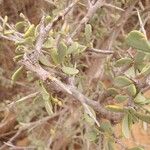
Nitraria retusa
Description
Source: leafsnapNitraria retusa, commonly known as Nitre bush, is a salt-tolerant and drought-resistant shrub in the family Nitrariaceae. It can grow to heights of 2.5 metres (8 ft 2 in), although it seldom exceeds more than 1 m in height. It produces small white/green coloured flowers and small edible red fruit. The plant is native to desert areas of northern Africa, where it grows in primary succession on barren sand dunes, and in areas with high salinities such as salt marshes.
Care Guide
💧 Water
☀️ Light Full sun
The Salt tree grows in open habitats, like sunny meadows and forest edges, which offer plenty of light. It flourishes in Full Sun but will also tolerate Partial Sun, showing good adaptability to different light conditions.
🌡️ Temperature 15–37.8°C
The salt tree comes from tropical areas where the climate is generally warm and humid. Consequently, it is adapted to high heat and moisture. It does not tolerate sudden temperature shifts and prefers a consistent thermal environment, so preventing indoor temperature fluctuations is important. It usually cannot withstand cold and needs warmer conditions to grow. If the surrounding temperature becomes too low, the plant may stop growing or even die.
💨 Humidity
🪴 Soil 6-8
🌱 Fertilizer
Fertilizing is essential for Salt tree care. Regular feeding during the growing season maintains the energy for its showy leaves and supports overall growth. If fertilization is neglected, leaves can become unhealthy, the plant’s ornamental appeal can decline, and growth may be stunted or weak and prone to breakage.
🪴 Pot & Repot
✂️ Pruning
The salt tree is a robust, salt-tolerant shrub that thrives in arid regions. To maintain its health and appearance, it's best to prune the plant in early spring. Start by removing any dead branches to encourage new growth and improve air circulation. Additionally, thinning out crowded branches will enhance the shrub's aesthetics and reduce the risk of disease, ultimately supporting the plant's health and longevity.
🌿 Propagating
🐛 Diseases & pets
☠️ Toxicity
Characteristics
- Plant Type
- Shrub
- Life Cycle
- Perennial
- Genus
- Nitraria
- Family
- Nitrariaceae
- Hardiness Zone
- 8-11
- Mature Height
- 0.91 m to 2.13 m
- Mature Spread
- 2.13 m to 3.05 m
- Leaf Color
- Green Yellow, Yellow Green
- Leaf Type
- Evergreen
- Flower Color
- White
- Flower Size
- 0.51 cm to 0.76 cm
- Bloom Time
- Mid spring, Late spring
- Planting Time
- Spring, Summer, Autumn
- Harvest Time
- Mid summer, Late summer, Early fall
- Native Area
- Saudi Arabia, Libya, Iraq, Syria, Tunisia, Egypt, Sudan, Mauritania, Algeria, Kuwait, Morocco