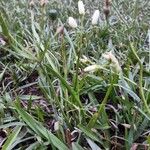
Nothoscordum bivalve
Crow-poison · False garlic · Grace Garlic · Yellow false-garlic
Description
Source: leafsnapNothoscordum bivalve is a species of flowering plant in the Amaryllidaceae known by the common names crowpoison and false garlic. It is native to the eastern United States from Texas to Florida up to Nebraska and Ohio, as well as Mexico, Peru, Uruguay, northeastern Argentina and central Chile.Nothoscordum bivalve is a perennial herb growing from a bulb about a centimeter wide. It produces one erect stem, or occasionally two. They grow up to 40 centimetres (16 in) tall. There are one to four narrow leaves up to 30 centimetres (12 in) long. The inflorescence is an umbel of 3 to 6 flowers, or sometimes up to 10. There are two bracts at the base of the umbel. The flower has six whitish tepals, each of which usually has a dark reddish midvein. The flower has no scent. The fruit is a capsule.This is a common plant which grows in parks and on roadsides, and soils which are not too dry or too wet; it grows well in lawns. It is a favorite nectar source for small butterflies such as the falcate orangetip.
🌳 Crowpoison is a popular perennial plant often found in gardens, valued for its delicate flowers that remain open for several days in sunny weather and bloom in early spring. It is an excellent choice for adding color to barren landscapes and is a must-have in any flower garden. For a striking color contrast, consider planting it alongside violet and yellow wood sorrel, verbena, and May apple.
🎭 Ingratitude and naivety
Care Guide
💧 Water
☀️ Light Full sun
🌡️ Temperature 5–37.8°C
💨 Humidity
🪴 Soil 6-7
🌱 Fertilizer
🪴 Pot & Repot
✂️ Pruning
🌿 Propagating
🐛 Diseases & pets
☠️ Toxicity
Characteristics
- Plant Type
- Herb
- Life Cycle
- Perennial
- Genus
- Nothoscordum
- Family
- Amaryllidaceae
- Hardiness Zone
- 5-11
- Mature Height
- 15 cm to 46 cm
- Mature Spread
- 30 cm
- Leaf Color
- Green, Bronze
- Leaf Type
- Evergreen
- Flower Color
- White
- Flower Size
- 2.54 cm
- Bloom Time
- Mid spring, Late spring, Early summer
- Planting Time
- Spring
- Harvest Time
- Early summer, Mid summer
- Native Area
- Mexico, Bolivia, Peru