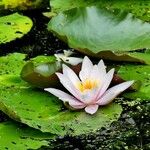
Nymphaea alba
نیلوفر آبی سفید · White water-lily · European White Water-Lily · White nenuphar · White water rose
Description
Source: leafsnapNymphaea alba, commonly known as the European white water lily, is a perennial aquatic plant that belongs to the Nymphaeaceae family. It is native to Europe as well as parts of Asia and Africa. The plant features large, round leaves that float on the water's surface and striking white flowers that bloom in the summer. The flowers of Nymphaea alba are fragrant and have numerous petals arranged in a star-like pattern. These flowers open during the day and close at night or on cloudy days. The leaves are green on top with a reddish-purple underside. Nymphaea alba thrives in still or slow-moving freshwater bodies such as ponds, lakes, or slow streams that receive plenty of sunlight. It can grow in water up to 1 meter deep. The plant has been used for medicinal purposes for centuries due to its anti-inflammatory properties, which help relieve pain caused by arthritis or other inflammatory conditions. Additionally, Nymphaea alba is popularly used as an ornamental aquatic plant. Its beautiful flowers attract pollinators such as bees and butterflies to gardens or ponds where it is grown. Overall, Nymphaea alba is an attractive aquatic perennial with both aesthetic appeal and medicinal properties, making it beneficial for both garden beauty and human health.
🌳 White water rose shows potential as a bioindicator of certain heavy metals in freshwater ecosystems. The plant's roots can take up metals such as copper and lead from the sediment, allowing it to act as a natural indicator of pollution levels. This little-known potential application can be a boon for environmental monitoring and bioremediation efforts in water bodies affected by industrial contamination.
Care Guide
💧 Water Every 7 days
☀️ Light Full sun
White water rose requires a substantial amount of sunlight for optimal growth, doing best when fully exposed to direct sun. It can, however, remain healthy with only partial sunlight. Excessive sun can impede its growth, while insufficient light may stop its development.
What are the sunlight requirements for White water rose?
The White water rose thrives best under full sun, requiring above 6 hours of sunlight a day for optimum growth. It can also sustain its health under partial sun conditions, with about 3-6 hours of sunlight. It's vital to observe how sunlight moves through your garden and select spots that provide an ideal balance of light and shade. This ensures that your plants receive the right amount of light for their happiness and health.
How does White water rose respond to different sun exposures?
White water roses benefit significantly from a generous amount of sunlight for optimal growth. They prefer being fully exposed to the sun's rays but can manage under partial solar conditions. If the plant is overexposed to the sun, it may experience impaired growth, while underexposure could stall its development. Thus, it's important to find the right amount of sunlight for these plants to keep them healthy.
What artificial lighting requirements do White water roses have?
When natural sunlight is insufficient, especially during winter or in less sunny spaces, artificial lighting is crucial for the growth of indoor White water roses. LED lights are recommended because they can be customized to provide specific wavelengths of light needed by the plants. Full sun plants require 30-50W\/sq ft of light, partial sun plants need 20-30W\/sq ft, and shade-loving plants need 10-20W\/sq ft. The light source should be placed 12-36 inches above the plant to simulate natural sunlight, and most plants will need 8-12 hours of light per day.
What are common signs of insufficient light in White water roses?
White water roses, when grown in settings with insufficient light, might display subtle symptoms such as smaller new leaves, leggy or sparse growth, faster leaf drop, slower or halted growth, lighter-colored new leaves, and symptoms of chlorosis. These signs often go unnoticed but indicate the plant is not receiving enough sunlight to maintain its health.
What are the symptoms of overexposure to sun in White water roses?
When White water roses are overexposed to sunlight, they may suffer from conditions like sunscald, which appears as pale or necrotic areas on plant tissues, leaf curling as a defense mechanism to reduce water loss, wilting due to increased transpiration, and leaf scorching characterized by brown, dry edges on leaves. These symptoms can significantly reduce the plant's overall health.
🌡️ Temperature 5–35°C
The white water rose is native to temperate regions and thrives in temperatures ranging from 41 to 95 °F (5 to 35 ℃). For optimal growth, ensure seasonal temperature fluctuations stay within this range. Adjustments may be necessary in extreme climates.
What are the ideal growing temperatures for White water rose?
White water rose thrives in temperate regions, with ideal temperatures ranging from 41 to 95 °F (5 to 35 °C). Seasonal temperature fluctuations within this range promote optimal growth. The plant possesses significant cold resistance, negating the need for special frost protection measures in most winter conditions. However, for extreme climates where winter temperatures may plummet below -30°C, implementing cold protection by covering the plant with materials like soil or straw is advised. Watering the plant abundantly before the first freeze of autumn ensures the soil remains moist and enters a frozen state, which is crucial for preventing drought and water scarcity during winter and early spring.
How does White water rose react to low temperatures?
White water rose is remarkably cold-tolerant, ideally growing in conditions above 5°C. It typically withstands winters well above -25°C. When temperatures fall below -30°C, the plant may not show immediate distress, but you might notice a decrease in sprouting or a lack of sprouting come springtime. To remedy the lack of sprouting in spring, it's advisable to remove any parts of the plant that have failed to sprout, promoting healthier growth in the warmer seasons.
What should I do if the White water rose experiences high temperatures?
During the summer months, it's crucial to ensure that the White water rose remains in conditions below 35°C. Exposure to temperatures above 38°C can lead to symptoms such as leaves becoming lighter in color, curling, susceptibility to sunburn, and in severe cases, the plant may wilt and dry out. To manage this, trim away any sunburned or dried parts and relocate the plant to a shadier spot or provide shade with a cloth during the sun's peak hours. Additionally, watering the plant during the morning and evening will help keep the soil adequately moist and reduce stress caused by high temperatures.
💨 Humidity
🪴 Soil
🌱 Fertilizer
🪴 Pot & Repot
✂️ Pruning
The white water rose is an aquatic plant known for its broad, floating leaves and beautiful white flowers. To maintain its health and appearance, it is important to prune it from early to late spring. This involves removing dead leaves and spent flowers, as well as cutting back stems to healthy nodes. Pruning in this way improves water circulation, lowers the risk of disease, and encourages vigorous growth, enhancing the plant's aesthetic appeal.
🌿 Propagating
🐛 Diseases & pets
☠️ Toxicity
Characteristics
- Plant Type
- Herb
- Life Cycle
- Perennial
- Genus
- Nymphaea
- Family
- Nymphaeaceae
- Hardiness Zone
- 4-9
- Mature Height
- 0.49 m to 2.13 m
- Mature Spread
- 91 cm
- Leaf Color
- Green
- Leaf Type
- Deciduous
- Flower Color
- White
- Flower Size
- 10.16 cm to 20.32 cm
- Bloom Time
- Early summer, Mid summer
- Planting Time
- Spring
- Harvest Time
- Mid summer
- Native Area
- Turkey, Sweden, Austria, Slovakia, Montenegro, Slovenia, Morocco, Croatia, Belarus, Russia, Iraq, Germany, Estonia, Romania, Latvia, Belgium, Portugal, Netherlands, France, Tunisia, Czech Republic, Bulgaria, Armenia, Poland, Greece, Ukraine, Serbia, China, Lithuania, Norway, Syria, Italy, Spain, Switzerland, Denmark, Myanmar, Finland, Iran, Albania, Ireland, United Kingdom, Hungary, Algeria, Azerbaijan