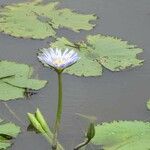
Nymphaea elegans
Blue water-lily · Elegant Waterlily · Tropical Royal-Blue Water-Lily · Tropical royalblue waterlily · Tropical royal-blue waterlily
Description
Source: leafsnapNymphaea elegans, the tropical royalblue waterlily, is a species of aquatic plants in the family Nymphaeaceae. It is found in Louisiana, Florida and Texas, in the United States, in Oaxaca in Mexico and in Antioquia in Colombia.
Care Guide
💧 Water
The tropical royal-blue waterlily thrives in warm, humid environments with consistent moisture. It grows best in water that is not waterlogged. To promote optimal growth and blooming, water the plant weekly. As an ornamental aquatic plant, the tropical royal-blue waterlily enhances outdoor ponds with its floating leaves and seasonal flowers, naturally adapting to local rainfall.
☀️ Light Full sun
The tropical royal-blue waterlily is native to sunny habitats, such as the shallow margins of ponds and lakes. It favors full sun but can also tolerate partial sun.
What are the sunlight requirements for plants?
Plants have varying needs when it comes to sunlight, with some requiring full sun, necessitating above 6 hours of sunlight daily, while others thrive in partial sun, needing about 3 to 6 hours of sunlight. Observing the movement of sunlight through your garden is crucial for identifying spots that offer the ideal mix of light and shade, which is essential for the well-being of your plants.
What essentials should be known about the Tropical royal-blue waterlily?
The Tropical royal-blue waterlily is a sun-loving, perennial, herbaceous plant hailing from open habitats. It generally flourishes in meadows and grasslands. Regarding sunlight, it prefers full sun but can also manage well in partial sun conditions. Artificial lighting becomes a necessary alternative when natural sunlight is lacking, especially during winter or in areas receiving less sunlight. Suitable artificial lighting, like LED lights, should provide the specific wavelengths needed by the plant. Full sun plants require 30-50W/sq ft, partial sun plants 20-30W/sq ft, and full shade plants 10-20W/sq ft. The light source should be placed 12-36 inches above the plant and kept on for 8-12 hours daily to emulate natural daylight hours.
How do you know if your Tropical royal-blue waterlily is getting insufficient light?
A Tropical royal-blue waterlily not receiving adequate light may exhibit several symptoms, including smaller new leaves, leggy or sparse growth, premature leaf drop, halted or no new growth, and lighter-colored or yellowing leaves (chlorosis). In cases of excessive sunlight, you might notice sunscald, leaf curling, wilting, or leaf scorching. These signs help in determining if your plant is suffering due to poor light conditions and whether adjustments are needed to its environment.
What solutions are available for Tropical royal-blue waterlilies receiving insufficient sunlight?
To address insufficient sunlight, indoor plants should be gradually moved to sunnier locations, aiming for at least 6 hours of direct sunlight daily, or supplemented with artificial light for 8 hours daily if moving them is not feasible. For outdoor plants, transitioning them to sunnier spots over weeks helps avoid shock. Reducing obstructions such as overhanging branches can increase sun exposure. For smaller plants, consider transplanting them to a sunny area during their dormant period. Remember, parts of the plant damaged by insufficient light may not recover, but new growth should be healthy with improved lighting.
🌡️ Temperature 20–37.8°C
The tropical royal-blue waterlily comes from tropical areas, where the climate is generally warm and humid. Consequently, it is adapted to high heat and moisture. It does not tolerate sudden temperature shifts and prefers a steady thermal environment, so avoiding temperature fluctuations indoors is important. It usually cannot endure cold temperatures and needs warmer conditions to grow. If the surrounding temperature falls too low, the plant may stop growing or even die.
💨 Humidity
🪴 Soil
🌱 Fertilizer
🪴 Pot & Repot
✂️ Pruning
The tropical royal-blue waterlily is known for its vibrant blue flowers and floating leaves. To help it thrive, prune the plant from early to late spring by removing any dead or yellowing foliage and spent blooms. This ensures optimal light and nutrient flow, enhances air circulation, minimizes the risk of disease, and promotes healthy growth in ponds or water gardens.
🌿 Propagating
🐛 Diseases & pets
☠️ Toxicity
Characteristics
- Plant Type
- Herb
- Life Cycle
- Perennial
- Genus
- Nymphaea
- Family
- Nymphaeaceae
- Hardiness Zone
- 10-11
- Mature Height
- 30 cm to 61 cm
- Mature Spread
- 0.91 m to 1.22 m
- Leaf Color
- Dark Green, Olive Drab
- Leaf Type
- Deciduous
- Flower Color
- White, Yellow, Purple, Blue, Pink
- Flower Size
- 6.35 cm to 12.70 cm
- Bloom Time
- Late spring, Summer, Fall
- Planting Time
- Spring, Summer, Autumn
- Harvest Time
- Summer, Fall, Early winter
- Native Area
- Colombia, Mexico, Bahamas