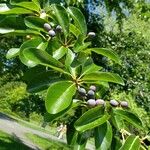
Nyssa sylvatica
Black tupelo · Black-gum · Tupelo · Sour-gum · Swamp tupelo
Description
Source: leafsnapNyssa sylvatica, commonly known as the black gum or sour gum tree, is a deciduous tree native to North America. This slow-growing tree can reach up to 80 feet in height and span 30 feet in width. The bark is dark gray and deeply furrowed, while its glossy green leaves transform into vibrant red or purple hues in the fall. The black gum tree produces small, greenish-white flowers that bloom in late spring or early summer. These flowers are followed by small, blue-black berries that attract birds and other wildlife. The black gum tree prefers moist soils but can tolerate dry conditions once established. It thrives in full sun to partial shade and is commonly found along streams, swamps, and other wetland areas. In addition to its ornamental value as a shade or specimen tree, the black gum has several practical uses. Its wood is hard and durable, making it suitable for furniture making. Moreover, its bark has been used for medicinal purposes by Native Americans. Overall, Nyssa sylvatica offers both aesthetic beauty and practical benefits, making it an excellent addition to any landscape design plan.
💡 Black gum is a popular tree choice for beekeepers who use sections of hollow trees, known as bee gums, to cultivate honey. Since the early 20th century, bee gums have been particularly common in the southeastern United States. While various types of trees can be used to create bee gums, the practice is named after the black gum tree, which is traditionally favored for this purpose.
🌳 Black tupelo not only provides a splendid canopy but also produces fruits enjoyed by wildlife and once enjoyed by indigenous Americans. Those same fruits are made into wine. Although black tupelo's wood is difficult to shape because its fibers are intertwined, "tupelo wood" is valued for crafting sturdy objects such as mauls and wheel parts due to its durability and shock-absorbing properties.
🎭 Resilience, transformation, adjusting to difficult circumstances
Care Guide
💧 Water Every 7 days
Black gum trees, which originate from wetlands and upland forests, thrive in moisture-rich environments. Once they are established, these trees can tolerate moderate drought conditions. To support their growth, water them every 1-2 weeks, which aligns with their natural moisture cycle. Usually grown outdoors, black gum trees are resilient to changes in humidity and adapt well to various climate zones.
When Should I Water My Black Gum?
Determining when to water your black gum, Nyssa sylvatica, involves paying attention to various indicators such as soil moisture, leaf condition, and environmental factors. Before deciding to water, check the soil moisture by inserting your finger about 2 inches deep into the ground; if it feels dry, the plant likely needs water. Additionally, wilting or drooping leaves, leaves turning yellow, or a change in leaf texture can signal the need for watering. Pay extra attention during hot and dry seasons as the plant's watering needs increase due to higher evaporation rates. However, avoid watering when the soil is still moist to prevent risks like root rot and fungal diseases. Proper watering assists in maintaining vibrant foliage, optimal growth, and the plant's overall health.
How Should I Water My Black Gum?
Watering your black gum effectively requires the use of proper techniques to ensure that the roots receive adequate moisture while avoiding common pitfalls like overwatering. Bottom-watering, where the plant's container sits in a tray of water allowing the plant to uptake water from the bottom, is recommended to ensure deep water absorption and minimize the risk of fungal diseases by avoiding excess moisture on the foliage. When using a watering can, it’s preferable to choose one with a narrow spout to direct water to the base of the plant, focusing on root hydration rather than wetting the leaves. This targeted approach contributes to healthier growth and minimizes issues associated with improper watering practices.
How Much Water Does Black Gum Really Need?
The amount of water required by a black gum tree depends on several factors, including its size, pot size, and the specific conditions of its environment. Its native habitat suggests it prefers well-drained, moist acidic soils, showing a particular affinity for wet, swampy areas more than dry sites. Ensure each watering session thoroughly soaks the soil, reaching the full depth of the roots, which encourages healthy and deep root development. Signs that your black gum has adequate water include shiny, lush green leaves and steady growth. Conversely, signs of over or under-watering may include yellow leaves, wilting or drooping, cracked bark, or stunted growth. Monitoring these indicators will help you maintain the right watering balance.
What Kind of Water is Best for Black Gum?
The ideal water for black gum is natural rainwater or filtered water, due to its minimal chlorine and fluoride content. If using tap water, it's advisable to let it sit for 24 hours to allow chlorine to evaporate or use a filtration system to remove additional contaminants. Black gum is somewhat tolerant to fluoride but sensitive to high mineral content, often found in hard tap water. Room temperature water is best to avoid shocking the plant's root system. These watering practices help in mitigating potential harmful effects on the black gum, supporting its overall health and growth.
How Do Black Gum's Watering Needs Change with the Seasons?
Throughout the year, the black gum's watering needs vary significantly with each season. In the spring, gradually increase watering to support new growth as the plant exits dormancy. During summer, ensure the soil remains moist, especially during hot and dry periods, potentially requiring more frequent watering to cope with evaporation and active growth. In autumn, reduce watering as the plant prepares for dormancy and to prevent root vulnerability to freezing conditions. During winter, water sparingly, only to prevent complete soil dryness, as the plant is dormant and its water needs are minimal. Adjusting watering practices seasonally is crucial for maintaining a healthy black gum tree.
☀️ Light Full sun
The black tupelo requires plenty of light for healthy growth and development. While it can tolerate lower light levels, ample exposure lets it prosper. Its native habitat reflects this requirement, as it adapts to varying light conditions. Too much light can cause stress, whereas insufficient light may hinder growth.
What are the sunlight requirements for a Black Gum tree?
The Black Gum tree thrives best in conditions of full sunlight, requiring more than 6 hours of sunlight daily to ensure its health and growth. It can also adapt to partial sun, with about 3-6 hours of sunlight. It's essential to observe the movement of sunlight through your garden to find the optimal balance of light and shade, as this will significantly affect the well-being of your plants. Overexposure or inadequate light can respectively lead to stress or stunt growth, mirroring the tree's natural habitat conditions where it adapts to varied degrees of light.
What are the essential considerations for Black Gum tree lighting?
For healthy development, the Black Gum tree requires substantial illumination. Although it can survive in less light, maximum exposure promotes its thriving best. In cases where natural sunlight is insufficient, especially during winter or in less sunny locations, artificial lighting becomes a crucial support. LED lights are recommended for their ability to be customized to provide specific light wavelengths needed by plants. Depending on the plant's sunlight requirements, the wattage per square foot varies: 30-50W for full sun plants, 20-30W for partial sun plants, and 10-20W for full shade plants. The artificial light should be placed 12-36 inches above the plant, mimicking natural sunlight for about 8-12 hours per day.
What symptoms indicate a Black Gum tree's light deficiency?
When a Black Gum tree doesn't receive enough light, it may show various symptoms indicating a problem. These include smaller new leaves compared to mature ones, leggy or sparse growth due to longer spaces between leaves or stems, faster leaf drop as the plant conserves resources, slowed or ceased growth as the plant enters survival mode, and paler new leaves indicating a lack of chlorophyll. In extreme sunlight, the tree might suffer from chlorosis, sunscald, leaf curling, wilting, or leaf scorching, demonstrating both ends of the spectrum of light-related stress.
How can I address Black Gum tree light deficiencies?
To address light deficiencies in Black Gum trees, consider gradually moving indoor plants towards sunnier locations each week, aiming for at least 6 hours of direct sunlight through a south-facing window. If the plant is large or hard to move, supplement with artificial light for at least 8 hours daily. For outdoor plants, also move them gradually to avoid shock and potential sunburn. Reducing obstacles that block sunlight, such as pruning trees, or transplanting smaller plants to sunnier spots, can significantly improve light exposure. Note that damaged parts might not recover, but new growth should be healthy with increased light exposure.
🌡️ Temperature 0–35°C
The black tupelo's natural growing environment has a temperature range of 0 to 32 ℃ (32 to 90 ℉). During the growing season it favors temperatures of 15 to 30 ℃ (59 to 86 ℉), and while dormant it can withstand temperatures down to -30 ℃ (-22 ℉). To cope with seasonal temperature shifts, it becomes dormant in the winter months.
What are the ideal temperature conditions for black gum?
Black gum thrives in native growth environments where temperatures range from 0 to 32°C (32 to 90°F). The ideal temperature range for its growing season is between 15 to 30°C (59 to 86°F). It is also well-adapted to cold temperatures, being able to withstand as low as -30°C (-22°F) during its dormant phase in winter. The tree exhibits strong cold resistance, and typical frost protection measures are not necessary, though extra care might be needed if temperatures are expected to drop below -35°C.
How should black gum trees be cared for in winter?
To prepare black gum trees for winter, it is recommended to water them abundantly before the first freeze in autumn to ensure the soil is moist and enters a frozen state. This practice helps prevent drought and water scarcity for the tree during the winter and early spring. Although black gums are cold-resistant, if winter temperatures are anticipated to fall below -35°C, protective measures, such as wrapping the trunk and branches with insulating materials like non-woven fabric or cloth, should be considered.
What are the symptoms and solutions for black gum in low temperatures?
Black gum trees show a remarkable tolerance to cold and perform best when temperatures are above 0°C. However, they should not be exposed to conditions colder than -30°C. At extremely low temperatures below -35°C, there might not be noticeable changes during winter, but branches can become brittle and dry, failing to produce new shoots in spring. The solution is to prune any dead branches that haven't produced new leaves, which encourages healthy growth.
What are the symptoms and solutions for black gum in high temperatures?
During the summer, it is critical to ensure that the temperature around black gum trees does not surpass 35°C. Temperatures above 41°C can cause the leaves to lighten in color, tips to become dry and withered, and increase susceptibility to sunburn. To mitigate these issues, sunburned and dried parts should be trimmed away. Relocating the plant to a shaded area or employing shade cloths during the peak sun hours helps. Additionally, watering the tree in the morning and evening maintains moisture in the soil.
💨 Humidity
🪴 Soil 5-6
🌱 Fertilizer
Fertilize your Black tupelo in early spring to encourage healthy growth. Regular feeding improves the tree’s overall health, producing vigorous growth, increased resilience to challenging conditions, and better resistance to disease and pests. Keep to a specific fertilization schedule for your Black tupelo to maintain foliage that is vibrant, deeply colored, and lush in appearance.
Why should I put fertilizer on my Black gum?
No matter what type of Black gum you have, fertilizing regularly can greatly contribute to its overall health. Providing the proper nutrients promotes stronger growth, making your Black gum more resistant to difficult growing conditions and better equipped to ward off diseases and pests. Maintaining the attractive foliage of your Black gum is essential. To achieve this, it is important to establish and follow a fertilization schedule that is tailored to your specific type of Black gum. By doing so, you can encourage the development of vibrant, deep-colored leaves, resulting in a lush and appealing appearance.
When should I fertilize my Black gum tree?
To ensure healthy growth, it's best to fertilize your Black gum tree during the late winter or early spring. This provides the necessary nutrients for the tree to thrive once the weather warms up. If you live in a warm climate region, an additional fertilizer feeding in early fall is beneficial. This adds nutrients for the following growing season and helps the tree withstand winter cold without damage. Fertilizing earlier will also promote the growth of strong branches that can withstand the cold winter.
When is it not a good idea to fertilize my Black gum tree?
There are specific times throughout the year when you should avoid fertilizing your Black gum. Firstly, during the early and mid-winter months, your Black gum will be in a dormant state and will not require any feeding. It is also advisable to refrain from fertilizing this plant during the late spring and summer. During this period, the weather tends to be hotter and drier, which increases the chances of your Black gum reacting negatively to fertilization. To prevent these problems, it is best to follow a fertilization schedule that involves feeding only in early spring and early fall.
What kind of plant food does my Black gum tree need?
Nitrogen is generally the most important nutrient for a Black gum tree, but phosphorus and potassium are also important. It is recommended to use a balanced fertilizer, like a 10-10-10, which contains all three nutrients. However, a ratio with a slightly higher amount of nitrogen, such as 10-6-4, tends to promote optimal growth for Black gum trees. Both granular and liquid-based fertilizers can be used for fertilizing the tree.
How should I give my Black gum tree the fertilizer it needs?
To fertilize your Black gum, you have two options: granular fertilizer or liquid fertilizer. If you choose to use granular fertilizer, simply sprinkle it on the soil at the right time. The slow-release nature of this type of fertilizer means that nutrients will gradually be released into the soil over time. It's a good idea to water your Black gum lightly before applying the fertilizer. Alternatively, you can use liquid fertilizer, although this method is not as common. To use it, mix the fertilizer with water and then pour it onto the soil around the base of your Black gum. Sometimes, it's helpful to perform a soil test before fertilizing, especially if you want to check for any pH adjustments that may be needed.
🪴 Pot & Repot
✂️ Pruning
Black gum trees boast vibrant fall foliage and can grow to a height of 30 to 50 feet (9 to 15 meters). Pruning during early spring helps remove dead or crossing branches, improves air circulation, and maintains a strong central leader. It's best to avoid pruning outside of the dormant season to prevent stress and health decline.
🌿 Propagating
🐛 Diseases & pets
☠️ Toxicity
Characteristics
- Plant Type
- Tree
- Life Cycle
- Perennial
- Genus
- Nyssa
- Family
- Nyssaceae
- Hardiness Zone
- 3-10
- Mature Height
- 20.12 m to 24.99 m
- Mature Spread
- 6.1 m to 9.14 m
- Leaf Color
- Green, Red, Orange, Purple, Blue, Yellow
- Leaf Type
- Deciduous
- Flower Color
- Green, Yellow, White
- Flower Size
- 1.27 cm
- Bloom Time
- Late spring, Early summer
- Planting Time
- Spring, Autumn
- Harvest Time
- Mid summer
- Native Area
- Mexico, Guatemala