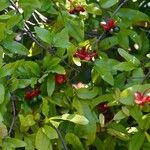
Ochna serrulata
Mickey Mouse-plant · Small-leaved plane · Carnival Redwood · Bird's Eye Bush · Carnival Ochna
Description
Source: leafsnapOchna serrulata, commonly known as the Mickey Mouse plant or bird's eye bush, is a small evergreen shrub native to South Africa. Belonging to the family Ochnaceae, this shrub can grow up to 2 meters in height. It is recognized by its glossy green, serrated leaves and bright yellow flowers that bloom in the spring and summer. These flowers are later replaced by black berries that resemble small cherries. The Mickey Mouse plant is popular as an ornamental shrub due to its attractive foliage and showy flowers. It can be grown as a hedge or used as an accent plant in gardens, parks, and landscapes. The shrub prefers well-drained soil with moderate moisture levels but can tolerate drought conditions once established. In addition to its ornamental value, Ochna serrulata has been used in traditional African medicine to treat various ailments such as fever, stomach problems, and respiratory infections. However, it should be noted that this species is listed among invasive species because of its ability to spread rapidly through seed dispersal. This can cause ecological damage if not properly controlled, especially when introduced into non-native areas where it may outcompete native plants for resources such as water and nutrients.
🌳 Although it is decorative, the mickey Mouse plant has an unexpected downside — it is an invasive species in multiple regions of the world, particularly in Australia and New Zealand. Its toughness and ability to spread quickly make it an unanticipated competitor in local ecosystems, frequently outcompeting native plants. Its berries, attractive for their bright color and distinctive shape, draw birds that unknowingly assist its spread by carrying seeds long distances.
Care Guide
💧 Water Every 7 days
The Mickey Mouse plant, native to Eastern South Africa, thrives in subtropical climates with moderate moisture levels. It should be watered every 2-3 weeks, allowing the soil to partially dry out between waterings. As an evergreen, it stores water in its leaves, enabling it to adapt to changing temperatures and varying rainfall patterns.
☀️ Light Partial sun
The mickey Mouse plant prefers moderate sun for best growth but can tolerate stronger light. In its natural habitat it is often found in places with varying sunlight intensity. Sufficient sun promotes robust growth; however, too much light can scorch the leaves, while too little light may weaken the plant.
What are the sunlight requirements for the Mickey Mouse plant?
The Mickey Mouse plant (Ochna serrulata) thrives in moderate sun exposure but can handle more intense daylight. It prefers locations with varied sun intensity, requiring about 3-6 hours of sunlight daily for partial sun exposure and more than 6 hours for full sun exposure. Insufficient light can lead to symptoms of light deficiency, while too much direct sunlight might cause leaf scorching and other damage. Artificial lighting can be used to supplement natural sunlight, especially for indoor plants, with LED lights being a good choice. The intensity and duration of artificial lighting should mimic natural sunlight as closely as possible to support healthy growth.
How does incorrect sunlight exposure affect the Mickey Mouse plant?
Insufficient sunlight can cause the Mickey Mouse plant to develop symptoms such as small leaves, leggy or sparse growth, faster leaf drop, slower or no new growth, and lighter-colored or chlorotic leaves. On the other hand, excessive sunlight can lead to sunscald, leaf curling, wilting, and leaf scorching. These problems indicate the need for better managing the plant's light exposure, ensuring it receives the ideal amount of sunlight for healthy growth without causing stress or damage to the plant.
What solutions can help a Mickey Mouse plant with insufficient sunlight?
To optimize the Mickey Mouse plant's growth when it shows signs of insufficient sunlight, gradually acclimate it to more sunlight by moving it to sunnier spots each week until it receives the necessary 3-6 hours of direct sunlight. For indoor plants that are large or difficult to move, consider using artificial lighting such as desk lamps or professional grow lights for at least 8 hours daily. Outdoor plants need to be relocated to sunnier spots gradually to prevent sunburn. Additionally, if trees or other obstructions block sunlight, pruning or transplanting during the plant's dormant period can improve light exposure. It's important to note that while parts of the plant damaged by inadequate light may not recover, new growth should be healthy with improved light conditions.
🌡️ Temperature 20–37.8°C
Mickey Mouse plant is native to regions with temperatures between 68 and 100 °F (20 to 38 °C). It flourishes in these moderate climates and can tolerate slight temperature fluctuations. Seasonal adjustments are seldom necessary.
What is the ideal temperature range for a Mickey Mouse plant?
The Mickey Mouse plant, botanically known as Ochna serrulata, thrives in climates where temperatures range between 68 to 100°F (20 to 38°C). It prefers moderate climates and can adjust to slight temperature variations. However, it is a heat-loving plant that is vulnerable to cold. During winter, it's advisable to keep the plant indoors in a location that receives plenty of light but is not too close to heaters, ensuring temperatures stay above 20°C to promote healthy growth. Temperatures nearing 0°C can be detrimental to the plant.
How does low temperature affect the Mickey Mouse plant and what actions should be taken?
The Mickey Mouse plant prefers warm temperatures and struggles with cold. Ideally, the temperature should remain above 20°C. Exposure to temperatures below -5°C can cause the leaves to lighten in color, and following frost, they may turn brown or black with symptoms of wilting and drooping. To counteract frost damage, remove the damaged parts and immediately move the plant indoors to a warm spot, ideally near a south-facing window, to ensure it receives sufficient sunlight. It's also important to keep the plant away from direct heat sources like heaters or air conditioning vents to avoid air dryness that could further stress the plant.
What should be done if a Mickey Mouse plant is exposed to high temperatures?
During the summer months, it's crucial to ensure the Mickey Mouse plant's temperature does not exceed 38°C. Temperatures above 43°C may cause the leaves to lighten and increase the plant's susceptibility to sunburn. If the plant suffers from sunburn, trim the damaged parts and relocate it to a shaded area, especially away from the intense midday and afternoon sunlight. Additionally, water the plant in the morning and evening to maintain soil moisture, aiding in cooling the plant and preventing further damage.
💨 Humidity normal (40-60%)
This plant will thrive in moderate humidity, which is probably the level in your home. However, misting it a few times a week can be very beneficial. Make sure the room has good ventilation.
🪴 Soil 5-6
🌱 Fertilizer
The best time to fertilize a Mickey Mouse plant is in early spring when it comes out of dormancy. This encourages overall growth and supports flower development. Fertilization improves the foliage, stems, and branches, and promotes flowers that are larger, more vibrant, and longer-lasting. It helps transfer nutrients from the roots to the flowers and enhances the plant’s health and resistance to disease.
🪴 Pot & Repot
✂️ Pruning
The Mickey Mouse plant is an ornamental shrub known for its yellow flowers and red fruits. To maintain its health and appearance, it's best to prune the plant in late spring after it has bloomed. Focus on removing weak branches to enhance airflow, which encourages dense growth and improves flowering and fruit production. Be careful not to prune too heavily, as this can stress the plant.
🌿 Propagating
🐛 Diseases & pets
☠️ Toxicity
Characteristics
- Plant Type
- Shrub
- Life Cycle
- Perennial
- Genus
- Ochna
- Family
- Ochnaceae
- Hardiness Zone
- 9-11
- Mature Height
- 0.91 m to 6.1 m
- Mature Spread
- 0.91 m to 1.22 m
- Leaf Color
- Green
- Leaf Type
- Evergreen, Semi-evergreen
- Flower Color
- Yellow
- Flower Size
- 2.03 cm
- Bloom Time
- Late spring, Early summer, Mid summer
- Planting Time
- Spring, Autumn
- Harvest Time
- Mid summer
- Native Area
- South Africa, Eswatini, Lesotho