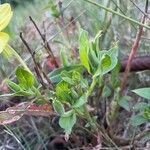
Oenothera drummondii
Beach evening-primrose · Coast evening-primrose
Description
Source: leafsnapOenothera drummondii, commonly known as Drummond's evening primrose, is a flowering plant native to North America. It belongs to the Onagraceae family and can be either a biennial or a short-lived perennial. The plant typically grows up to 3 feet tall and boasts lance-shaped leaves that can reach up to 6 inches in length. Its bright yellow flowers bloom in the evening, giving rise to the name "evening primrose." These flowers feature four petals that open in a cross shape, measuring approximately 1-2 inches in width. Drummond's evening primrose thrives in full sun or partial shade and prefers well-drained soil. While it is drought-tolerant, it does require regular watering during extended dry spells. The plant is easy to grow from seed, which can be sown directly into the ground in either spring or fall. The flowers of Oenothera drummondii attract a variety of pollinators, including bees, butterflies, moths, and hummingbirds. In addition to their ecological benefits, the flowers have medicinal properties. Native Americans historically used them to treat various ailments such as coughs, wounds, and to reduce fever. Overall, Oenothera drummondii is an attractive addition to any garden. Its bright yellow blooms that open at night make it an excellent choice for moon gardens!
Care Guide
💧 Water Every 3 days
Beach evening primrose is well-suited to sandy, well-drained soils and thrives in coastal environments with natural moisture cycles. Although it is drought-tolerant, it benefits from weekly watering. When grown outdoors, beach evening primrose develops a deep root system, allowing it to utilize water efficiently during the active growing season.
☀️ Light Full sun
Beach evening primrose is a perennial, sun-loving herbaceous plant that comes from open habitats and commonly grows in meadows and grasslands. It favors full sun but can tolerate partial sun conditions.
What are the sun requirements for Beach evening primrose or Oenothera drummondii?
Beach evening primrose, or Oenothera drummondii, thrives under specific sun conditions to ensure its growth and wellbeing. For plants to flourish, they require full sun exposure, which means they should receive above 6 hours of sunlight daily. However, they can also adapt to partial sun conditions, where they get about 3-6 hours of sunlight. It's crucial to observe how sunlight moves through your garden throughout the day to find spots that provide an ideal balance of light and shade. This attention to the plant's lighting needs is essential for its health and happiness.
🌡️ Temperature 15–37.8°C
Beach evening primrose has a strong ability to handle temperature, tolerating high heat and wide temperature fluctuations. In hot conditions, take care to water adequately and give suitable shade to avoid sunburn. On the other hand, beach evening primrose is not very tolerant of cold. Although it can endure some chill, very low temperatures can cause frost damage.
💨 Humidity
🪴 Soil 6-7
🌱 Fertilizer
The best time to fertilize a Beach evening primrose is in early spring, when it is coming out of dormancy and beginning active growth. Fertilizing supplies essential nutrients for healthy development. Although Beach evening primrose has fairly low fertilizer requirements, applying fertilizer once a year can improve its survival and encourage better, longer-lasting flowers.
🪴 Pot & Repot
✂️ Pruning
The beach evening primrose is a hardy plant with bright yellow flowers that thrive in coastal regions. To promote growth, it's best to prune it from early to late spring. Additionally, regularly deadhead the plant to encourage continuous blooming. It's important to avoid heavy pruning after midsummer to preserve its natural blooming cycle and to enhance air circulation.
🌿 Propagating
🐛 Diseases & pets
☠️ Toxicity
Characteristics
- Plant Type
- Herb, Shrub
- Life Cycle
- Perennial
- Genus
- Oenothera
- Family
- Onagraceae
- Hardiness Zone
- 8-11
- Mature Height
- 30 cm to 91 cm
- Mature Spread
- 49 cm
- Leaf Color
- Green
- Leaf Type
- Semi-evergreen
- Flower Color
- Yellow
- Flower Size
- 3.05 cm to 4.06 cm
- Bloom Time
- Summer, Fall
- Planting Time
- Spring, Summer, Autumn
- Harvest Time
- Late summer, Fall, Early winter