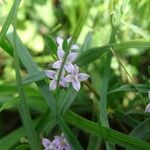
Oldenlandia corymbosa
انار · Flattop mille graines · Flat-Top Mille-Graines · Flat-top mille graines · Old World diamond flower
Description
Source: leafsnapOldenlandia corymbosa, commonly known as star grass or snake weed, is a perennial herbaceous plant belonging to the Rubiaceae family. It is native to tropical and subtropical regions of Asia, Africa, and Australia. The plant can grow up to 60 cm in height and features small white flowers that bloom in clusters at the ends of its branches. The leaves of Oldenlandia corymbosa are simple, opposite, and ovate-shaped with smooth margins. Its slender stem has a reddish-brown coloration, and the roots are shallow yet extensive. This plant has been used for medicinal purposes for centuries due to its anti-inflammatory properties. It serves as an herbal remedy for various ailments, including fever, coughs, asthma, and skin diseases. Oldenlandia corymbosa thrives in moist soils and can grow in full sun or partial shade, although it is drought-tolerant once established. It can be propagated by seeds or stem cuttings. Overall, Oldenlandia corymbosa is an attractive ornamental plant that also provides medicinal benefits, making it a popular choice among gardeners who value both aesthetics and functionality in their gardens.
🌳 Although flat-top mille graines isn't commonly recognized for uses beyond its traditional applications, it might have unexplored potential as a source of natural dyes. Plant extracts are frequently evaluated for their colorant properties, and flat-top mille graines could be a candidate for further study in developing sustainable, eco-friendly pigments.
Care Guide
💧 Water Every 7 days
The flat-top mille graines plant flourishes in consistently moist environments and benefits from weekly watering to mimic its tropical habitat. It thrives in high humidity, making outdoor cultivation ideal, particularly when there is rainfall during its active growing season. This promotes robust health and vigorous growth.
What should I do if I give too much or too little water to my Flat-top mille graines plant?
Proper watering is crucial for the health of your Flat-top mille graines. Overwatering is a more common issue, causing wilted and yellow leaves, as well as diseases like root rot, mold, and mildew. Underwatering is less common, but can result in brittle, brown leaves. It's important to identify signs of overwatering early and adjust your watering schedule accordingly. If the soil drains poorly, replace it with a well-draining mix. If your plant lacks water, increase your watering frequency until the signs improve.
How often do I need to water my Flat-top mille graines plant?
If your plant is in a pot, the most precise way to determine if your Flat-top mille graines needs water is by checking the soil moisture. Inserting your finger into the soil and feeling the first two to three inches will indicate if it has dried out. If it has dried, it's time to water. If you have your Flat-top mille graines planted outdoors in the ground, you can use a similar method to assess the soil moisture. Again, if the first few inches of soil feel dry, it is time to water. Typically, during spring and early fall, watering once a week using this method is sufficient. However, in extremely hot weather, you may need to increase the frequency to twice a week or more. Nevertheless, mature and well-established Flat-top mille graines plants have shown the ability to withstand drought.
How much water does my Flat-top mille graines plant need?
To water your Flat-top mille graines effectively, it is important to be generous with the amount of water you use. Wait until the top two to three inches of soil are dry, and then give the plant a thorough watering. Make sure to soak the soil completely, allowing the water to flow through the drainage holes at the bottom of the pot. If you notice that excess water is not draining from the pot, it means you have not given enough water. However, be cautious not to let water accumulate in the soil, as this can be harmful to the plant. At the same time, if water does not drain properly, it may indicate that the soil is not providing adequate drainage, which can be detrimental to the health of the plant. If the plant is located outside, one inch of rainfall per week should be enough.
How should I water my Flat-top mille graines plant as it grows?
The water needs of the Flat-top mille graines can vary depending on its growth stages. For example, when your Flat-top mille graines is in the early years of its life or when it has just been transplanted, it will require more water than usual. During these stages, the plant focuses on developing new roots that will support future growth. To help these roots perform well, they need slightly more moisture. As the plant matures over a few seasons, it will require less water. Additionally, during the bloom period, the plant may need more water as flower development utilizes a significant amount of moisture.
How do I water my Flat-top mille graines during different seasons?
The Flat-top mille graines plant has different water needs depending on the season. In the summer, when it's hottest, you may need to water it more than once a week if the soil dries out quickly. On the other hand, during the winter, the plant goes into a dormant phase and requires much less water. In fact, you may not need to water it at all during the winter months. However, if you choose to water it in winter, do so no more than once a month to avoid the risk of disease.
☀️ Light Full sun
Flat-top mille graines is a sun-loving, perennial herbaceous plant native to open habitats and commonly found in meadows and grasslands. It prefers full sun but can also tolerate partial sun conditions.
What are the sunlight requirements for Flat-top mille graines?
Flat-top mille graines, also known as Oldenlandia corymbosa, thrives best in full sunlight, which means it requires more than 6 hours of sunlight daily. However, it can also tolerate partial sun conditions, needing about 3-6 hours of sunlight. When planning where to place your plant, it's crucial to observe how sunlight moves through your garden or home to ensure that your Flat-top mille graines gets the adequate balance of light and shade it needs for optimal growth.
What should I know about artificial lighting for Flat-top mille graines?
For indoor Flat-top mille graines plants or in scenarios where natural sunlight is insufficient, especially during winter or in less sunny spaces, artificial lighting can be a vital solution for promoting healthier growth. LED lights are recommended due to their ability to provide specific wavelengths needed by the plant. Full sun plants require 30-50W/sq ft, partial sun plants 20-30W/sq ft, and full shade plants 10-20W/sq ft of artificial light. The light source should be placed 12-36 inches above the plant, simulating natural sunlight as closely as possible, with most plants benefiting from 8-12 hours of light per day.
What are the symptoms of inadequate lighting for Flat-top mille graines?
Flat-top mille graines may exhibit several symptoms when exposed to inadequate lighting, including smaller new leaves, leggy or sparse growth, faster leaf drop, slower or halted growth, and lighter-colored new leaves. Additional symptoms like chlorosis, sunscald, leaf curling, wilting, and leaf scorching can also occur, each indicating various stresses related to sunlight exposure. These signs help in diagnosing whether the plant is receiving too much or too little light.
How can I address sunlight-related issues for Flat-top mille graines?
To address sunlight-related issues for Flat-top mille graines, consider the following solutions: For indoor plants, gradually move them to sunnier spots to achieve at least 6 hours of direct sunlight daily, or use artificial lighting such as desk or ceiling lamps for at least 8 hours a day. For outdoor plants, gradually acclimate them to brighter conditions by moving them to sunnier locations weekly, avoiding sudden changes to prevent sunburn. Furthermore, to maximize sunlight for ground-planted specimens, reduce obstructions by pruning blocking trees or transplant smaller plants during their dormant period to a location with better sunlight and drainage. Note that parts of the plant affected by prior inadequate sunlight may not recover, but new growth should be healthy with improved light conditions.
🌡️ Temperature 20–37.8°C
Flat-top mille graines comes from tropical areas, where conditions are usually warm and humid. Consequently, it is suited to high heat and humidity. It is sensitive to abrupt temperature changes and prefers a constant thermal environment, so avoiding indoor temperature swings is important. It typically does not tolerate cold and needs warmer conditions to grow. If the surrounding temperature falls too low, the plant may stop growing or even die.
What is Flat-top mille graines?
Flat-top mille graines, scientifically known as Oldenlandia corymbosa, is a plant species recognized by its unique botanical name. There isn't provided information on its essentials, such as general descriptions or care instructions, nor are there details on symptoms related to this plant, whether in terms of health, care, or common issues.
💨 Humidity
🪴 Soil 6-7
🌱 Fertilizer
Flat-top mille graines needs the most fertilizer during its active growth period, which occurs mainly in spring, summer, and early fall. Fertilizing supplies essential nutrients the soil may lack, encouraging healthy root and stem development and the attractive foliage that is a key feature of this plant.
🪴 Pot & Repot
✂️ Pruning
🌿 Propagating
🐛 Diseases & pets
☠️ Toxicity
Characteristics
- Plant Type
- Herb
- Life Cycle
- Perennial, Annual
- Genus
- Oldenlandia
- Family
- Rubiaceae
- Hardiness Zone
- 9-10
- Mature Height
- 30 cm to 40 cm
- Mature Spread
- 15 cm to 25 cm
- Leaf Color
- Green
- Leaf Type
- Evergreen
- Flower Color
- White
- Flower Size
- 2.03 cm
- Bloom Time
- Late spring, Early summer, Mid summer
- Planting Time
- Spring, Summer, Autumn
- Harvest Time
- Summer
- Native Area
- Burkina Faso, Libya, Somalia, Egypt, India, Angola, Madagascar, Rwanda, Eritrea, Nigeria, Yemen, Kenya, Uganda, Tanzania, Zimbabwe, Guinea-Bissau, Mali, Benin, Sierra Leone, Cameroon, Liberia, Mozambique, Venezuela, Burundi, Oman, Ghana, Ethiopia, Botswana, Congo, Nepal, Saudi Arabia, Malawi, Central African Republic, South Africa, Zambia, Sudan, Guinea, Chad, Lebanon, China, Syria, Togo, Senegal, Eswatini, Côte d'Ivoire, Gambia, Congo (DRC), Gabon