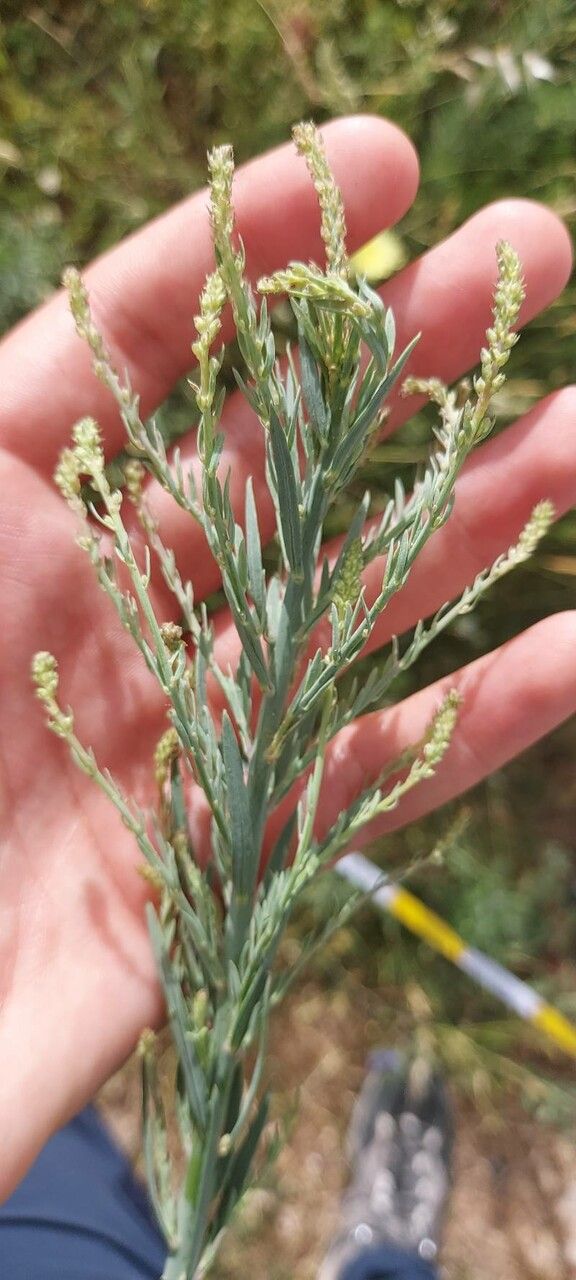
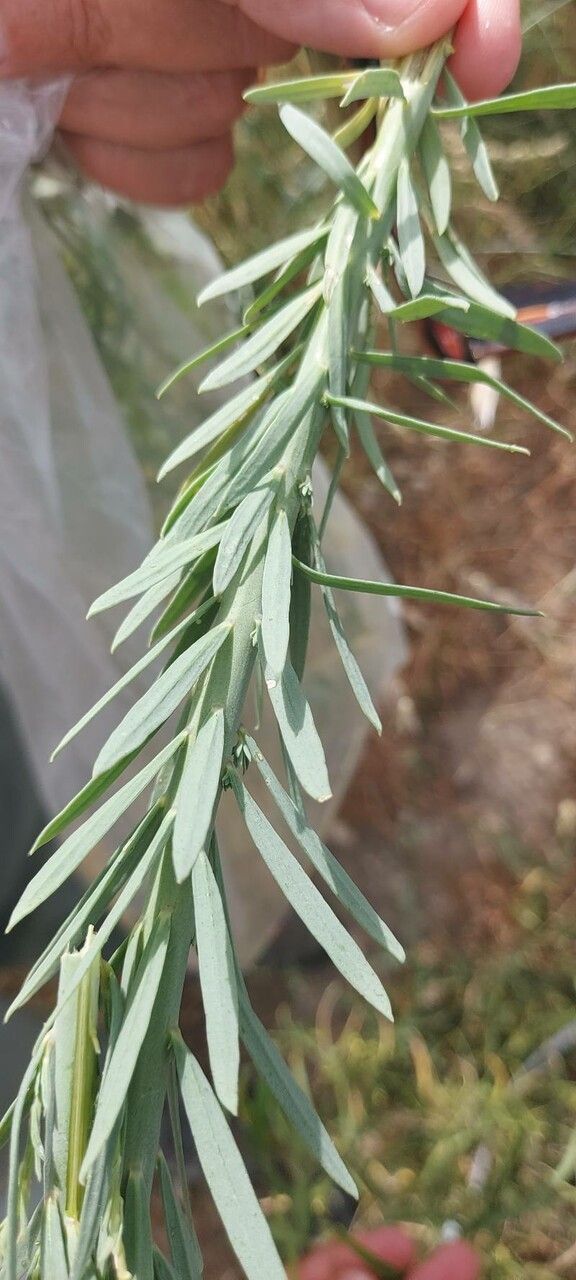
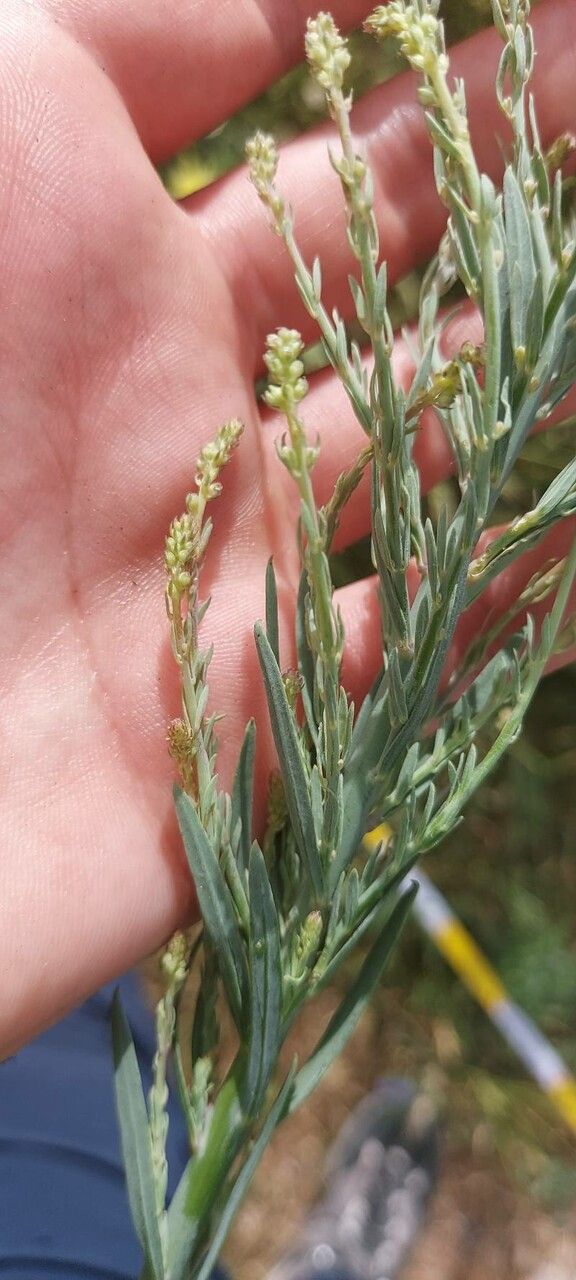
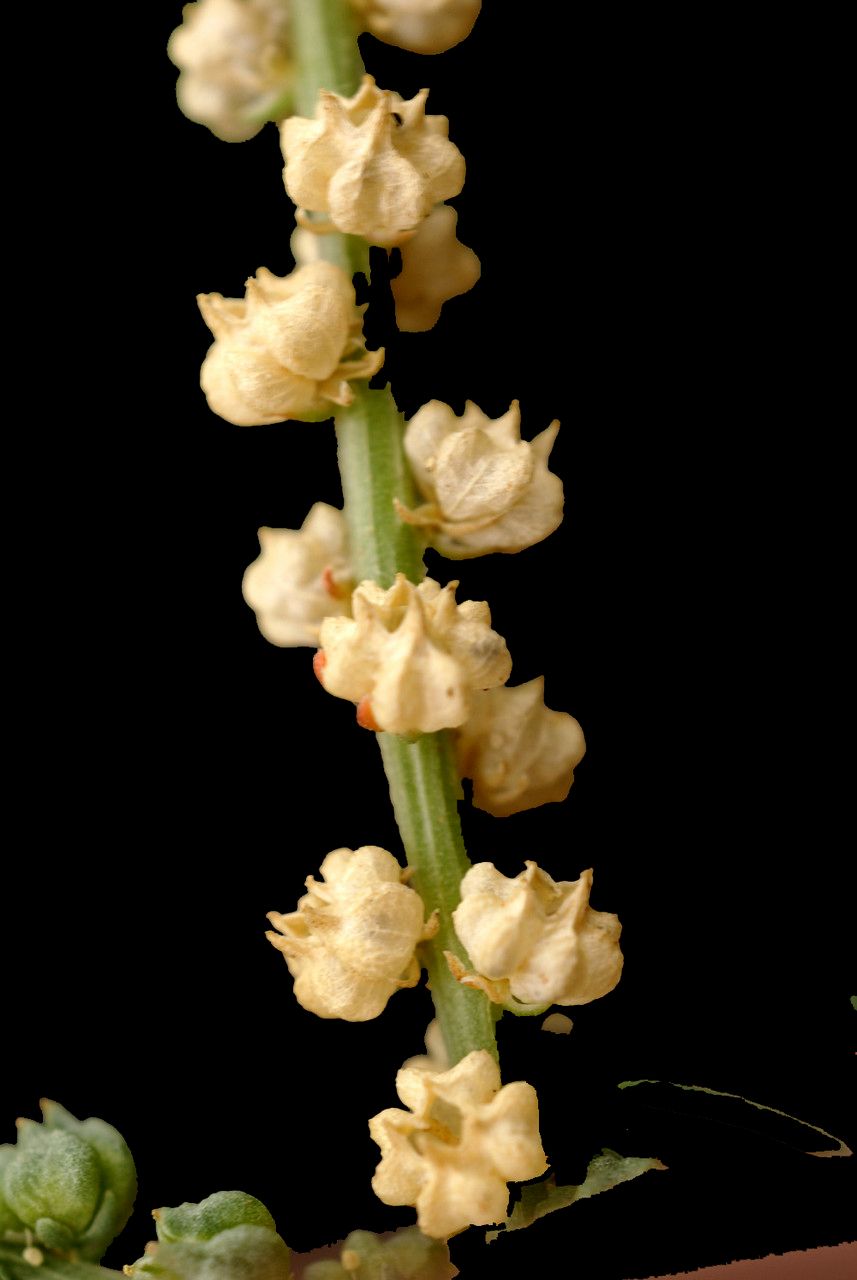
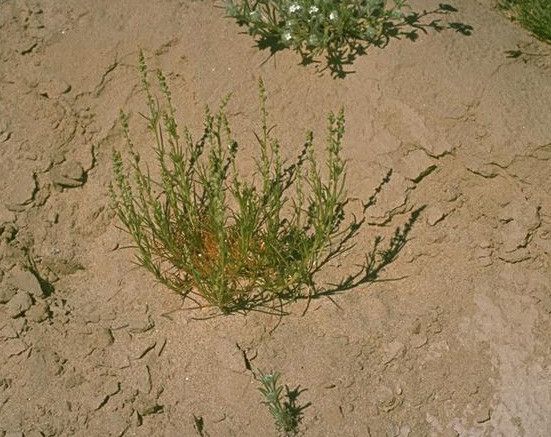
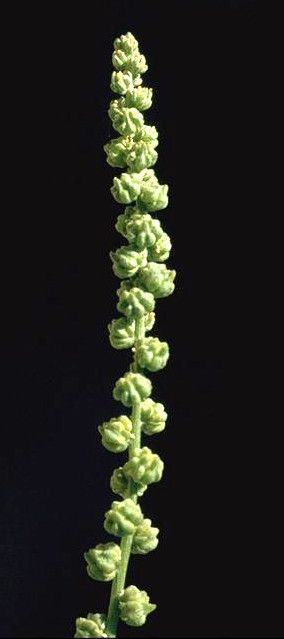
Oligomeris linifolia is a species of flowering plant in the small family Resedaceae known by the common name lineleaf whitepuff. It is native to parts of the Middle East and the Indian subcontinent, as well as southern Europe and North Africa, and the southwestern United States and northern Mexico. It grows in many types of habitat, including disturbed areas and saline soils, in deserts, plains, coastline, and other places. It is a fleshy annual plant, producing several erect, ribbed stems 35 to 45 centimeters in maximum height. The linear or widely lance-shaped leaves are narrow, up to 4.5 centimeters long but only a few millimeters side. The flowers occur in long, erect spikes. Each flower is a rounded, lobed, pocket-like structure with 4 curving sepals and usually two whitish petals which may be partially fused together. The fruit is a capsule a few millimeters long containing tiny shiny black seeds.
Lineleaf whitepuff is fairly resistant to disease and typically not prone to illnesses. Still, it can be vulnerable to pests and diseases present in its surroundings. Such infections are generally mild. Regarding care, this plant needs a moderate level of maintenance. It should be pruned regularly to preserve a good appearance and healthy growth. Fertilizing can also encourage flowering. Lineleaf whitepuff is suitable for anyone with outdoor space, like a garden or patio, and does not demand extensive care experience. It may require more attention when kept indoors.
How to keep Oligomeris Linifolia.
Light
Lineleaf whitepuff comes from sunny, open habitats where it prospers in full sun. It will tolerate some shade but favors direct sunlight for best growth. This plant, which can be annual or biennial, is recognized for its preference for sun.
Water
The Lineleaf Whitepuff is a plant native to arid regions that thrives with minimal moisture, demonstrating strong drought tolerance. It needs occasional watering, about once a week. Mostly grown outdoors, the Lineleaf Whitepuff is perfect for xeriscaping because of its efficient water use during growth cycles.
Temperature
Lineleaf whitepuff is fairly adaptable to temperature, able to endure higher heat and considerable temperature swings. In hot weather, attention should be paid to watering and providing adequate shade to avoid sunburn. On the other hand, Lineleaf whitepuff is relatively sensitive to low temperatures. It can tolerate some cold, but very cold conditions can cause frost damage.
Fertilizer
Lineleaf whitepuff benefits from regular, dilute fertilizer applications to encourage healthy leaf development. You should fertilize Lineleaf whitepuff about once a month during the summer months. Nitrogen is essential for foliage, and supplying nitrogen-rich sources helps Lineleaf whitepuff thrive.
Pruning
The Lineleaf Whitepuff is known for its delicate white-puff flowers and slender leaves. To promote healthy growth and abundant flowering, it's best to prune the plant from early to late spring. This helps remove dead stems and improve air circulation and sunlight exposure. Always use sharp tools to prevent disease, and avoid cutting back too much. Regular, light pruning is ideal for maintaining the plant's health.
Botanical profile.
- Plant Type
- Herb
- Life Cycle
- Annual
- Genus
- Oligomeris
- Family
- Resedaceae
- Hardiness Zone
- 8-11
- Mature Height
- 34 cm to 46 cm
- Mature Spread
- 15 cm to 25 cm
- Leaf Color
- Light Green
- Leaf Type
- Semi-evergreen
- Flower Color
- White
- Flower Size
- 0.10 cm to 0.20 cm
- Bloom Time
- Spring, Summer
- Planting Time
- Spring, Summer
- Harvest Time
- Late spring, Summer, Early fall, Mid fall
- Native Area
- Saudi Arabia, Libya, Somalia, Egypt, India, Tunisia, United Arab Emirates, Mexico, Mauritania, Pakistan, Morocco, Yemen, Chad, China, Iraq, Oman, Iran, Kuwait, Algeria, Qatar
Other names.
Reader questions.
What are the sunlight requirements for Lineleaf whitepuff?
Lineleaf whitepuff thrives in bright, open environments and requires full sun, which means it needs above 6 hours of sunlight daily for optimal growth. It can tolerate partial sun, about 3-6 hours of sunlight, but prefers conditions of direct sunlight to flourish. Observing how sunlight moves through your garden is essential for choosing the best spots for your plants, ensuring a balance of light and shade that promotes their well-being.
How does artificial lighting support the growth of indoor Lineleaf whitepuff plants?
For indoor Lineleaf whitepuff plants, when natural sunlight is insufficient, especially during winter or in less sunny locations, artificial lighting becomes crucial. Adequate lighting is vital for optimal growth, with LED lights recommended due to their capability to provide specific light wavelengths needed by plants. Full sun plants require 30-50W/sq ft, partial sun plants need 20-30W/sq ft, and full shade plants need 10-20W/sq ft of artificial light. The light source should be placed 12-36 inches above the plant and kept on for 8-12 hours per day to mimic natural sunlight conditions.
What are symptoms of insufficient light in Lineleaf whitepuff and how to address them?
Lineleaf whitepuff may exhibit various symptoms when exposed to inadequate light, such as smaller new leaves, leggy or sparse growth, faster leaf drop, slower or no new growth, lighter-colored new leaves, chlorosis, sunscald, leaf curling, wilting, and leaf scorching. To address these, for indoor care, gradually move plants to a sunnier spot each week until they receive at least 6 hours of direct sunlight daily, or use artificial light for at least 8 hours daily. Outdoors, slowly migrate plants to sunnier locations to prevent sunburn. If obstructions block sunlight, consider pruning or transplanting to more suitable locations. Unfortunately, parts of the plant that suffered from low light might not recover, but new growth will be healthy with improved light access.