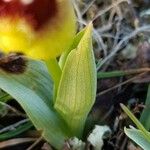
Ophrys tenthredinifera
Sawfly Orchid
Description
Source: leafsnapOphrys tenthredinifera, the sawfly orchid, is a terrestrial species of orchid native to the Mediterranean region from Portugal and Morocco to Turkey. The common name refers to a purported resemblance between the flower and the sawfly, a wasp-like insect. Many subspecies, varieties and forms have been proposed, but as of May 2014, none are recognized.
Care Guide
💧 Water
The Sawfly Orchid thrives in Mediterranean climates, where it has adapted to seasonal rainfall. This plant is drought-tolerant but benefits from weekly watering to sustain moisture levels. It can be grown both indoors and outdoors; however, outdoor conditions usually lead to more abundant flowering thanks to the higher humidity.
How should I water my Sawfly orchid?
The watering needs of the Sawfly orchid depend on its growth phase and the weather conditions. During active growth, you should water the soil and occasionally sprinkle water on the plant's leaves if it is warm. However, in winter or when the weather is cool or wet, stick to watering the soil only. You can tell if the orchid needs more water by checking if its roots and leaves are dry or discolored. Overwatered orchids will appear mushy and limp. To grow a Sawfly orchid, use a pot with good drainage and a potting mix that drains well. During the growing season, water the plant several times a week, ensuring the water drains quickly. The frequency of watering depends on the pot size, with larger pots needing less frequent watering. Use rainwater or distilled water that matches the air temperature as closely as possible.
What should I do if I give too much or too little water to my Sawfly orchid?
To prevent killing your Sawfly orchid, it's important to avoid keeping it in overly moist soil for too long. Although these plants need frequent watering during active growth, they also require well-draining soil. Overwatering can lead to the plant becoming mushy and developing root rot. In such cases, it's recommended to use sterile pruning shears to remove any rotted roots, followed by repotting the orchid in a container with good drainage and a fast-draining potting mix. However, excessive repotting can adversely affect the orchid, so finding the right watering rate is crucial. If the orchid starts to shrivel and feels dry to the touch, it is likely being underwatered. In this case, increasing the watering frequency is necessary to prevent the soil from drying out too quickly.
How often do I need to water my Sawfly orchid?
To properly care for your Sawfly orchid, here are some guidelines for watering throughout the year. During the active growth stage in spring and summer, water your orchid about once or twice per week. If the weather gets hot and dry, increase the watering frequency to three times per week or more. In winter, you still need to water your orchid, but not as frequently. Aim for two to three waterings per month to keep it alive during the coldest months. However, if you keep your orchid indoors during winter, be aware that indoor locations can cause the soil to dry faster, so you may need to water more frequently. Use autumn as a transition period to gradually reduce watering from the summer rate to your reduced winter schedule.
What do I need to think about when watering my Sawfly orchid in different seasons and growth times?
When planning the watering schedule for your Sawfly orchid, it is important to consider two growth phases. The first phase is the active growth period which occurs in spring and summer. During this time, the plant should be watered multiple times per week. The second phase is the rest period which occurs in winter for about two to three months. During this period, the orchid requires less water and fertilization. It is advisable to water the plant once or twice per month during this time. In the fall, you should gradually reduce the frequency of watering from multiple times per week to once or twice per month to align with the appropriate winter watering rate.
If I grow my Sawfly orchid indoors, how should I water it in a different way?
The Sawfly orchid needs a relatively humid environment to thrive. Unfortunately, indoor growing locations usually have less air moisture, causing the plant and its soil to dry out quickly. To counter this, consider using a humidifier in the room where you grow your Sawfly orchid. You may also need to water it more often. However, remember that adequate air circulation is also necessary to prevent excessive moisture and diseases. To ensure proper air circulation, think about including a fan in the room where you grow this plant.
☀️ Light Partial sun
Sawfly orchid occurs naturally in habitats like forest understories and rocky sites, where it grows in natural shade. It prefers partial sun but can tolerate full sun or full shade, showing its versatile, hardy character.
🌡️ Temperature 15–35°C
The Sawfly orchid can adapt to a wide range of temperatures, yet its distribution may still be limited by particular combinations of moisture and heat. It does best in warm summer climates with sufficient rainfall or watering. Extended periods of cloudy, rainy weather or prolonged high temperatures raise the chances of the Sawfly orchid dying. In winter, proper protection from cold can increase the plant’s survival rate.
💨 Humidity
🪴 Soil 6-7
🌱 Fertilizer
The best time to fertilize a Sawfly orchid is in early spring, as it comes out of dormancy and begins active growth. Fertilization supplies essential nutrients for healthy development. Although the Sawfly orchid has relatively low fertilizer requirements, feeding it once a year can boost its survival and encourage better, longer-lasting flowers.
🪴 Pot & Repot
✂️ Pruning
The Sawfly Orchid has vibrant flowers that attract bees and requires minimal pruning. You should prune them from early to late spring, right after they finish blooming. Focus on removing any dead or damaged foliage during this time, as it promotes healthy growth and flowering. Be careful not to over-prune, as this can disrupt the plant's natural growth cycle.
🌿 Propagating
🐛 Diseases & pets
☠️ Toxicity
Characteristics
- Plant Type
- Herb
- Life Cycle
- Perennial
- Genus
- Ophrys
- Family
- Orchidaceae
- Hardiness Zone
- 7-10
- Mature Height
- 49 cm
- Mature Spread
- 10 cm to 20 cm
- Leaf Color
- Green, Dark Green
- Leaf Type
- Deciduous
- Flower Color
- Pink, Brown
- Flower Size
- 0.51 cm to 4.06 cm
- Bloom Time
- Early spring, Mid spring
- Planting Time
- Spring
- Harvest Time
- Late spring, Early summer
- Native Area
- Turkey, Tunisia, Italy, Portugal, Spain, Cyprus, Algeria, Greece, Croatia, Morocco, France