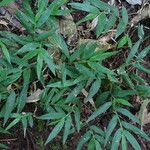
Oplismenus compositus
Running Mountaingrass · Running mountain basketgrass · Running mountain grass · Armgrass
Description
Source: leafsnapOplismenus compositus, commonly known as basket grass or composite fingergrass, is a perennial grass species that belongs to the Poaceae family. Native to the southeastern United States, this plant thrives in wetlands, marshes, and along stream banks. The plant exhibits a clumping growth habit, with stems that can reach up to 3 feet in height. Its leaves are narrow and pointed, showcasing a bright green color that transforms to reddish-brown as they mature. The inflorescence of Oplismenus compositus comprises small spikelets, which are arranged in clusters at the ends of the stems. Basket grass plays a crucial role in wetland ecosystems by providing habitat for various wildlife species, including birds and small mammals. Additionally, it helps in preventing soil erosion by stabilizing stream banks. Beyond its ecological significance, Oplismenus compositus is also valued in traditional medicine. Practitioners have attributed medicinal properties to the plant, using it to treat ailments such as fever and diarrhea. In summary, Oplismenus compositus is an important plant species with both ecological and potential medicinal value, warranting further research into its properties.
Care Guide
💧 Water Every 7 days
Running mountain grass flourishes in areas with consistent rainfall and high humidity. For optimal growth, it should be watered moderately, ideally once a week. This grass thrives in outdoor, humid environments and benefits greatly from regular rainfall.
☀️ Light Partial sun
Running mountaingrass occurs naturally in habitats like forest understories and rocky sites, where it is subject to natural shade. It prefers partial sun but can tolerate both full sun and full shade, highlighting its adaptable, hardy nature.
How much sunlight does Running mountaingrass need?
Running mountaingrass prefers partial sun, requiring about 3-6 hours of sunlight per day. This versatile perennial herbaceous plant originates from environments such as forest understories or rocky areas, where it experiences natural shade. Despite its preference for partial sun, Running mountaingrass can also tolerate full shade, making it adaptable to various lighting conditions. It's important to observe how sunlight moves through your garden to choose spots that offer a good balance of light and shade, ensuring the plant's overall health and happiness.
What are the artificial lighting requirements for indoor Running mountaingrass?
When natural sunlight is insufficient, especially during winter or in areas receiving less sunlight, artificial lighting becomes crucial for the growth of indoor Running mountaingrass. LED lights are recommended due to their ability to be customized to provide specific wavelengths needed by plants. Full sun plants require 30-50 watts per square foot, partial sun plants need 20-30 watts per square foot, and full shade plants should have 10-20 watts per square foot of artificial light. The light source should be placed 12-36 inches above the plant to simulate natural sunlight, with the duration mimicking natural daylight hours, generally between 8-12 hours per day.
What are some common symptoms of insufficient light for Running mountaingrass, and how can they be addressed?
Running mountaingrass may exhibit symptoms of light deficiency such as smaller new leaves, leggy or sparse growth, faster leaf drop, slower or halted growth, lighter-colored new leaves, chlorosis, sunscald, leaf curling, wilting, and leaf scorching. To address insufficient light indoors, consider shifting plants to sunnier spots progressively each week or use artificial lighting like desk or ceiling lamps and professional grow lights for at least 8 hours daily. Outdoors, gradually move plants to areas with better sunlight exposure. Also, reducing obstructions like pruning trees can help. Transplanting to sunnier spots is another solution, particularly during the plant's dormant periods.
What are the special care instructions for Running mountaingrass regarding sunlight exposure?
Careful attention to sunlight exposure is crucial for the health of Running mountaingrass. When adjusting the plant to different light conditions, make the transition gradual to prevent stress or sunburn. Indoor plants requiring more light can benefit from being moved closer to windows or supplemented with artificial grow lights, ensuring they receive the recommended 3-6 hours of direct sunlight daily. For outdoor plants, finding the ideal spot with sufficient sunlight, yet avoiding drastic changes in light exposure, is key. Though parts affected by insufficient sunlight might not recover, new growth should be healthy with proper light adjustment.
🌡️ Temperature 20–37.8°C
Running mountaingrass comes from tropical areas, where the climate is usually warm and humid. Consequently, it is well adapted to high heat and humidity. It is not tolerant of sudden temperature changes and prefers a steady thermal environment, so avoiding indoor temperature swings is important. It generally does not endure cold and needs warmer conditions to grow. If the surrounding temperature becomes too low, the plant may stop growing or even die.
💨 Humidity
🪴 Soil 6-7
🌱 Fertilizer
Running mountaingrass needs extra nutrients to encourage healthy new growth. In spring, placing compost around the base of the plant will effectively supply the nutrition it requires. Fertilizing helps support vigorous growth and enables the plant to resist diseases and pests.
🪴 Pot & Repot
✂️ Pruning
Running mountaingrass benefits from early spring pruning, which promotes healthy growth. To maintain its vigor and control its spread, remove any damaged foliage. Regular maintenance not only enhances the plant's aesthetic appeal but also supports its natural growth cycle, encouraging robust development in its environment.
🌿 Propagating
🐛 Diseases & pets
☠️ Toxicity
Characteristics
- Plant Type
- Grass
- Life Cycle
- Perennial
- Genus
- Oplismenus
- Family
- Poaceae
- Hardiness Zone
- 9-11
- Mature Height
- 0.15 m to 1.52 m
- Mature Spread
- 30 cm to 49 cm
- Leaf Color
- Green, Dark Green
- Leaf Type
- Evergreen
- Flower Color
- Yellow, Green, Red
- Flower Size
- 0.20 cm to 0.25 cm
- Bloom Time
- Summer, Early fall, Mid fall
- Planting Time
- Spring, Summer, Autumn, Winter
- Harvest Time
- Late summer, Fall, Early winter
- Native Area
- Sri Lanka, India, Malaysia, Mexico, Guatemala, Madagascar, Eritrea, Pakistan, Yemen, Kenya, Uganda, Tanzania, Zimbabwe, Indonesia, Cambodia, Mozambique, Ethiopia, South Korea, Nepal, Malawi, Honduras, Peru, Philippines, Zambia, Sudan, Bangladesh, Laos, Panama, China, Colombia, Myanmar, Japan, El Salvador, Bhutan, Iran, Ecuador, Azerbaijan, Costa Rica, Thailand