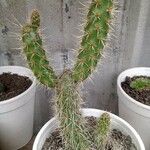
Opuntia pycnantha
Care Guide
💧 Water Every 3 weeks
The Pycnantha cactus thrives in arid environments, expertly storing water and withstanding drought. It only requires watering every three weeks. Its blooming depends on the infrequent rainfall, demonstrating its xerophytic adaptation characteristic of desert climates.
☀️ Light Full sun
The pycnantha cactus is native to habitats where sunlight is typically mostly unfiltered and it prefers very high exposure to solar energy. Reduced light levels can impede healthy growth. It tolerates excessive radiation without harm. No distinct requirements for different growth stages have been documented.
What are the sunlight requirements for a Pycnantha cactus?
A Pycnantha cactus requires more than 6 hours of sunlight daily to thrive. It's important to observe how sunlight moves through your garden to choose spots that provide a balance of light and shade, ensuring the plant's health. These cacti are adapted to environments with unfiltered sunlight, and although they can tolerate excessive radiation, limitations in light can hinder their growth. No specific light requirements change as the plant grows, but ensuring adequate exposure is crucial for its health.
How can artificial lighting be used for indoor Pycnantha cacti?
For indoor Pycnantha cacti, adequate lighting is essential, especially when natural sunlight is insufficient, like in winter or less sunny spaces. Artificial lighting, such as LED lights, can be customized to provide the wavelengths needed by the plants. Full sun plants require 30-50W/sq ft of artificial light, partial sun plants need 20-30W/sq ft, and full shade plants need 10-20W/sq ft. The light source should be placed 12-36 inches above the plant to mimic natural sunlight, and most plants need 8-12 hours of light per day.
What are the symptoms of insufficient light in Pycnantha cacti?
Symptoms of insufficient light in Pycnantha cacti include smaller new leaves, leggy or sparse growth, faster leaf drop, slower or no new growth, lighter-colored new leaves, and specific conditions like chlorosis, sunscald, leaf curling, wilting, and leaf scorching. These symptoms indicate that the plant is not receiving adequate light for photosynthesis and healthy growth.
What solutions can be applied for Pycnantha cacti struggling with insufficient light?
To combat insufficient light, gradually move plants to sunnier locations until they receive at least 6 hours of direct sunlight daily, using a south-facing window for indoor plants. Consider artificial lighting for plants that are large or not easily movable, keeping lamps on for at least 8 hours daily. Outdoor plants should also be moved gradually to avoid sunburn. If needed, reduce obstructions like trees by pruning, and consider transplanting smaller plants to sunnier locations with good drainage during their dormant periods.
🌡️ Temperature 20–37.8°C
The Pycnantha cactus originates from temperate regions where mean temperatures generally fall between 68 and 100 °F (20 and 38 °C). It favors that range of heat consistently, and any seasonal temperature changes should be handled with care when necessary.
What is the native climate of the Pycnantha cactus?
The Pycnantha cactus is native to temperate climates where the average temperatures typically range from 68 to 100 °F (20 to 38 °C). Such climates are ideal for the cactus, as they offer the warm conditions that it thrives in. Maintaining these temperature ranges is crucial for the health and growth of the Pycnantha cactus, necessitating seasonal temperature adjustments as needed.
How should Pycnantha cactus be cared for in winter?
During winter, when the outdoor temperature drops below 0°C, it's essential to move the Pycnantha cactus indoors to protect it from the cold. The ideal indoor location is near a south-facing window to maximize sunlight exposure. If natural light is insufficient, supplemental lighting should be considered. Additionally, the plant's growth slows when temperatures fall below 20°C, prompting a reduction or complete stop in watering to prevent root rot. For those grown outdoors, watering should be halted in low temperatures. To further protect the cactus, consider setting up a temporary greenhouse or wrapping the plant with plastic film or fabric for insulation against the cold.
What are the symptoms and solutions for Pycnantha cactus in low temperature conditions?
Pycnantha cactus does not tolerate low temperatures well and prefers environments above 20°C. Exposure to temperatures below 0°C can weaken the plant, leading to wilting and a higher risk of root rot, especially if temperatures fall below -5°C. Initial symptoms may not be immediately apparent, but the plant might gradually wither a week after experiencing mild frost damage. The solution involves trimming the frostbitten areas, checking for and removing rotted roots, then propagating through cuttings if necessary. Moving the plant to a warmer setting indoors near a south-facing window can ensure it receives enough sunlight. Supplemental lighting can be used if natural light is inadequate.
How should Pycnantha cactus be cared for in high temperature conditions?
In the summer, it's critical to ensure the Pycnantha cactus does not encounter temperatures above 38°C. Exceeding 43°C will halt its growth, leading to water loss, wilting, and an increased risk of sunburn. To manage this, remove any sunburned or rotten parts of the plant immediately. Shielding the plant from the harsh afternoon sunlight until it recovers and resumes growth is also advisable. In cases where the plant suffers from root rot, watering should be ceased until new growth is evident.
💨 Humidity
🪴 Soil 6-7
🌱 Fertilizer
For Pycnantha cactus, small amounts of fertilizer applied once or twice a year during the growing season are enough. Do not fertilize in winter or in summer while the plant is dormant. Reduce fertilizer for repotted plants and wait a couple of months after repotting before applying it. Fertilizing supports healthy growth and encourages blooms.
🪴 Pot & Repot
✂️ Pruning
The Pycnantha cactus requires minimal pruning. To help the plant direct nutrients towards healthy growth, regularly remove any withered flowers and branches.
🌿 Propagating
🐛 Diseases & pets
☠️ Toxicity
Characteristics
- Plant Type
- Succulent
- Life Cycle
- Perennial
- Genus
- Opuntia
- Family
- Cactaceae
- Hardiness Zone
- 9-11
- Mature Height
- 46 cm
- Mature Spread
- 46 cm
- Leaf Color
- Green
- Leaf Type
- Evergreen
- Flower Color
- Yellow, Green
- Flower Size
- 6.35 cm to 10.16 cm
- Bloom Time
- Early summer, Mid summer
- Planting Time
- Spring, Summer
- Harvest Time
- Late summer, Early fall, Mid fall
- Native Area
- Mexico