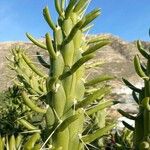
Opuntia subulata
Eve's needle · Eve's pin · Long-spine cactus · Cane cholla · Eve's pin cactus
Description
Source: leafsnapOpuntia subulata, commonly called the cane cholla or tree cholla, is a cactus species native to the southwestern United States and northern Mexico. This shrub-like plant can grow up to 10 feet tall and 6 feet wide. Its cylindrical, segmented stems feature spines that can reach lengths of up to 2 inches. The cactus produces yellow or orange flowers that bloom in late spring or early summer. Adapted to arid environments with low rainfall and high temperatures, the Opuntia subulata has developed several water-conservation mechanisms, such as storing water in its stems for extended periods. Indigenous peoples have utilized Opuntia subulata for centuries for food, medicine, and as a building material. Its fruit, known as tunas, are edible when ripe but must be harvested carefully due to their protective spines. Beyond its cultural importance, Opuntia subulata also serves a significant ecological role by providing habitat for various wildlife, including birds and insects. Overall, Opuntia subulata is a fascinating plant with unique adaptations that enable it to thrive in harsh environments while offering valuable resources to both humans and wildlife.
🌳 Eve's needle cactus does more than merely survive harsh conditions; it also hosts cochineal bugs. These tiny insects extract carminic acid, which is later converted into a red dye used in foods, makeup, and in protecting art.
Care Guide
💧 Water Every 7 days
☀️ Light Full sun
To thrive, eve's needle cactus requires ample sunlight during the day, though it can tolerate limited light. Native to sun-drenched habitats, it is adaptable. Both excessive and insufficient sunlight can impair its health and negatively affect the plant.
🌡️ Temperature 20–37.8°C
The natural habitat of eve's needle cactus shows it prefers temperatures from 20 to 38 ℃ (68 to 100 ℉). Its temperature needs are on the relatively warm to hot side and it must be protected from frost temperatures. In colder months, the plant is best kept indoors or placed in a sheltered spot.
💨 Humidity
🪴 Soil 6-7
🌱 Fertilizer
For Eve's needle cactus, light applications of fertilizer once or twice a year during the growing season are sufficient. Avoid fertilizing in winter and in summer when it's dormant. Reduce fertilizer for repotted plants and wait a couple of months after repotting before fertilizing. Fertilizing supports healthy growth and encourages blooms.
🪴 Pot & Repot 2-3 years
Repot Eve's needle cactus in spring or summer, selecting a pot slightly larger than the current one with good drainage. Use a sandy or gritty cactus mix that drains well. Handle it carefully to avoid its spikes. Allow the cactus to dry out before repotting to prevent root rot. After repotting, wait a week before watering so the roots can heal.
✂️ Pruning
Obtain a clean, sharp knife, and cut a few stems from the cactus' base. Make sure to spread out your desired number of cuts on a paper towel for a few days so they can begin to dry out. You can plant the cuttings in well-draining soil once they have dried up.
🌿 Propagating
🐛 Diseases & pets
☠️ Toxicity
Characteristics
- Plant Type
- Succulent, Shrub
- Life Cycle
- Perennial
- Genus
- Opuntia
- Family
- Cactaceae
- Hardiness Zone
- 9-12
- Mature Height
- 2.13 m to 3.96 m
- Mature Spread
- 91 cm
- Leaf Color
- Green
- Leaf Type
- Evergreen
- Flower Color
- Red, Pink
- Flower Size
- 10.16 cm
- Bloom Time
- Early summer, Mid summer
- Planting Time
- Spring, Summer, Autumn
- Harvest Time
- Mid summer
- Native Area
- Peru