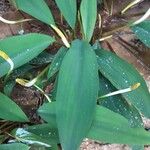
Orontium aquaticum
Golden-club · Floating arum
Description
Source: leafsnapOrontium aquaticum, commonly known as Golden Club, is an aquatic plant species that belongs to the Araceae family. Native to North America, it thrives in shallow waters of ponds, lakes, and slow-moving streams. The plant is easily recognizable by its bright yellow-green leaves, which grow in a spiral pattern around the stem and have long, narrow, and pointed tips. Golden Club blooms from May to July, producing small yellow flowers on a spike-like inflorescence at the top of the stem. These flowers are unisexual, lacking petals and sepals, but are distinguished by six stamens surrounding a central pistil. Historically, Native American tribes have utilized this plant for various medicinal purposes. It was used as an emetic to treat stomach ailments and as an antiseptic for wounds. Golden Club is also favored by aquarium enthusiasts for its unique appearance and ease of care in freshwater aquariums. Overall, Orontium aquaticum is an intriguing aquatic plant species known for its distinctive spiral-shaped leaves and small yellow flowers that bloom during the summer months.
Care Guide
💧 Water Every 7 days
Floating arum thrives in wet environments such as marshes and shallow waters, requiring consistent moisture for optimal growth. To mimic its natural habitat, it is best to water it weekly. As an aquatic plant, floating arum can also be grown in water-filled containers, making it a great addition to indoor water gardens.
How should I water my Floating arum plant to keep it healthy?
There are several ways to water your Floating arum plant. If you have it in a small pot indoors, you can take it to your kitchen sink and use the faucet to add water. As you hold the pot, you'll notice water flowing out of the drainage holes, indicating it's enough. Avoid doing this in cold weather as it can harm the roots. If your tap water has high levels of fluorine, chlorine, or salts, consider using rainwater or lake water instead. Alternatively, you can also water the plant from above or directly into the soil using a watering can, hose, or any other watering tool you prefer.
What should I do if I give my Floating arum plant too much or too little water?
If you find that your Floating arum is underwatered, your first step is to give it some water. Water it deeply until excess water runs from the drainage hole, or if it's outside, water it until the soil is completely moist. On the other hand, if your Floating arum is getting too much water, start by reducing your watering schedule. You should also consider the soil and container it's in. If the soil or container doesn't allow for efficient drainage, your plant will likely become overwatered again. To resolve this, move your plant to looser soil and/or a container with larger drainage holes or a more porous material. Additionally, check the location of your plant. If it's in a corner, it's recommended to move it to a window or near a door to improve ventilation. Ensuring your plants are in a well-ventilated location can help prevent overwatering to some extent.
How frequently should I give water to my Floating arum?
The Floating arum does not need constant soil moisture. It's actually better to let the soil dry out between waterings. If you're growing Floating arums in containers, you can tell when it's time to water by checking how dry the soil is. If about half of the soil in your container is dry, it's time to add water. You can check the soil by touching it with your fingers or a stick, or by using a soil moisture meter. For those growing Floating arums outside, you can plan to water them once every other week, as long as there hasn't been recent rainfall.
How much water does my Floating arum plant need?
To ensure the optimal watering of your Floating arum, follow these steps: 1. Wait for the top half of the soil around the plant's root to dry out. 2. Add water to make the soil moist again, but the quantity needed depends on factors like container size and plant size. 3. For small plants in small to medium-sized containers, one to two cups of water may be enough. 4. Larger plants will require a greater volume of water. 5. To confirm adequate watering, check the soil's moisture level by sticking your finger or a trowel into it. 6. Alternatively, water until you see excess water draining from the container's bottom holes.
How can I know if I'm giving enough water to my Floating arum?
Both overwatering and underwatering can be detrimental to the health of your Floating arum. However, these two problems can be identified through different signs. When your Floating arum doesn't receive enough water, its leaves may turn yellow. In addition, underwatering can cause the leaf edges to become brown and brittle. On the other hand, if you overwater your Floating arum, you may notice yellow and brown marks on the leaves simultaneously. Overwatering may also make the plant susceptible to diseases like root rot, which can be visible on the plant. Nonetheless, if you can recognize the signs of overwatering and underwatering, you have a good chance of remedying these issues.
☀️ Light Full sun
Floating arum performs best in full sunlight but can tolerate some shade. Its native habitat receives a substantial amount of sunlight. However, too much light can be damaging. Conversely, in shaded locations the plant’s growth may be limited.
What are the sunlight requirements for Floating Arum?
Floating Arum (Orontium aquaticum) thrives under full exposure to sunlight, necessitating above 6 hours of sunlight daily. It can, however, tolerate partial sun conditions, meaning it can grow in areas receiving about 3-6 hours of sunlight. The plant's originating habitat conditions involve significant sunlight exposure, although excessive light might be harmful, and too little can stunt growth. It's essential to watch how sunlight moves through your garden and choose spots that provide a balance of light and shade, ensuring your plants' optimum growth and happiness.
How to use artificial lighting for Floating Arum?
Indoor Floating Arum plants require adequate lighting for optimal growth, especially when natural sunlight is insufficient, such as in winter or less sunny spaces. Artificial lights, particularly LED lights, can be customized to provide the specific wavelengths of light that plants need, promoting faster, healthier growth. For full sun plants, 30-50W/sq ft of artificial light is needed; for partial sun plants, 20-30W/sq ft; and for full shade plants, 10-20W/sq ft. The light source should be placed 12-36 inches above the plant to mimic natural sunlight, and most plants will need 8-12 hours of light per day to mimic the length of natural daylight hours for your plant species.
What are common symptoms of light deficiency in Floating Arum?
Floating Arum can exhibit several symptoms if it is exposed to insufficient light, including smaller new leaves, leggy or sparse growth, faster leaf drop, slower or halted growth, lighter-colored new leaves, chlorosis, sunscald, leaf curling, wilting, and leaf scorching. These symptoms arise due to the plant's inability to photosynthesize efficiently, leading to reduced health and vigor. Chlorosis, for example, is a condition where leaves turn yellow due to the breakdown of chlorophyll from excessive sunlight, negatively affecting the plant's ability to photosynthesize.
How can I address insufficient sunlight for Floating Arum?
To address insufficient sunlight for Floating Arum, consider gradually moving your plants to sunnier locations to ensure they receive at least 6 hours of direct sunlight daily, particularly using a south-facing window. If moving the plant is not feasible, supplement with artificial lighting by keeping a desk or ceiling lamp on for at least 8 hours daily or investing in professional plant grow lights for ample light exposure. For outdoor plants, avoid sudden changes in light intensity to prevent sunburn. Pruning nearby trees to reduce obstructions or transplanting the plant during its dormant period can also help increase sunlight exposure. Remember, parts of the plant affected by insufficient sunlight may not recover, but new growth will be healthy with increased light exposure.
🌡️ Temperature 5–35°C
Floating arum is adapted to a temperate environment and tolerates temperatures from 41 to 95 °F (5 to 35 ℃). It adapts well to seasonal changes, but extreme heat or cold should be avoided to maintain continued growth.
What is the ideal temperature range for Floating arum?
Floating arum, also known by its botanical name Orontium aquaticum, is adapted to thrive in temperate environments. It prefers temperatures ranging from 41 to 95 °F (5 to 35 °C). While it adjusts well to seasonal changes, maintaining a consistent environment within this temperature range is crucial for its growth. Extremes of hot or cold beyond these limits should be avoided.
Does Floating arum need special frost protection during winter?
Floating arum boasts strong cold resistance, meaning special frost protection measures are not usually necessary during winter. However, in regions where winter temperatures are expected to plunge below -25°C, taking steps to protect the plant from cold is important. Protection can be provided by covering the plant with insulating materials such as soil or straw. Additionally, watering the plant abundantly before the first freeze in autumn helps keep the soil moist and prevents drought and water scarcity in the colder months.
How does Floating arum react to low temperatures?
Floating arum is a cold-tolerant plant, thriving best at temperatures above 5°C. During winter, it should be kept above -20°C to avoid damage. When temperatures fall below -25°C, there may not be visible signs of distress during winter; however, this could lead to decreased sprouting or a complete lack of sprouting in spring. To counteract any negative effects of low winter temperatures, removing non-sprouting parts in spring can help the plant recover.
What are the effects of high temperatures on Floating arum and how should it be cared for in such conditions?
In the summer, Floating arum should be protected from temperatures exceeding 35°C to prevent heat stress. Exposure to temperatures above 41°C can cause the leaves to lighten in color, curl, become prone to sunburn, and in severe cases, the plant may wilt and dry out. To ensure its wellbeing during hot weather, trim any sunburned or dried parts, move the plant to a shaded location or use a shade cloth to protect it from direct midday and afternoon sun. Additionally, watering the plant during cooler times of the day, such as morning and evening, helps keep the soil adequately moist.
💨 Humidity
🪴 Soil
🌱 Fertilizer
🪴 Pot & Repot
✂️ Pruning
To help floating arum thrive, prune it from early to late spring. Trim away dead foliage to promote growth and improve water flow, and regularly remove decayed leaves to prevent fungal growth. Be careful not to prune too much, as this can stress the plant. Aim to cut just above the water surface to enhance flowering and improve aesthetics.
🌿 Propagating
🐛 Diseases & pets
☠️ Toxicity
Characteristics
- Plant Type
- Herb
- Life Cycle
- Perennial
- Genus
- Orontium
- Family
- Araceae
- Hardiness Zone
- 5-10
- Mature Height
- 30 cm to 61 cm
- Mature Spread
- 76 cm
- Leaf Color
- Green, Blue, Silver, Gray
- Leaf Type
- Deciduous
- Flower Color
- Yellow, Gold
- Flower Size
- 2.54 cm to 7.62 cm
- Bloom Time
- Mid spring, Late spring
- Planting Time
- Spring, Summer
- Harvest Time
- Summer