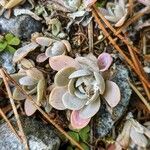
Orostachys iwarenge
Chinese Dunce Cap
Description
Source: leafsnapOrostachys iwarenge is a succulent plant belonging to the Crassulaceae family, native to Japan and Korea. Commonly known as the Chinese Dunce Cap or Japanese Dunce Cap, this plant features a rosette-like growth pattern with thick, fleshy leaves spirally arranged around its stem. The leaves are green with pointed tips and can grow up to 5 cm long and 1 cm wide. In late summer or early fall, the plant produces small white or pink flowers on tall stalks. Orostachys iwarenge thrives in well-draining soil with moderate moisture levels. It can tolerate full sun but also does well in partial shade. This hardy plant can withstand temperatures as low as -20°C. In addition to its aesthetic appeal, Orostachys iwarenge has medicinal properties. It exhibits anti-inflammatory effects, making it useful for treating skin conditions such as eczema and psoriasis. Overall, Orostachys iwarenge is an attractive succulent with unique growth habits, making it an excellent addition to any garden or indoor plant collection.
Care Guide
💧 Water Every 7 days
The Chinese dunce cap is a drought-tolerant, evergreen plant that thrives in dry environments. It needs to be watered every two weeks and efficiently stores water during dry spells, making it perfect for outdoor container gardening.
☀️ Light Full sun
The Chinese dunce cap originates from locations with abundant sunshine, suggesting it has a preference for plentiful light. Its wellbeing is enhanced when exposed to steady sunlight, devoid of darkness. Its growth might be hindered by cloudy conditions or consistent shade. Yet, excessive direct sunlight could cause the plant stress, which could potentially be detrimental.
What are the sunlight requirements for the Chinese dunce cap?
The Chinese dunce cap thrives in environments where it can receive plenty of sunlight. It requires full sun, defined as more than 6 hours of sunlight per day, to grow optimally. Partial sun, or about 3-6 hours of sunlight per day, can be sufficient but might not yield the best results. It's crucial to observe the movement of sunlight through your garden to identify locations that offer a good mix of light and shade, ensuring the plant's health and happiness.
How does artificial lighting benefit indoor Chinese dunce cap plants?
Artificial lighting is essential for Chinese dunce cap plants kept indoors, especially in conditions where natural sunlight is insufficient. Adequate lighting promotes faster and healthier growth. LED lights are recommended due to their efficiency and ability to provide specific light wavelengths needed by plants. For full sun plants, 30-50 watts per square foot is required; for partial sun plants, 20-30 watts per square foot; and for full shade plants, 10-20 watts per square foot. Positioning the light source 12-36 inches above the plant and ensuring it receives 8-12 hours of light per day mimics natural sunlight conditions, supporting optimal growth.
What symptoms indicate light deficiency in Chinese dunce cap?
When a Chinese dunce cap experiences insufficient light, it may exhibit several symptoms. These include smaller new leaves, leggy or sparse growth, quicker leaf drop, slowed or halted growth, lighter-colored new leaves, chlorosis (yellowing leaves), sunscald, leaf curling, wilting, and leaf scorching. These symptoms reflect the plant's struggle with inadequate sunlight, affecting its health and growth significantly.
What are the solutions for improving light conditions for the Chinese dunce cap?
Improving light conditions for the Chinese dunce cap involves several strategies depending on whether the plant is kept indoors, outdoors, or in the ground. Indoors, gradually increase sunlight exposure or use artificial lighting for at least 8 hours daily. Outdoors, move the plant to sunnier locations gradually to prevent sunburn. Reducing obstructions like pruning tree branches can also help. When transplanting smaller ground plants, do so during their dormant period to a location with ample sunlight and good drainage. Note that while affected parts may not recover, new growth should be healthy with improved light conditions.
🌡️ Temperature 5–32.2°C
The Chinese dunce cap thrives naturally in regions where temperatures usually span from 5 to 32 degrees Celsius (41 to 89.6 degrees Fahrenheit). While they flourish more in hotter weather, they can withstand colder temperatures. If the weather becomes colder, think about adjusting the indoor temperature to a moderate level.
What is the native environment of the Chinese dunce cap?
The Chinese dunce cap is native to environments that are typically warm, with temperatures ranging from 41 to 89.6 °F (5 to 32 °C). While it prefers warmer climates, it can tolerate somewhat chillier conditions. During cooler months, if kept indoors, moderate heating may be considered to maintain an appropriate temperature for the plant.
How does the Chinese dunce cap react to winter conditions?
During the winter, the Chinese dunce cap enters a dormant state and gradually stops growing as it is a heat-loving plant. Outdoor cultivation should be moved indoors if temperatures are expected to drop below -25°C to protect the plant from extreme cold. Indoors, it's best to place the plant near a south-facing window to ensure it receives as much sunlight as possible. Supplemental lighting can be used if natural light is insufficient. Additionally, watering should be reduced or stopped altogether when the temperature falls below 5°C to prevent root rot, and no watering should occur during low outdoor temperatures. Temporary insulation solutions such as a greenhouse or wrapping with materials like plastic film or fabric can be helpful.
What are the symptoms and solutions for Chinese dunce cap exposed to low temperatures?
When exposed to temperatures below 5°C, the growth of the Chinese dunce cap slows down significantly, and it cannot tolerate temperatures below -25°C. Damage becomes evident when temperatures fall below -30°C, leading to the plant becoming weak, wilting, and being prone to root rot. Initial symptoms of frost damage may not appear instantly, but after a week, the plant may gradually wither. The solution involves trimming off frostbitten areas and checking for root rot—if found, the rotten roots should be cut off. The plant can then be propagated through cuttings and should be moved to a warm indoor environment near a south-facing window for adequate sunlight. Supplemental lighting can be used if necessary.
How should the Chinese dunce cap be cared for during high temperatures?
In high temperatures, especially during summer, it's important to keep the Chinese dunce cap's environment below 32°C. Temperatures exceeding 35°C halt the plant's growth, cause water loss, wilting, and increase susceptibility to sunburn. Any sunburned and rotten parts should be removed promptly. To aid recovery and encourage growth, the plant should be shielded from the harsh afternoon sunlight. If root rot is observed due to overwatering, watering should be stopped until new roots develop, ensuring the plant's health and growth.
💨 Humidity dry (<40%)
This plant prefers dry conditions, so don't mist it. However, watering it less often can also thrive in higher humidity.
🪴 Soil 6-7
🌱 Fertilizer
For the Chinese dunce cap plant, moderate amounts of fertilizer twice or once annually during the growth period are adequate. Refrain from fertilizing during summer and winter when the plant is in its dormant stage. After repotting, lessen the amount of fertilizer and wait a few months before adding fertilizer again. The provision of fertilizer aids in healthy development and promotes flowering.
🪴 Pot & Repot Every 2 years
When it's time to repot the Chinese dunce cap, opt for a container that is a bit larger than the current one and ensure it has adequate drainage. Use a gritty cactus or succulent mix that drains well. Gently take the plant out of its former pot, wipe off the surplus soil, and plant it again at the same level. Wait several days before watering, which lets any injured roots recover. Repot in the springtime or autumn, and place it in a region with bright lighting.
✂️ Pruning
To maintain an aesthetically pleasing shape, it's important to prune large succulents, such as the Chinese Dunce Cap, in both spring and autumn. Focus on removing dense or redundant branches during this process. For propagation, cut stems with 5 to 6 leaves each. Treat the cut wounds with sulfur powder, and ensure the soil remains slightly moist to encourage successful rooting.
🌿 Propagating
🐛 Diseases & pets
☠️ Toxicity
Dogs and cats cannot handle it. In humans, it also results in dermatitis. The leaves and blooms of this plant can be cooked with meat or made into a tea to treat colds, the flu, and vomiting. Its pungent roots are used to remove parasites. Additionally, it is said to increase circulation and treat baldness.
Characteristics
- Plant Type
- Succulent
- Life Cycle
- Perennial
- Genus
- Orostachys
- Family
- Crassulaceae
- Hardiness Zone
- 4-8
- Mature Height
- 5 cm to 15 cm
- Mature Spread
- 46 cm
- Leaf Color
- Green, Bronze
- Leaf Type
- Evergreen
- Flower Color
- White
- Flower Size
- 2.54 cm
- Bloom Time
- Late summer, Early fall, Mid fall
- Planting Time
- Spring, Autumn
- Harvest Time
- Mid fall, Late fall, Early winter
- Native Area
- Japan, South Korea