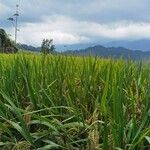
Oryza sativa
Lowland rice · Asian rice · Upland rice · Rice · Cultivated Rice
Description
Source: leafsnapOryza sativa, commonly known as rice, is a staple food crop belonging to the Poaceae family. It is one of the world's most important cereal crops, extensively cultivated in Asia, Africa, and Latin America. Rice plants are annuals that can grow between 1 to 2 meters tall, featuring long leaves with a prominent midrib. The plant produces flowers in panicles that range from 15 to 30 cm in length, typically white or yellowish-green. Rice plants require warm temperatures (20-35°C) and high humidity for optimal growth. They also need ample water, as they are typically grown in flooded fields or paddies. The plant has a shallow root system, making it susceptible to drought stress. Rice grains are harvested when they turn golden brown and reach maturity after about 4 to 6 months of growth, depending on the variety. Rice grains are rich in carbohydrates (starch), protein, and vitamins such as B1 (thiamine), B2 (riboflavin), and B3 (niacin), as well as minerals like iron. Beyond its role as a crucial food crop for millions of people worldwide, rice also holds cultural significance in many societies. It plays an important role in religious ceremonies and traditional festivals such as weddings and harvest celebrations. Overall, Oryza sativa is essential not only for its nutritional value but also for its cultural significance, making it one of humanity's most valuable crops today.
🎭 Safeguarding, Rainfall, Fruitfulness
Care Guide
💧 Water Every 7 days
☀️ Light Full sun
Asian Rice does best with an adequate amount of sunlight. Too little sun can cause stunted growth and make it more prone to diseases. Conversely, too much sun can lead to dehydration and scorching. During the growing phase it needs plenty of light for photosynthesis and to maximize yield.
What are the sunlight requirements for Asian Rice (Oryza sativa)?
Asian Rice (Oryza sativa) thrives in areas that receive more than 6 hours of direct sunlight daily. It's essential for the plant's growth and health to find the perfect balance of light and shade. Too little sunlight can cause stunted growth and disease susceptibility, while too much can lead to dehydration and scorching. Especially during the growing stage, sufficient light is crucial for photosynthesis and maximizing yield. Observing how sunlight moves through your garden helps in choosing the best spots for planting, ensuring the plants get adequate light.
How do artificial lights support the growth of indoor Asian Rice plants?
Indoor Asian Rice plants require adequate lighting for optimal growth, especially when natural sunlight is insufficient. Artificial lights are vital for promoting healthier and faster growth. LED lights are popular for indoor plant lighting due to their customizability to provide specific wavelengths needed by plants. For full sun plants, 30-50W/sq ft of artificial light is recommended, 20-30W/sq ft for partial sun plants, and 10-20W/sq ft for full shade plants. The light source should be placed 12-36 inches above the plant to mimic natural sunlight, and the duration should match natural daylight hours, generally between 8-12 hours per day.
What are the symptoms of light deficiency in Asian Rice?
When Asian Rice is grown in indoor settings with insufficient light, it may exhibit symptoms like smaller new leaves, leggy or sparse growth, faster leaf drop, slower or halted new growth, and leaves appearing lighter in color or with chlorosis (yellowing due to a lack of chlorophyll). Other issues include sunscald, which causes damage to leaves or stems from excessive sunlight, leaf curling as a defense against too much light, wilting from excessive water loss, and leaf scorching, characterized by brown, dry edges on leaves. These symptoms highlight the plant's struggle with inadequate or excessive sunlight.
What solutions can alleviate light deficiency issues for Asian Rice?
To address light deficiency in Asian Rice, gradually move the plants to sunnier locations until they receive at least 6 hours of direct sunlight daily. For indoor plants that are large or not easily movable, consider using artificial light, keeping a desk or ceiling lamp on for at least 8 hours daily, or investing in professional plant grow lights. Outdoors, avoid sudden changes in light intensity to prevent sunburn, and for ground plants, identify and reduce obstructions like tree branches. Transplanting smaller plants during their dormant period to a location with ample sunlight and good drainage can also be effective. Note that parts of the plant affected by insufficient sunlight may not recover, but new growth should be healthy after adjusting light levels.
🌡️ Temperature 20–37.8°C
Asian Rice originates from areas where temperatures mainly range from 68 to 100 °F (20 to 38 ℃). In winter, keep the temperature nearer the lower end to replicate its natural environment, and increase it during summer.
What is the ideal temperature range for growing Asian Rice?
Asian Rice, botanically known as Oryza sativa, thrives in environments where temperatures predominantly vary between 68 to 100°F (20 to 38°C). To mimic its natural habitat, it is advisable to regulate the temperature closer to the lower end of this range during winter, gradually adjusting upwards as summer approaches. This plant is extremely fond of heat, and exposure to cold can be detrimental. Hence, during autumn, it is recommended to bring outdoor-grown Asian Rice indoors, placing it near a bright window but at a certain distance from direct heat sources to avoid harm. Maintaining temperatures above 20°C during the winter season is beneficial for its growth, while temperatures nearing 5°C or lower are harmful.
How does low temperature affect Asian Rice and what are the solutions?
Asian Rice is not tolerant of low temperatures, showing a preference for warm conditions, ideally above 20°C. Low temperatures during winter should not drop below 5°C to prevent damage. Exposure to temperatures below 1°C may result in the leaves lightening in color. Following frost damage, symptoms such as browning or blackening of leaves alongside wilting and drooping might occur. To manage frost damage, it’s recommended to trim off the affected parts and move the plant to a warm environment indoors immediately. Positioning the plant near a south-facing window can ensure it receives ample sunlight. Additionally, it's important to avoid placing the plant near heaters or air conditioning vents to prevent the air from becoming excessively dry.
How does high temperature affect Asian Rice and what measures should be taken?
During the summer, it’s crucial to ensure that the surrounding temperature for Asian Rice remains below 38°C. Exposure to temperatures above 43°C may cause the leaves to lighten in color and increase the plant's susceptibility to sunburn. To address issues of high temperature, it is recommended to trim away the sunburned and dried parts of the plant. Relocating the plant to an area that provides adequate shade during the midday and afternoon sun can also be beneficial. Moreover, watering the plant during the morning and evening hours can help maintain soil moisture, which is vital for the health of the plant.
💨 Humidity
🪴 Soil 5-7
🌱 Fertilizer
🪴 Pot & Repot
✂️ Pruning
🌿 Propagating
🐛 Diseases & pets
☠️ Toxicity
Characteristics
- Plant Type
- Herb
- Life Cycle
- Annual, Perennial
- Genus
- Oryza
- Family
- Poaceae
- Hardiness Zone
- 10-12
- Mature Height
- 76 cm
- Mature Spread
- 30 cm
- Leaf Color
- Green
- Leaf Type
- Deciduous
- Flower Color
- White
- Flower Size
- 0.51 cm to 0.76 cm
- Bloom Time
- Summer, Early fall
- Planting Time
- Spring
- Harvest Time
- Late summer, Fall
- Native Area
- Myanmar, India, Thailand, China