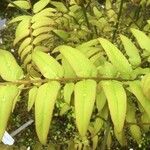
Osmunda japonica
Asian royal fern · Japanese royal fern
Description
Source: leafsnapOsmunda japonica (syn. Osmunda nipponica Makino), also called Asian royal fern, is a fern in the genus Osmunda native to east Asia, including Japan, China, Korea, Taiwan, and the far east of Russia on Sakhalin. It is called gobi (고비) in Korean and zenmai (ゼンマイ; 薇) in Japanese.It is a deciduous herbaceous plant which produces separate fertile and sterile fronds. The sterile fronds are spreading, up to 80–100 cm tall, bipinnate, with pinnae 20–30 cm long and pinnules 4–6 cm long and 1.5–2 cm broad; the fertile fronds are erect and shorter, 20–50 cm tall. It grows in moist woodlands and can tolerate open sunlight only if in very wet soil. Like other ferns, it has no flowers, but rather elaborate sporangia, that very superficially might suggest a flower, from which the alternative name derives. Like its relative Osmundastrum cinnamomeum (Cinnamon fern), the fertile fronds become brown-colored and contain spores. The sterile (vegetative) fronds resemble in form, another relative, Osmunda regalis (Royal fern). In some parts of China (where it is called 蕨菜 or juecai in Mandarin), Tibet and Japan (where it is called zenmai in Japanese), the young frond or fiddlehead of Osmunda japonica is used as a vegetable. In Korea too, these young shoots are commonly used to make dishes like namul.Osmunda Japonica has also been shown to be a significant reducer of air toxins, specifically formaldehydes.
Care Guide
💧 Water
The Asian royal fern thrives in moisture-rich environments and needs consistent hydration to maintain its lush foliage. It benefits from being watered twice a week. Typically grown outdoors, this evergreen plant requires high humidity and moist soil to stay green throughout the year.
☀️ Light Full shade
The asian royal fern flourishes with a plentiful supply of light, comparable to exposure to the sun at full strength. It can, however, withstand moderate sunlight, showing a strong capacity for growth. Coming from places where sunlight is abundant, both too much and too little can harm its health and disturb its growth.
What are the sunlight requirements for the Asian royal fern?
The Asian royal fern, or Osmunda japonica, thrives best under full sunlight, which is characterized by more than 6 hours of direct sunlight daily. It can also adapt to partial sun conditions, receiving about 3-6 hours of sunlight. It's crucial to monitor the movement of sunlight through your garden to ensure that your fern is placed in an area that offers an optimal balance of light and shade, catering to its needs for growth and health.
What are the essentials for growing an Asian royal fern successfully?
Successful growth of the Asian royal fern requires an abundant source of light, mimicking its natural habitat that is rich in sunlight. While it demonstrates resilience by growing under moderate sunlight, both too much and too little sunlight can impact its health adversely. In scenarios where natural light is insufficient, particularly during winter or in less illuminated spaces, artificial lighting becomes essential. Indoor plants benefit greatly from LED lights, which can be tailored to provide specific wavelengths necessary for plant growth. For full sun plants, 30-50W/sq ft of artificial light is recommended, for partial sun plants 20-30W/sq ft, and for full shade plants 10-20W/sq ft. The artificial light source should be placed 12-36 inches above the plant, and the lighting duration should simulate natural daylight hours, generally requiring 8-12 hours per day.
What symptoms indicate the Asian royal fern is receiving inadequate light?
Symptoms of inadequate sunlight in an Asian royal fern include smaller new leaves, leggy or sparse growth, accelerated leaf drop, delayed or ceased growth, lighter-colored new leaves, chlorosis (yellowing leaves), sunscald, leaf curling, wilting, and leaf scorching. These symptoms arise from either too little or too much sunlight. Insufficient sunlight leads to growth issues like smaller leaves and sparse, weak growth, while excessive sunlight can cause symptoms such as chlorosis, sunscald, and leaf scorching, which harm the plant's ability to perform photosynthesis effectively.
How can I address lighting issues for my Asian royal fern?
To address lighting issues for an Asian royal fern, consider gradually moving indoor plants to a sunnier spot, ensuring they receive at least 6 hours of sunlight daily. Utilize a south-facing window and keep curtains open during the day. For plants that are too large or immobile, supplement with artificial lighting, keeping it on for at least 8 hours daily. For outdoor plants, move them to sunnier locations gradually to prevent sunburn. It's also crucial to minimize obstructions such as overhanging branches to allow more sunlight. When transplanting smaller plants for better sunlight exposure, do so during their dormant period, usually late winter or early spring, ensuring the new location has ample sunlight and good drainage. Note that parts of the plant already affected by poor lighting may not recover, but new growth should be healthy once light conditions improve.
🌡️ Temperature 5–35°C
Asian royal fern grows best in forest undergrowth. It is very sensitive to temperature and moisture, and high heat, dry conditions, and strong sunlight can all stress the plant. In summer it needs adequate shade and a humid environment. Generally it does not require special care in winter, but a prolonged lack of water during that season can still kill it.
What is the Asian royal fern?
The Asian royal fern is known by its botanical name 'Osmunda japonica'. It doesn't have any provided information about its essentials or symptoms. However, it is recognized for its distinct characteristics and uses, tied to its unique botanical classification.
💨 Humidity
🪴 Soil 5-6
🌱 Fertilizer
🪴 Pot & Repot
✂️ Pruning
To promote healthy growth in your Asian royal fern, prune it in early spring. Remove any dead or damaged fronds along with old growth. Pruning at the right time aligns with the fern's natural growth cycle, enhancing its vibrancy and reducing the risk of disease. This practice is beneficial for gardeners who want to improve both the aesthetic appeal and the health of their ferns.
🌿 Propagating
🐛 Diseases & pets
☠️ Toxicity
Characteristics
- Plant Type
- Fern
- Life Cycle
- Perennial
- Genus
- Osmunda
- Family
- Osmundaceae
- Hardiness Zone
- 5-9
- Mature Height
- 46 cm to 91 cm
- Mature Spread
- 91 cm
- Leaf Color
- Green, Dark Green
- Leaf Type
- Deciduous
- Planting Time
- Spring, Summer, Autumn
- Native Area
- Russia, Nepal, India, Vietnam, Myanmar, Japan, Koppen, Bhutan, Pakistan, South Korea, Thailand, China