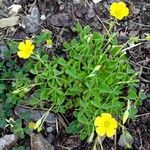
Oxalis stricta
Yellow wood-sorrel · Sourgrass · Yellow woodsorrel · Yellow sheep-sorrel · Upright yellow-sorrel
Description
Source: leafsnapOxalis stricta, called the common yellow woodsorrel (or simply yellow woodsorrel), common yellow oxalis, upright yellow-sorrel, lemon clover, or more ambiguously and informally "sourgrass", "sheep weed", or "pickle plant", is a herbaceous plant native to North America, parts of Eurasia, and a rare introduction in Britain. It tends to grow in woodlands, meadows, and in disturbed areas as both a perennial and annual. Erect when young, this plant later becomes decumbent as it lies down, and branches regularly. It is not to be confused with similar plants in the same genus which are also often referred to as "yellow woodsorrel".
🌳 Creeping woodsorrel can serve as a bioindicator of fertile soil and can also fix nitrogen, thereby helping to improve soil. Its presence may signal soil compaction, which can guide land management decisions. It is also used ornamentally, though not primarily, to beautify gardens with its delicate yellow flowers.
🎭 Love of country, fortune, happiness, kindness
Care Guide
💧 Water Every 3-5 days
Yellow woodsorrel has moderate water needs; it's important to avoid waterlogging. Water the plant when the top inch of soil feels dry, and aim to keep the top 2 inches moist. If possible, use rainwater for watering. However, tap water is fine as long as it's not too hard or cold.
☀️ Light Full sun
Creeping woodsorrel grows best in places where it gets abundant sunlight throughout the day, though it can also tolerate areas with limited light. Too little sun can weaken its strength and vitality, while too much exposure can negatively affect its growth.
🌡️ Temperature 5–37.8°C
Creeping woodsorrel flourishes best at temperatures ranging from 5 to 38 degrees Celsius (41 to 100 degrees Fahrenheit). Its ideal growing condition typically involves a steady temperature between 21 and 29 degrees Celsius (70 and 85 degrees Fahrenheit). In the heat of the summer, the plant could profit from sporadic misting of water to maintain leaf hydration in elevated temperatures.
💨 Humidity normal (40-60%)
This plant will thrive in moderate humidity, which is probably the level in your home. However, misting it a few times a week can be very beneficial. Make sure the room has good ventilation.
🪴 Soil 5-6
🌱 Fertilizer
Usually a single fertilizer application in spring is enough for Creeping woodsorrel, although repeated feedings can increase growth. Apply fertilizer roughly every month to month and a half. Fertilization improves the leaves’ appearance and function, maintaining even color and a healthy texture. It also promotes root development and nutrient uptake for sustained plant health.
🪴 Pot & Repot Every 12 months
✂️ Pruning
Yellow woodsorrel should be pruned during its winter dormancy, which is indicated by withering foliage. It's normal for the leaves to turn brown, so remove them during this time; new growth will appear in 2 to 4 weeks. Remember to always disinfect your pruning tools to prevent cross-contamination.
🌿 Propagating
🐛 Diseases & pets
☠️ Toxicity
Oxalis plants are toxic both to people and animals when ingested. All parts of the plant are poisonous, with the highest concentration of toxins being in the bulbs.
Characteristics
- Plant Type
- Herb
- Life Cycle
- Perennial
- Genus
- Oxalis
- Family
- Oxalidaceae
- Hardiness Zone
- 4-11
- Mature Height
- 10 cm to 34 cm
- Mature Spread
- 46 cm
- Leaf Color
- Green, Purple, Red
- Leaf Type
- Deciduous
- Flower Color
- Yellow
- Flower Size
- 0.51 cm to 0.51 cm
- Bloom Time
- All year round
- Planting Time
- Autumn, Spring
- Harvest Time
- All year round
- Native Area
- Libya, Pakistan, Nigeria, Slovenia, Cameroon, Koppen, Ethiopia, Central African Republic, Tunisia, Peru, Bulgaria, Bangladesh, Laos, Colombia, Afghanistan, Solomon Islands, Kazakhstan, Togo, El Salvador, Eswatini, Egypt, Angola, Austria, Namibia, Jamaica, Uzbekistan, Russia, Cuba, Venezuela, Ghana, Botswana, France, Nepal, Tajikistan, Sudan, Armenia, Greece, Switzerland, Bhutan, Nicaragua, Algeria, Sri Lanka, United Arab Emirates, Mexico, Guatemala, Slovakia, Montenegro, Croatia, Morocco, Uganda, Tanzania, Benin, Germany, Sierra Leone, Belgium, Saudi Arabia, Malawi, Honduras, Cyprus, Panama, Lebanon, Syria, Côte d'Ivoire, Iran, Ecuador, Azerbaijan, Kuwait, Costa Rica, Congo (DRC), Somalia, Lesotho, Rwanda, Eritrea, Yemen, Kenya, Iraq, Equatorial Guinea, Burundi, Liberia, Brazil, Congo, Czech Republic, Guinea, Serbia, Bahamas, Myanmar, Albania, Hungary, Turkmenistan