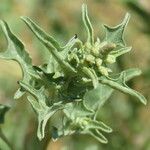
Oxybasis chenopodioides
Low goosefoot · Saltmarsh Goosefoot
Description
Source: leafsnapOxybasis chenopodioides, (syn. Chenopodium chenopodioides) is a species of flowering plant in the family Amaranthaceae known by the common name low goosefoot. It is native to South America, but it is known in widespread parts of Africa, Asia, Europe, and North America as an introduced species.It grows in wet non-saline and saline soils, such as mudflats, salt marshes, and lake margins. It is an annual herb growing erect to heights approaching 35 to 45 centimeters, or prostrate in a creeping mat. It is green to magenta in color and non-aromatic. The leaves may be several centimeters long and vary in shape from smooth-edged and oval to triangular and lobed or toothed. The inflorescence is a small, dense cluster of tiny flowers, each flower with its three-lobed calyx enclosing the developing fruit.
Care Guide
💧 Water
Adapted to saline environments, the saltmarsh goosefoot thrives with minimal water, demonstrating its drought tolerance through efficient water management. For optimal growth, weekly watering is recommended, particularly in outdoor coastal areas where tidal cycles affect its specific moisture requirements and resilience.
☀️ Light Full sun
Saltmarsh goosefoot comes from bright, open habitats where it performs best in full sun. It can withstand partial shade but prefers direct sunlight for optimal growth. This plant, which may be annual or biennial, is noted for its sun-loving character.
What are the sun requirements for Saltmarsh goosefoot?
Saltmarsh goosefoot, scientifically known as Oxybasis chenopodioides, thrives in full sun conditions, requiring above 6 hours of sunlight daily for optimal growth. It can also tolerate partial sun, needing about 3-6 hours of sunlight. When planning where to place your Saltmarsh goosefoot, observe how sunlight moves through your garden to ensure you choose a location that offers a good balance of light and shade, catering to the plant's needs for its happiness and healthy growth.
How does artificial lighting benefit indoor Saltmarsh goosefoot plants?
Artificial lighting becomes vital for the growth of indoor Saltmarsh goosefoot plants, especially when natural sunlight is insufficient, such as during winter or in less sunny spaces. Artificial lights can emulate natural sunlight, helping in promoting faster, healthier plant growth. Useful tips include choosing the right type of artificial light like LED, which can be customized to specific wavelengths needed by plants. For full sun plants, 30-50W/sq ft of artificial light is recommended, for partial sun plants 20-30W/sq ft, and for full shade plants 10-20W/sq ft. The appropriate distance for placing lights is 12-36 inches above the plant, and most plants benefit from 8-12 hours of light per day to mimic natural daylight hours.
What symptoms indicate light deficiency in Saltmarsh goosefoot?
When Saltmarsh goosefoot does not receive adequate light, several symptoms can manifest. These include smaller new leaves, leggy or sparse growth, faster leaf drop, slowed or halted growth, and lighter-colored or irregularly patterned new leaves. These symptoms indicate the plant's struggle with inadequate sunlight, impacting its ability to photosynthesize and maintain health. Additionally, chlorosis, sunscald, leaf curling, wilting, and leaf scorching can occur when the plant is exposed to inappropriate light conditions, either too much or too little.
How can I mitigate light deficiency for indoor and outdoor Saltmarsh goosefoot plants?
To address light deficiency in Saltmarsh goosefoot plants, follow these recommendations. For indoor plants, gradually move them to a sunnier location each week to ensure they receive at least 6 hours of direct sunlight daily, using a south-facing window for maximum exposure. If moving the plant is not feasible, consider using artificial lighting, such as a desk lamp or professional grow lights, to provide the necessary light for at least 8 hours daily. For outdoor plants, it's crucial to gradually acclimatize them to sunnier spots to prevent sunburn. Observe the environment and reduce obstructions like overhanging branches that might block sunlight. For smaller plants that can be moved, transplant them during their dormant period to a sunnier location with good drainage, ensuring they can thrive in their new spot.
🌡️ Temperature 5–35°C
Saltmarsh goosefoot can tolerate a wide range of temperatures, though its distribution may still be restricted by particular combinations of moisture and heat. It performs best in warm summer climates with sufficient rainfall or irrigation. Extended periods of cloudy, rainy weather, as well as prolonged high temperatures, raise the risk of Saltmarsh goosefoot dying. In winter, suitable protection from cold improves the plant’s chance of survival.
💨 Humidity
🪴 Soil 6-7
🌱 Fertilizer
Saltmarsh goosefoot benefits from regular, light applications of fertilizer to encourage healthy leaf growth. Fertilize Saltmarsh goosefoot about once a month throughout the summer. Nitrogen is essential for the foliage, and providing nitrogen-rich supplements helps Saltmarsh goosefoot thrive.
🪴 Pot & Repot
✂️ Pruning
Saltmarsh goosefoot is well-suited to saline environments and is characterized by its fleshy leaves. For best results, prune the plant from early to late spring. This encourages growth and involves removing dead stems to improve airflow. A light trimming helps maintain the plant’s shape and enhances its vitality. Be sure to avoid heavy pruning, as it can cause stress to the plant. By pruning at the right time and with care, you can support both the health and appearance of your saltmarsh goosefoot.
🌿 Propagating
🐛 Diseases & pets
☠️ Toxicity
Characteristics
- Plant Type
- Herb
- Life Cycle
- Annual
- Genus
- Oxybasis
- Family
- Amaranthaceae
- Hardiness Zone
- 5-9
- Mature Height
- 30 cm to 46 cm
- Mature Spread
- 20 cm to 49 cm
- Leaf Color
- Green, Dark Green
- Leaf Type
- Semi-evergreen
- Flower Color
- Yellow, Green, Red
- Flower Size
- 2.54 cm
- Bloom Time
- Mid summer, Late summer, Early fall
- Planting Time
- Spring, Autumn
- Harvest Time
- Early fall, Mid fall
- Native Area
- Turkey, Austria, Slovakia, Croatia, Morocco, Uzbekistan, Russia, Iraq, Germany, Romania, Belgium, Portugal, France, Czech Republic, Bulgaria, Armenia, Poland, Greece, Ukraine, China, Afghanistan, Italy, Kazakhstan, Spain, Switzerland, Denmark, Mongolia, Israel, Iran, Ireland, United Kingdom, Hungary, Algeria, Azerbaijan, Turkmenistan