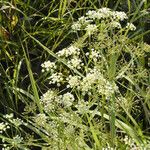
Oxypolis rigidior
Cowbane · Stiff cowbane · Water-dropwort · Stiff hog-fennel
Description
Source: leafsnapOxypolis rigidior, known as cowbane, common water dropwort, stiff cowbane, or pig-potato, is a species of flowering plant in the carrot family native to eastern North America. It is a perennial wildflower found in wet habitats. Oxypolis rigidior is poisonous to mammals.
Care Guide
💧 Water
Stiff cowbane flourishes in moist environments and needs to be watered weekly to strike a balance between drought resistance and hydration. Usually grown outdoors as an herbaceous perennial, this plant thrives when the soil is both well-drained and consistently moist, mimicking its natural growth conditions.
☀️ Light Full sun
Stiff cowbane does best in locations that get a substantial amount of daytime sunlight, but not at full intensity. This level of light promotes healthy growth. It comes from regions with comparable light conditions. Too much exposure can be harmful, while too little light limits its growth.
What are the sunlight requirements for Stiff cowbane?
Stiff cowbane requires about 3-6 hours of sunlight daily, thriving in conditions where it's exposed to a good amount of sunlight but not to its full intensity. These lighting conditions simulate its natural habitat and promote healthy growth. It's important to watch how sunlight moves through your garden to provide Stiff cowbane with the right balance of light and shade, ensuring optimal growth and happiness.
How can artificial lighting be used for Stiff cowbane?
When natural sunlight is insufficient, especially during winter or in areas that receive less sunlight, artificial lighting can be a vital solution for Stiff cowbane's growth. LED lights are recommended because they can be tailored to provide specific wavelengths needed by the plant. For full sun plants, 30-50W/sq ft of artificial light is needed, for partial sun plants 20-30W/sq ft, and for full shade plants 10-20W/sq ft. The light source should be placed 12-36 inches above the plant and kept on for 8-12 hours per day to mimic natural light conditions.
What are the symptoms of insufficient lighting for Stiff cowbane?
Insufficient lighting can cause several symptoms in Stiff cowbane, including smaller new leaves, leggy or sparse growth, faster leaf drop, slower or no new growth, lighter-colored new leaves, chlorosis, sunscald, leaf curling, wilting, and leaf scorching. These symptoms indicate the plant's struggle with inadequate light, leading to a breakdown of chlorophyll, reduced photosynthesis, and decreased overall plant health.
What are the solutions for insufficient sunlight exposure for Stiff cowbane?
To address insufficient sunlight exposure for Stiff cowbane, indoor plants can be shifted to sunnier spots each week until they receive 3-6 hours of direct sunlight daily. Artificial light can also be used for at least 8 hours daily. For outdoor plants, they should be gradually moved to sunnier locations each week to avoid sunburn. Removing obstructions like tree branches can improve sunlight exposure. If necessary, smaller plants can be transplanted during their dormant period to areas with better sunlight and drainage.
🌡️ Temperature 5–35°C
Stiff cowbane can adjust to a broad range of temperatures, though its distribution may still be constrained by various combinations of moisture and heat. It does best in warm summer conditions with sufficient rainfall or watering. Extended periods of cloudy, rainy weather or prolonged high temperatures increase the chance of Stiff cowbane dying. In winter, adequate protection from the cold can raise the plant's survival rate.
💨 Humidity
🪴 Soil 6-7
🌱 Fertilizer
Typically a single fertilizer application in spring is sufficient for Stiff cowbane, though multiple feedings can boost growth. Apply every one to one and a half months. Fertilizing improves the leaves' appearance and function, helping maintain even color and a healthy texture. It also encourages root development and nutrient uptake, supporting long-term plant health.
🪴 Pot & Repot
✂️ Pruning
Stiff cowbane benefits from pruning in early to late spring to encourage healthy growth and maintain its shape. Remove any dead or damaged stems to improve air circulation and prevent disease. Regularly check the plant and trim back any overgrown stems to enhance blooming and preserve its structural integrity.
🌿 Propagating
🐛 Diseases & pets
☠️ Toxicity
Characteristics
- Plant Type
- Herb
- Life Cycle
- Perennial
- Genus
- Oxypolis
- Family
- Apiaceae
- Hardiness Zone
- 4-9
- Mature Height
- 0.61 m to 1.52 m
- Mature Spread
- 30 cm to 61 cm
- Leaf Color
- Green
- Leaf Type
- Semi-evergreen
- Flower Color
- White
- Flower Size
- 0.25 cm to 0.51 cm
- Bloom Time
- Mid summer, Late summer, Early fall
- Planting Time
- Spring, Autumn
- Harvest Time
- Fall