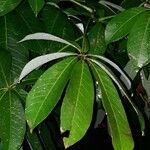
Pachira aquatica
Money Plant · Provision-tree · Water-chestnut · Wild cocoa · Malabar-chestnut
Description
Source: leafsnapPachira aquatica, commonly known as the money tree or Guiana chestnut, is a tropical plant native to Central and South America. As a member of the Malvaceae family, it can grow up to 60 feet tall in its natural habitat. However, when cultivated as an indoor plant, it typically reaches a more manageable height of 6 to 8 feet. The money tree is known for its distinctive appearance, featuring a braided trunk and large green leaves that resemble hands with five fingers. It also produces small white or pink flowers that eventually develop into edible nuts. In feng shui practices, this plant is popular for its reputed ability to bring good luck and prosperity into the home. It thrives in bright, indirect light but can tolerate low light conditions as well. The soil should be kept moist but not waterlogged to ensure healthy growth. Overall, Pachira aquatica makes an attractive indoor plant that not only adds aesthetic value but also contributes positive energy to your living space.
🌳 Money tree is more than a symbol of prosperity; it also has culinary value. Its fruit contains edible nuts that are an uncommon delicacy, especially enjoyable when roasted. These nuts lend a distinctive flavor to local dishes. Beyond cooking, the tree's seeds have another use – they can be processed into biodiesel, indicating a move toward sustainable energy.
🎭 Prosperity, plenty, good luck
Care Guide
💧 Water Every 7 days
The money tree is well-suited to tropical wetlands and thrives in high humidity and consistent moisture. It needs to be watered every two weeks. While it can tolerate a moderate drought, it prefers well-draining soil to prevent waterlogging. This makes it ideal for indoor environments, where its ornamental appeal can be enjoyed.
When Should I Water My Money Tree?
To maintain a healthy money tree, crucial signs indicate it's time to water. First, check the soil moisture by inserting a finger about 1 to 2 inches deep near the plant's base; if dry, it's time to water. Observing the leaves for signs of wilting or color loss can also guide you. The pot's weight decreases as the plant uses water, so a lighter pot indicates the need for watering. Additionally, a dry soil surface and the time elapsed since the last watering help gauge the tree's watering needs. Be mindful of the risks of both early and late watering, as they can lead to root diseases or plant stress, respectively. By monitoring these signs, you can ensure your money tree receives the right amount of water for its health and growth.
How Should I Water My Money Tree?
Watering a money tree correctly involves balancing moisture to avoid over and under-watering. A highly effective method is bottom-watering, where the potted plant is placed in a container of water for 10-15 minutes, allowing water absorption from the bottom up. Alternatively, using a watering can with a long spout helps target water at the plant's base, avoiding foliage wetness. Tools like a moisture meter can aid in monitoring soil moisture levels, ensuring water is added only when necessary, and focusing on the root area without over-saturating the surface. Proper hydration leads to vibrant and robust leaves; yellowing or browning can indicate over or under-watering, respectively.
How Much Water Does Money Tree Really Need?
A money tree prefers consistently moist but well-draining soil, with an optimal watering amount for an average-sized tree in a 6-inch pot being about 200-250 milliliters per session. Signs of a properly hydrated money tree include green, shiny leaves, and firm stem, and, if blooming, vibrant flowers. Overwatering or underwatering can lead to issues like wilting leaves, yellowing, or growth stunts. To ensure the right watering amount, check the soil moisture beforehand, and use a pot and soil that allow proper drainage, maintaining the top inch of the soil slightly moist between waterings.
What Kind of Water is Best for Money Tree?
Money tree thrives best with distilled or rainwater due to their lack of harmful substances. If using tap water, let it sit for 24 hours to evaporate chlorine, as the tree is sensitive to chlorine and fluoride, which can cause leaf-tip burn. Soft water is preferable over hard water, as the latter may lead to mineral build-up in the soil. Treating water by dechlorination and using room-temperature water helps avoid shocking the plant's roots and promotes overall health.
How Do Money Tree's Watering Needs Change with the Seasons?
The money tree's watering needs vary across seasons. In spring, its growing season, the tree may need more water than in winter, but avoid overwatering. During the summer's peak growth, watch for increased watering needs, providing proper drainage. As temperatures drop in autumn, slightly reduce watering while monitoring soil dryness, especially around indoor heating systems. In winter, water sparingly, only when the soil top layer feels dry, to prevent root rot during the tree's dormant period.
☀️ Light Partial sun
Naturally found in settings where sunlight is not consistently abundant, the money tree grows best when light is neither excessively strong nor too weak. Even, evenly distributed light helps preserve its health, while too much or too little sun can diminish the plant's vitality.
What are the sunlight requirements for a money tree?
A money tree thrives in conditions that mimic its natural environment where sunlight is not consistently intense. It requires partial sun, which translates to about 3-6 hours of sunlight per day. However, it can also tolerate full sun or full shade conditions, with full sun referring to more than 6 hours of sunlight daily. It's crucial to observe how sunlight moves through your garden or home and choose locations that provide a harmonious balance of light and shade to ensure the plant's well-being.
How does artificial lighting affect money trees when natural sunlight is insufficient?
When natural sunlight is lacking, especially during winter or in less sunny indoor spaces, artificial lighting can be a lifesaver for money trees. Adequate artificial lighting promotes faster and healthier growth by providing vital light sources. Selecting the right type of artificial light, such as LED lights, is crucial because they can be customized to emit specific wavelengths needed by the plant. Depending on the plant's sunlight needs (full sun, partial sun, or full shade), the required artificial light intensity ranges from 10-50W per square foot. The light source should be placed 12-36 inches above the plant and left on for 8-12 hours per day to simulate the length of natural daylight hours, crucial for the plant's growth.
What are the common symptoms of insufficient light in money trees?
Money trees display several symptoms when exposed to insufficient light, which may include faster leaf drop as the plant tries to conserve resources, leggy or sparse growth due to increased spacing between leaves or stems, smaller new leaves compared to mature ones, and conditions such as chlorosis where leaves lose their green color. Sunscald can also occur from intense sunlight exposure, presenting as pale or necrotic spots on the plant. Additional symptoms include leaf curling as a defense mechanism against excessive sunlight, wilting due to increased water loss, and leaf scorching characterized by brown, dry edges on leaves. Understanding these signs can help address lighting issues early and maintain the plant's health.
How can I mitigate symptoms of light deficiency in money trees?
To counteract symptoms of light deficiency in money trees, it's advisable to gradually adjust them to receive 3-6 hours of direct sunlight daily. This can be achieved by sequentially moving them to sunnier locations each week for both indoor and outdoor plants, thus allowing them to adapt to the light changes without getting sunburned. For plants that are hard to move or require additional light, consider using artificial light sources, such as desk lamps or professional grow lights, and keep them on for at least 8 hours a day. For obstructed outdoor plants, reducing barriers such as pruning obstructive branches can help increase sunlight exposure. Transplanting smaller plants during their dormant period to a sunnier location can also enhance their light intake and promote healthier growth. It's important to remember that while affected parts may not recover, new growth following increased light exposure will be healthy.
🌡️ Temperature 20–37.8°C
The money tree originates from Central and South America and prefers temperatures of 68 to 100 ℉ (20 to 38 ℃). In summer, it’s best kept in partly shaded locations to prevent excessive heat. In winter it can tolerate somewhat cooler conditions but should not be exposed to temperatures below 50 ℉ (10 ℃).
What is the native region of the Money tree, and what are its temperature preferences?
The Money tree, scientifically known as Pachira aquatica, originates from Central and South America. It flourishes in temperatures ranging from 68 to 100°F (20 to 38°C). During the summer, it's advisable to place the Money tree in partially shaded areas to protect it from excessive heat, whereas, in winter, the plant can handle cooler temperatures but should not be exposed to temperatures below 50°F (10°C). As a heat-loving plant, cold temperatures can harm it. Therefore, during autumn, it's recommended to bring Money trees grown outdoors inside, positioning them near a bright window but away from direct heat sources to maintain a temperature above 20°C, which is beneficial for their growth. Temperatures nearing 5°C can be detrimental to the plant.
What should I do if my Money tree is exposed to low temperatures?
Money trees prefer warm temperatures and do not tolerate low temperatures well, thriving best when the temperature is above 20°C. It's crucial to keep the plant above 5°C during winter, as temperatures below 1°C can cause the leaves to lighten in color. Following frost damage, leaves might turn brown or black, and the plant may exhibit signs of wilting and drooping. To remedy this, trim off the frost-damaged parts and move the plant to a warmer indoor environment immediately. Place it near a south-facing window for ample sunlight, but ensure it's not too close to heaters or air conditioning vents to avoid dry air, which could lead to further damage.
How do I protect my Money tree from high temperatures?
To protect your Money tree during the hot summer months, it's important to keep the plant in conditions below 38°C, as temperatures exceeding 43°C can cause the leaves to lighten in color and increase susceptibility to sunburn. If sunburn occurs, trim away the sunburned and dried parts of the plant. Relocate the plant to a spot where it can be shielded from the intense midday and afternoon sun. Ensuring the soil remains moist is also crucial, so water the plant in the morning and evening to keep it hydrated and healthy.
💨 Humidity normal (40-60%)
This plant will thrive in moderate humidity, which is probably the level in your home. However, misting it a few times a week can be very beneficial. Make sure the room has good ventilation.
🪴 Soil 6-7
🌱 Fertilizer
Fertilization is essential for caring for a Money tree. Feeding it regularly during the growing season preserves the energy needed for its showy leaves and encourages overall growth. Failing to fertilize can lead to unhealthy leaves, reduced ornamental appeal, and stunted or weak growth that is more likely to break.
Why do I have to add nutrients to my Money tree?
Regular fertilization is essential for Money trees because their showy leaves require a significant amount of energy to grow and stay healthy. This poses a challenge because the Money tree not only needs to dedicate energy to keep its leaves in good condition but also to support the growth of its stems, branches, roots, and other important structures. If you ignore fertilization, two likely outcomes will occur. Firstly, the leaves will lose their natural color and texture, making the tree look unhealthy and unappealing. Secondly, the Money tree's overall growth will slow down or result in weak growth, which could make it prone to breaking.
When should I put fertilizer on my Money tree?
To ensure the well-being of your Money tree, it is not necessary to establish a fixed feeding schedule when planting it. You can conveniently fertilize the plant by applying fertilizer during occasional watering. Additionally, the Money tree requires a good amount of water during the growing season. You can feed the plant every two to three weeks throughout the period of new growth.
When is the best time to not add fertilizer to my Money tree?
For most of the year, it is fine to fertilize your Money tree on a regular schedule. This includes during the active growing season in spring, summer, and early fall. However, it's important to note that during the winter, you should not fertilize the plant at all. This is because the Money tree enters a dormancy phase during winter where it either doesn't grow or grows very little. This lack of growth means that the plant uses less energy overall, which is why it doesn't need fertilizer during that time.
What kind of fertilizer should I use for my Money tree?
The fertilizer for a Money tree is made up of specific nutrients, but in relatively low amounts. The ideal fertilizer has a ratio of 3 parts nitrogen to 1 part phosphorous to 2 parts potassium (N-P-K). However, a general-purpose fertilizer with an even blend of nutrients can still work well in some cases. Even when using a balanced fertilizer, the volume of each nutrient should be at 3 or lower. You have the option to use either granular or liquid-based fertilizer. If you choose the liquid-based fertilizer, it's usually best to dilute it by half. While there isn't much downside to using granular fertilizer, it's often more practical to use liquid fertilizer, especially if you water your Money tree while feeding it.
How can I give my Money tree the nutrients it needs?
One of the easiest ways to fertilize a Money tree is by feeding it every time you water it. To do this, gather your fertilizer and a water container, like a watering can. Dilute the fertilizer by mixing it with water. Then, pour the water with the fertilizer onto the soil and let it reach the roots. Alternatively, you can use a granular fertilizer. Simply sprinkle the fertilizer on the Money tree's soil. Granular fertilizers are usually slow-release, so you don't have to fertilize as frequently compared to liquid fertilizers. In both cases, watering while you feed your Money tree is beneficial.
🪴 Pot & Repot 2-3 years
When repotting a Money tree, choose a pot 1-2 inches (2.5–5.1 cm) larger with ample drainage. Use a well-draining potting mix. Repot in spring or fall, making sure the root ball is slightly lower than the rim of the flower pot. Water thoroughly after repotting and place it in a warm spot with indirect sunlight.
✂️ Pruning
The money tree is a tropical wetland plant known for its braided trunk and glossy leaves. To maintain its size and health, it's best to prune the tree between early and late winter. This helps remove dead branches and encourages healthy growth. Be sure to use clean, sharp tools during pruning to enhance growth, improve air circulation, and boost the tree's overall health and appearance.
🌿 Propagating
🐛 Diseases & pets
☠️ Toxicity
The money tree is generally non-toxic and safe to have around both people and pets. It is even possible to eat certain parts; however, the stems and foliage may cause vomiting and nausea upon ingestion.
Characteristics
- Plant Type
- Tree
- Life Cycle
- Perennial
- Genus
- Pachira
- Family
- Malvaceae
- Hardiness Zone
- 10-12
- Mature Height
- 3.96 m to 17.98 m
- Mature Spread
- 49 cm
- Leaf Color
- Green
- Leaf Type
- Evergreen
- Flower Color
- White
- Flower Size
- 1.27 cm
- Bloom Time
- Late spring, Early summer, Mid summer
- Planting Time
- Spring, Autumn
- Harvest Time
- Early summer, Mid summer
- Native Area
- Colombia, Belize, Honduras, Mexico, Guatemala, Bolivia, Venezuela, Peru, Guyana, El Salvador, Nicaragua, Ecuador, Suriname, Costa Rica, Panama