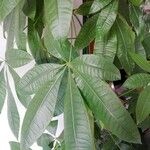
Pachira glabra
Moneytree · How to take care ofmoney tree · French-peanut · Luckytree · Water chestnut
Description
Source: leafsnapPachira glabra, commonly known as the Malabar chestnut or money tree, is a tropical tree indigenous to Central and South America. It belongs to the Bombacaceae family and can reach heights of up to 18 meters in its natural environment. One of its unique characteristics is its distinctive trunk, which can become swollen at the base, giving it an unusual and striking appearance. The leaves of Pachira glabra are large, glossy, and green, featuring five to nine leaflets. The plant produces fragrant flowers that are white or pink with yellow centers. These flowers later develop into large green fruits containing edible seeds. Pachira glabra is often cultivated as an ornamental houseplant due to its attractive appearance and ease of care. It thrives best in bright, indirect light but can tolerate lower light levels. The plant needs regular watering but should be allowed to dry out slightly between waterings. In some cultures, Pachira glabra is believed to bring good luck and prosperity when placed in homes or businesses. As a result, it has become a popular gift for housewarming parties and other special occasions. Overall, Pachira glabra is a fascinating tropical tree with distinctive features that make it both visually appealing and easy to care for, making it a favorite among indoor gardening enthusiasts worldwide.
🌳 The wood of the money tree is praised for being both sturdy and flexible, an ideal combination for a range of uses. Local craftsmen skillfully weave this wood into braided items, showing the plant’s notable pliability without losing strength. The money tree is also used in raft construction, offering dependable buoyancy because of its density. This inventive use of the money tree demonstrates the collaboration between nature’s resources and human creativity, shown in the clever use of natural materials.
Care Guide
💧 Water Every 7 days
The money tree thrives in humid environments and is tolerant of drought because of its water-absorbing adaptations. It needs to be watered every two weeks and should be placed in areas with higher humidity. You can increase humidity by misting the plant or using a pebble tray.
☀️ Light Partial sun
Money tree prefers light that isn't too intense, yet it can tolerate both the warmth of full-day sun and spots with lower lighting. Its native habitat lets it adapt to either abundant or limited light without hindering its healthy growth.
What are the sunlight requirements for a Money Tree?
A Money Tree requires partial sun, which means about 3-6 hours of sunlight daily. However, it can also thrive in full sun or full shade conditions, where full sun involves more than 6 hours of sunlight. It's important to observe how sunlight moves through your garden or indoors to find the ideal balance for your Money Tree, ensuring it gets the right amount of light and shade for optimum growth.
How does the Money Tree adapt to different light conditions?
The Money Tree is quite adaptable to various light conditions due to its native environment. It thrives best in not overly strong light but can withstand full day's rays as well as thrive in less lit sites. This adaptability allows it to grow healthily without being stunted by either excessive or insufficient light exposure.
What are the considerations for using artificial lighting with Money Trees?
When natural sunlight is insufficient, artificial lighting becomes crucial for the growth of Money Trees. Choosing the right type of artificial light is essential, with LED lights often recommended due to their ability to provide specific wavelengths needed by plants. For effective growth, full sun plants require 30-50W/sq ft, partial sun plants 20-30W/sq ft, and full shade plants 10-20W/sq ft of artificial light. The light source should be placed 12-36 inches above the plant to mimic natural sunlight, and most plants will benefit from 8-12 hours of artificial light per day.
What symptoms indicate a Money Tree is receiving insufficient light?
When a Money Tree receives insufficient light, several symptoms can appear, including faster leaf drop due to conservation of resources, leggy or sparse growth resulting in a thin appearance, slower or no new growth as the plant enters survival mode, smaller new leaves, and conditions like chlorosis (yellowing leaves), sunscald (pale, bleached areas on the plant), leaf curling, wilting, and leaf scorching. These symptoms signal the plant's struggle with inadequate light exposure.
What solutions can alleviate light deficiency symptoms in Money Trees?
To combat light deficiency symptoms in Money Trees, gradually shifting them to sunnier spots each week can help them adapt to increased light exposure, aiming for 3-6 hours of direct sunlight daily. If a plant is large or not easily movable, supplementing with artificial light for at least 8 hours daily can be beneficial. For outdoor plants, a gradual relocation to sunnier spots avoids sudden changes that could lead to sunburn. Pruning nearby trees to reduce obstructions and transplanting smaller plants to brighter locations can also improve light access. Note that parts of the plant affected by previous light deficiencies might not recover, but new growth will be healthy with improved light conditions.
🌡️ Temperature 20–37.8°C
The native habitat of the money tree is warm, humid tropical or sub-tropical regions. For best growth it favors temperatures between 68 and 100 ℉ (20 to 38 ℃). If exposed to cooler temperatures it can be damaged by frost. In hot summer periods, providing shade or misting can help control temperature and stop it from drying out.
What is the ideal growth environment for a Money Tree?
The ideal growth environment for a Money Tree (Pachira glabra) is in warm and humid tropical or sub-tropical regions. It thrives within a temperature range of 68 to 100°F (20 to 38°C) for optimal growth. These conditions replicate its native habitat, providing it with the warmth and moisture it needs to grow healthily. During the warm summer months, the Money Tree appreciates shade or misting to keep it cool and prevent drying out. However, it's extremely sensitive to cold and requires protection from low temperatures, especially in autumn and winter when it's advisable to move outdoor plants indoors and maintain a temperature above 20°C to facilitate growth.
How does low temperature affect a Money Tree and what are the solutions?
Low temperatures can significantly harm a Money Tree, as it prefers warm conditions and thrives when temperatures are above 20°C. During winter, it's crucial to keep the tree above 5°C to avoid damage. Exposure to temperatures below 1°C may cause the leaves to lighten in color before gradually turning brown or black, accompanied by wilting and drooping as signs of frost damage. To mitigate such damage, trim off the frost-affected parts and move the tree to a warm indoor setting promptly. Placing the plant near a south-facing window can ensure it receives enough sunlight while avoiding proximity to heaters or air conditioning vents to prevent air dryness.
What are the effects of high temperatures on a Money Tree and how can they be addressed?
High temperatures, specifically exceeding 38°C, can be detrimental to a Money Tree, causing the leaves to lighten and increasing susceptibility to sunburn if the temperature surpasses 43°C. To address issues arising from high temperatures, start by trimming away the sunburned and dried-up parts of the plant. Then, relocate the Money Tree to an area with shade, especially during the midday and afternoon sun to prevent further damage. It's also advisable to water the plant in the early morning and evening to maintain soil moisture and help the tree cope with the heat.
💨 Humidity
🪴 Soil 5-7
🌱 Fertilizer
Fertilization is essential for caring for a Money tree. Feeding it regularly during the growing season preserves the energy needed for its showy leaves and encourages overall growth. Failing to fertilize can lead to unhealthy leaves, reduced ornamental appeal, and stunted or weak growth that is more likely to break.
🪴 Pot & Repot 2-3 years
When repotting a Money tree, choose a pot 1-2 inches (2.5–5.1 cm) larger with ample drainage. Use a well-draining potting mix. Repot in spring or fall, making sure the root ball is slightly lower than the rim of the flower pot. Water thoroughly after repotting and place it in a warm spot with indirect sunlight.
✂️ Pruning
The money tree has distinctive braided trunks and vibrant, palmate leaves. To encourage bushier growth, remove unhealthy branches, and shape the plant, it's best to prune between early and late winter. Make sure to use clean tools for precise cuts, which will help improve air circulation and light penetration. After pruning, dispose of the cut branches and leaves to prevent disease.
🌿 Propagating
🐛 Diseases & pets
☠️ Toxicity
Characteristics
- Plant Type
- Tree
- Life Cycle
- Perennial
- Genus
- Pachira
- Family
- Malvaceae
- Hardiness Zone
- 10-12
- Mature Height
- 9.14 m to 18.29 m
- Mature Spread
- 14.94 m
- Leaf Color
- Green
- Leaf Type
- Evergreen
- Flower Color
- White
- Flower Size
- 7.62 cm to 10.16 cm
- Bloom Time
- Late spring, Early summer, Mid summer
- Planting Time
- Spring, Summer, Autumn
- Harvest Time
- Mid summer, Late summer, Early fall
- Native Area
- Brazil