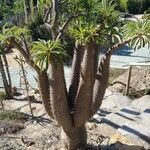
Pachypodium lamerei
نخل ماداگاسکار · آریایی · Madagascar Palm
Description
Source: leafsnapPachypodium lamerei is a species of flowering plant in the family Apocynaceae. It is a stem succulent, photosynthesizing mainly through its trunk, and comes from the island of Madagascar, off the east coast of Africa. It has large thorns and leaves mostly just at the top of the plant, and large, fragrant flowers. The species has become one of the best known pachypodiums in cultivation, being relatively easy to propagate and grow. In cultivation it is often marketed as the Madagascar palm, despite its not being a palm at all. A variety called "Ramosum" has been described. It is distinguished mostly by a dwarf growth habit.
🌳 Madagascar palm is more than a striking succulent; its drought resistance gives it potential as a landscape ornament in arid regions. Already prized for its decorative presence in xeriscapes, it can embody resilience to climate change, offering an aesthetic yet practical plant option for future landscaping projects in increasingly dry climates.
Care Guide
💧 Water Every 1-2 weeks
The Madagascar palm comes from the dry regions of Madagascar and is highly tolerant of drought. To care for it, water the plant once every 1-2 weeks, making sure the soil has completely dried out between waterings. This plant thrives outdoors in warm climates and requires more moisture during the growing season to promote healthy growth.
What important things should I think about when I water my Madagascar palm?
To properly water your Madagascar palm, there are a few environmental factors to consider. The size of the container and type of soil you use will determine how frequently and how much water to give. It's important to use a container with drainage holes so excess water can escape. Smaller containers hold less moisture, so they need to be watered more often, while larger pots hold more water and require less frequent watering. Avoid using an oversized pot, as this can lead to overwatering. When repotting, choose a container just one size larger than the current one, and opt for a shallow container since the palm has shallow roots. In terms of seasonal watering, the palm will need less water in the winter when its growth slows down. The soil retains water longer in cooler winter temperatures due to reduced evaporation. Additionally, the climate of your location plays a role. Humid regions with abundant rainfall require less frequent watering, while dry and arid climates necessitate more watering. Remember that conditions can change throughout the year, including indoor heating and air conditioning. For outdoor planting, once the Madagascar palm has established its root system in the ground, it generally doesn't require additional watering beyond what it receives naturally. However, during prolonged dry periods, occasional watering may be necessary. In areas where the palm can only be grown in a container, it can be moved outside in the spring and summer when the temperature is suitable, and brought indoors when temperatures start to drop. Potted palms kept outside typically need more water due to increased sun exposure, even if they are on a shaded porch.
How should I water a Madagascar palm?
When watering your Madagascar palm, it is best to thoroughly soak the plant and then allow it to dry out before watering again. This plant can withstand drought, so it's okay to let it become quite dry before giving it water. It's always better to underwater this plant rather than overwater it.
☀️ Light Full sun
Madagascar palm does best in locations where it receives ample sunlight throughout the day, although it can tolerate places with moderate light. Plenty of sun encourages healthy growth, reflecting its origins in strongly sunlit habitats. Still, too much or too little light can slow its development and may result in health problems.
What are the sunlight requirements for the Madagascar palm?
The Madagascar palm thrives best in full sun conditions, which means it needs more than 6 hours of sunlight daily. However, it can also grow in partial sun, receiving about 3-6 hours of sunlight. It's vital to observe how sunlight moves through your garden to ensure your plants get the right balance of light and shade, guaranteeing their health and happiness.
Can the Madagascar palm grow with artificial lighting, and how?
Yes, the Madagascar palm can grow with artificial lighting, especially when natural sunlight is insufficient. Indoor plants can benefit from artificial lights, such as LED lights, which can be customized to provide specific wavelengths necessary for optimal growth. For a plant that requires full sun, 30-50W/sq ft of artificial light is ideal. Place the light source 12-36 inches above the plant and ensure it receives 8-12 hours of light per day to mimic natural sunlight conditions.
What are the symptoms of inadequate light for the Madagascar palm?
Inadequate light can lead to several symptoms in a Madagascar palm, including leggy or sparse growth, faster leaf drop, slower or no new growth, chlorosis (yellowing of leaves), sunscald, leaf curling, wilting, and leaf scorching. These symptoms indicate that the plant is not receiving the optimal amount of light, either too little or too much, which can affect its health and growth.
How can I address light-related issues for my indoor, outdoor, or ground-planted Madagascar palm?
For indoor Madagascar palms, gradually increase sunlight exposure to at least 6 hours daily or use artificial lights for at least 8 hours. For outdoor plants, move them progressively to sunnier spots each week to prevent sunburn. If the palm is in the ground and blocked by obstructions like trees, consider pruning to improve sunlight access or transplant the plant during its dormant period to a brighter location with ample sunlight and good drainage. Remember, parts of the plant previously affected might not recover, but new growth should be healthy with improved light conditions.
🌡️ Temperature 20–37.8°C
The madagascar palm grows in its native habitat with temperatures ranging from 20 to 38 ℃ (68 to 100.4 ℉). The plant favors warm conditions and needs minimum average temperatures of 12 to 16℃ (53.6 to 60.8 ℉) in winter. In summer it requires good air circulation, a minimum of 50% relative humidity, and temperatures from 25 to 35℃ (77 to 95 ℉).
What are the essential growing conditions for the Madagascar palm?
The Madagascar palm thrives in warm environments, with optimal temperature ranges between 20 to 38°C (68 to 100.4°F). During winters, it prefers minimum average temperatures between 12 to 16°C (53.6 to 60.8°F). In the summer, it requires good air circulation and at least 50% relative humidity, with temperatures ranging from 25 to 35°C (77 to 95°F). The plant enters a dormant state and ceases growth in cooler conditions. When outdoor temperatures fall too low, it's advisable to move the palm indoors, near a south-facing window for maximum sunlight exposure. Supplemental lighting can be used if natural light is insufficient. During colder periods, watering should be reduced or stopped to prevent root rot, and for outdoor plants, it should be halted entirely. If necessary, a temporary greenhouse or wrapping the plant in plastic film or fabric can provide additional insulation.
How does low temperature affect the Madagascar palm and what are the solutions?
The Madagascar palm prefers high temperatures and doesn't tolerate cold well. It grows best in temperatures above a certain minimum and should be kept above a tolerable growing temperature minimum during winter. Exposure to temperatures below a certain limit can lead to weakness, wilting, and root rot in the plant. Mild frost may not show immediate symptoms, but affected plants will gradually wither. If frost damage occurs, trim off frosted areas and inspect the roots for rot, removing as necessary. You can then propagate from cuttings. Moving the plant to a warmer indoor environment and ensuring it receives ample sunlight through south-facing windows or supplemental lighting is crucial for its recovery.
How does high temperature affect the Madagascar palm and what are the solutions?
During summer, the Madagascar palm should be kept below a certain maximum suitable growth temperature. Exceeding a tolerable growing temperature maximum halts growth, leads to water loss, wilting, and increases susceptibility to sunburn. To manage heat stress, remove sunburned and rotten parts of the plant. Protect the palm from direct afternoon sunlight until it recovers and resumes growth. For plants suffering from root rot due to overwatering, cease watering until new roots form. Implementing these measures helps mitigate the effects of excessive heat.
💨 Humidity normal (40-60%)
This plant will thrive in moderate humidity, which is probably the level in your home. However, misting it a few times a week can be very beneficial. Make sure the room has good ventilation.
🪴 Soil 6-7
🌱 Fertilizer
Madagascar palm needs only light fertilizer applications once or twice a year during its growing season. Do not fertilize in winter or in summer when it is dormant. Cut back on feeding for plants that have been repotted and wait a couple of months after repotting before applying fertilizer. Fertilizing helps maintain healthy growth and encourages flowering.
🪴 Pot & Repot 2-3 years
Repot the Madagascar palm during warmer months, selecting a pot slightly larger than the current one with good drainage. Use a well-draining cactus or succulent soil mix. Handle the roots and caudex gently when repotting. After repotting, wait about a week before watering to avoid root rot. Place it in a sunny location for optimal growth.
✂️ Pruning
Pruning is not usually needed for a Madagascar palm. Even so, the plant actually has incredible regenerative properties. While this species typically grows a single trunk, sometimes it will branch after flowering or after the main stem is injured. To maintain a smaller size or to try to induce branching, prune the tree with care. Slice the top with a sterile knife, saw, or shears to prevent infection.
🌿 Propagating
🐛 Diseases & pets
☠️ Toxicity
Characteristics
- Plant Type
- Succulent, Shrub
- Life Cycle
- Perennial
- Genus
- Pachypodium
- Family
- Apocynaceae
- Hardiness Zone
- 9-11
- Mature Height
- 6.1 m
- Mature Spread
- 0.91 m to 2.44 m
- Leaf Color
- Green
- Leaf Type
- Deciduous
- Flower Color
- White
- Flower Size
- 11.43 cm
- Bloom Time
- Early summer, Mid summer
- Planting Time
- Spring
- Harvest Time
- Early spring, Late summer, Fall, Winter
- Native Area
- Madagascar