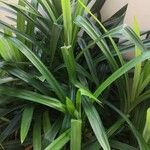
Pandanus amaryllifolius
Pandan · Pandan arum · Fragrant Pandan
Description
Source: leafsnapPandanus amaryllifolius, commonly known as pandan, is a tropical plant native to Southeast Asia. As a perennial herb belonging to the Pandanaceae family, it can reach heights of up to 2 meters. The plant features long, narrow, dark green leaves that emit a fragrant aroma. Pandan is extensively used in Southeast Asian cuisine to flavor a variety of dishes, including rice, desserts, and beverages. Its leaves also serve medicinal purposes, such as treating fever and headaches. The plant thrives in well-drained soil rich in organic matter and requires regular watering. It can be cultivated both indoors and outdoors in warm climates with ample sunlight. Beyond its culinary applications, pandan holds cultural significance in many Southeast Asian countries, often being used for decoration during festivals and religious ceremonies. In summary, Pandanus amaryllifolius is a versatile herb with significant culinary and cultural importance across Southeast Asia.
🌳 Known for its aromatic leaves, pandan is a common ingredient in many Southeast Asian dishes, flavoring rice and desserts with its distinctive scent. Outside the kitchen, pandan holds untapped potential. It has air-purifying qualities: its leaves can absorb certain volatile compounds, offering a natural method for cleaner indoor air. There is also promise in using pandan for natural dyes or fibers, since its sturdy leaves could be turned into sustainable textiles, making pandan a versatile plant with broad application possibilities yet to be explored and used.
Care Guide
💧 Water Every 7 days
Pandan plants, which are native to tropical regions, thrive in high humidity and need consistently moist, well-draining soil. To encourage lush growth, water them weekly. As evergreens, pandan plants are well-suited for indoor environments where humidity can be controlled, and they require sufficient moisture to maintain their foliage throughout the year.
☀️ Light Partial sun
The pandan prefers a spot with moderate sunlight, though it can tolerate stronger light. Being tropical in origin, it is adapted to a variety of light intensities. Excessive or inadequate light may impede growth and affect leaf color, but the plant is generally resilient to these conditions. Different stages of growth do not significantly change its light requirements.
What are the sunlight requirements for plants?
Plants have varying sunlight requirements to thrive. Partial sun plants need about 3-6 hours of sunlight daily, while full sun plants require more than 6 hours of sunlight. It's important to observe the movement of sunlight in your garden to find spots that offer the right balance of light and shade, ensuring your plants grow happily and healthily.
How do pandan plants adapt to sunlight exposure?
Pandan plants, originating from tropical environments, are adaptable to different light intensities. They thrive best under moderate sunlight exposure but can also tolerate more intense light. While excessive or insufficient light may impact growth and leaf coloring, pandan plants are generally resilient to these conditions. Throughout various growth stages, their light requirements don't change significantly. However, when natural light is not sufficient, especially during winter or in darker indoor areas, artificial lighting can be a valuable alternative to promote healthy plant growth.
How should artificial lighting be used for indoor plants?
Indoor plants can benefit greatly from artificial lighting, especially when natural sunlight is inadequate. LED lights are a recommended option because they can be adjusted to provide specific light wavelengths needed by plants. For optimal growth, full sun plants should have 30-50W/sq ft of artificial light, partial sun plants need 20-30W/sq ft, and full shade plants require 10-20W/sq ft. The light source should be placed 12-36 inches above the plants to mimic natural sunlight as closely as possible. Most plants will thrive with 8-12 hours of artificial light per day.
What are the symptoms of insufficient light in pandan plants?
Pandan plants may exhibit several symptoms if they're not receiving enough light. These include smaller new leaves, leggy or sparse growth, faster leaf drop, slower or halted growth, lighter-colored new leaves, chlorosis (yellowing leaves due to chlorophyll breakdown), sunscald, leaf curling, wilting, and leaf scorching. These symptoms indicate that the plant is struggling with the light conditions and may require adjustments to its environment.
What solutions can address insufficient sunlight for pandan plants?
To counter insufficient sunlight for pandan plants, consider gradually moving them to sunnier spots, providing at least 3-6 hours of direct sunlight daily. If moving the plant is not feasible, using artificial light sources like desk or ceiling lamps for at least 8 hours daily, or investing in professional grow lights, can also be effective. For outdoor plants, gradual relocation to avoid sunburn is key. Additionally, reducing obstructions like tree branches can help increase sunlight exposure. In the case of smaller plants, transplanting during the dormant period to a location with better sunlight and drainage might be necessary. Note that parts of the plant already affected may not recover, but new growth should be healthier with improved light conditions.
🌡️ Temperature 15–37.8°C
Pandan originates from tropical regions and does best in temperatures between 59 and 100 °F (15 to 38 ℃). In hotter conditions, regular misting may be required to mimic its native humidity and keep it cool.
What is the optimal temperature range for Pandan plants?
Pandan, scientifically known as Pandanus amaryllifolius, thrives in tropical regions and prefers temperatures between 59 to 100 °F (15 to 38 °C). In environments with temperatures closer to the upper limit, it's essential to simulate the plant's native humidity through consistent misting to keep it cool. Pandan demonstrates some cold tolerance, but care should be taken to protect it from temperatures dropping below -5°C.
How should I protect my Pandan plant from low temperatures?
Pandan plants have a moderate tolerance for cold and generally do well in temperatures above 15°C. However, during winter, it's vital to ensure the temperature doesn't fall below -5°C to prevent damage. If temperatures are expected to drop below -10°C, the plant's leaves may begin to droop, and in severe cases, wilt and fall off. To protect your Pandan from low temperatures, trim off any frost-damaged parts and wrap the plant using materials like non-woven fabric or cloth. Additionally, constructing a wind barrier can help shield the plant from cold winds.
What steps should I take if my Pandan plant is exposed to high temperatures?
Pandan plants should ideally be kept below 38°C during summer to avoid stress from heat. Exposure to temperatures above 43°C can cause the leaves to lighten in color, dry out, curl, and the plant may become prone to sunburn. To manage high temperatures, trim the sunburned and dried-up parts of the plant. Move the Pandan to a shaded location or use a shade cloth to protect it from the harsh midday and afternoon sun. Ensure to water the plant in the morning and evening to maintain soil moisture.
💨 Humidity normal (40-60%)
This plant will thrive in moderate humidity, which is probably the level in your home. However, misting it a few times a week can be very beneficial. Make sure the room has good ventilation.
🪴 Soil 5-7
🌱 Fertilizer
For maximum yield, Pandan does best with regular applications of a balanced fertilizer, especially one high in nitrogen. Apply fertilizer before planting, at planting, and when seedlings are 2 inches (5.1 cm) tall. Adding compost or manure also provides a continuous nutrient supply. Insufficient nutrients in the soil result in underdeveloped leaves and stems, inferior flavors, thin stems, and a potentially bitter taste.
🪴 Pot & Repot Every 12 months
✂️ Pruning
Pandan is a plant known for its aromatic leaves, which are commonly used in cooking. To encourage healthy growth, prune the plant from early to late spring by removing any dead leaves and giving it a desirable shape. This practice improves airflow, reduces the risk of disease, and encourages bushier, healthier foliage.
🌿 Propagating
🐛 Diseases & pets
☠️ Toxicity
The plant leaves are safe to eat and used in cooking. Therefore, they are commonly used in Asian home-cooked foods such as stews, curries, soups, desserts, etc.
Characteristics
- Plant Type
- Herb
- Life Cycle
- Perennial
- Genus
- Pandanus
- Family
- Pandanaceae
- Hardiness Zone
- 8-11
- Mature Height
- 6.1 m
- Mature Spread
- 0.91 m to 2.44 m
- Leaf Color
- Green
- Leaf Type
- Evergreen, Semi-evergreen
- Flower Color
- White, Green
- Bloom Time
- All year round
- Planting Time
- Spring
- Harvest Time
- All year round
- Native Area
- Malaysia, Cambodia, Vietnam, Myanmar, Philippines, Laos, Thailand