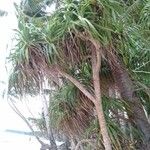
Pandanus tectorius
السيكاس · خنجری، پاندانوس · پاندانوس ابلق · Screw pine · Tahitian Screw-Pine
Description
Source: leafsnapPandanus tectorius, commonly known as the Tahitian screwpine or hala tree, is a tropical plant species in the Pandanaceae family. Native to Southeast Asia and the Pacific Islands, it has been widely cultivated in tropical regions worldwide. This plant features unique long, spiky leaves that grow in a spiral around its trunk. These tough, leathery leaves have sharp edges that can cause injury if not handled carefully. The tree can reach heights of up to 30 feet and bears small, fragrant flowers followed by edible fruit. Pandanus tectorius holds significant cultural importance in many Pacific Island societies, where it is used for weaving baskets, mats, hats, and other handicrafts. The leaves are also valued for their medicinal properties due to their antibacterial qualities. Beyond its cultural significance, Pandanus tectorius has ecological importance as well. It provides habitat for various bird species and helps prevent soil erosion along coastlines. In summary, Pandanus tectorius is a fascinating plant species with distinctive physical features, substantial cultural value, and notable ecological benefits in its native habitats.
🌳 The screw pine is an outstanding plant that carries multiple uses in Pacific indigenous traditions. Its leaves are used as natural roofing, and its fruit is also made into fashionable accessories. The sturdy wood of the screw pine is used to craft seafaring vessels, and the fruit’s segments contain oil employed in eco-friendly fuels and beauty products. Even the juice of the fruit can be turned into an exotic beverage.
🎭 Modesty
Care Guide
💧 Water Every 7 days
The screw pine flourishes in humid, tropical coastal areas and prefers soil that is consistently moist yet well-drained. It is generally grown outdoors and should be watered every 1-2 weeks, allowing the roots to dry out slightly between waterings. For optimal growth, its growing season should align with its native rainy climate.
How should I water my Screw pine plant to keep it healthy?
Watering your Screw pine is easy and flexible. You can use common tools like watering cans, hoses, or even cups. It is best to water directly into the soil, making sure to evenly moisten all areas so that the whole root system gets enough water. Filtered water is preferred to tap water because tap water may contain harmful particles. Also, using water that is at or slightly above room temperature is ideal, as the Screw pine may find extreme temperatures shocking. However, this plant generally responds well to any type of water.
What should I do if I give my Screw pine too much water or too little water?
Watering outdoor plants, especially newly planted ones or seedlings, is crucial to their health. While the Screw pine relies on rainwater once its roots are established, it is important to water it adequately for the first few months. Overwatering is more common for potted Screw pines. If you accidentally overwater, immediately stop watering the plant to minimize the impact. Check the roots for signs of root rot and trim any affected ones. Applying a fungicide can help prevent further damage. Repot the plant in well-draining soil. Conversely, if the Screw pine is underwatered, increase the frequency of watering. Signs of underwatering include drooping and drying leaves, which will return to fullness with sufficient watering. Make sure to adjust your watering routine promptly when you notice underwatering.
How frequently do I need to water my Screw pine?
Most outdoor plants can rely on rainfall for their water needs. However, if you live in an area with little rainfall, you should water your plants adequately every 2 weeks in the spring and fall. In the summer, you may need to water them more frequently. In the winter, when plants grow slower and need less water, you should water them sparingly or not at all. If your Screw pine is young or newly planted, it will require more frequent watering to help it establish and grow. For potted plants, there are two main approaches to determining watering frequency for Screw pines. The first is to set a schedule, such as watering once every week or every other week. However, this may not consider the specific conditions of your plant's environment. Another approach is to monitor soil moisture and water accordingly. Generally, it is best to wait until the top two to four inches of soil are completely dry before watering again. Keep in mind that during the summer, the plant will have higher water needs and may require more frequent watering.
How much water does my Screw pine plant need?
When watering your Screw pine, you don't always need to give it a lot of water. If only a few inches of soil have dried since your last watering, giving it about five to ten ounces of water each time will promote healthy growth. You can also gauge the water volume based on the moisture of the soil. Pay attention to how many inches of soil have dried out between waterings. To ensure your Screw pine gets enough moisture, water it enough to moisten all the dry soil layers since the last watering. If more than half of the soil is dry, give it more water than usual. Keep adding water until you see excess water draining from the pot's drainage holes. If your Screw pine is in an area that gets a lot of rain outdoors, it may not need extra watering. When it's young or still establishing, make sure it gets 1-2 inches of rain per week. As it grows, it can rely solely on rainwater, except when it's hot and there's no rainfall for 2-3 weeks. In that case, give it a thorough watering to prevent stress.
How do I know if I am watering my Screw pine enough?
The Screw pine is often overwatered, and there are clear signs to watch out for. Normally, overwatering causes yellowing leaves and leaf loss. In addition, it can make the plant structure shrink and foster root rot. Conversely, an underwatered Screw pine will also start to droop and show brown, brittle leaves. Whether you notice signs of overwatering or underwatering, you should be ready to step in and revive your Screw pine.
☀️ Light Full sun
The screw pine flourishes in a setting where it is exposed to sunlight for most of the day, but it's also capable of growing even if it only gets partial sun exposure. Overexposure to sunlight may scorch its leaves, while underexposure could restrict its healthy growth and hinder the development of its leaves.
What are the sunlight requirements for the screw pine?
The screw pine requires a substantial amount of daily sunlight to thrive properly. It performs best when it receives full sun, which is above 6 hours of sunlight each day, but it can also grow with partial sun exposure, approximately 3-6 hours of sunlight a day. It's essential to observe how sunlight moves through your garden to identify spots that offer an optimal balance of light and shade, ensuring your screw pine's health and happiness.
How does the screw pine react to different lighting conditions?
Screw pine prefers environments with ample sunlight exposure throughout most of the day but can also tolerate partial sun. However, too much direct sun exposure can lead to foliage burn, while not enough sunlight might inhibit healthy growth and proper leaf development. For indoor plants facing insufficient natural light, especially during winter or in less sunny areas, artificial lighting such as LED lights can be a suitable alternative, providing essential wavelengths of light for healthier, faster growth. The amount of artificial light needed varies depending on the type of plant, with full sun plants requiring 30-50W/sq ft, partial sun plants 20-30W/sq ft, and full shade plants 10-20W/sq ft.
What are the common symptoms of improper lighting for screw pine?
When the screw pine does not receive adequate light, several symptoms may emerge. Common signs include smaller new leaves, leggy or sparse growth, faster leaf drop, and a halt in new growth, indicating the plant is in survival mode due to insufficient light. Other symptoms include lighter-colored new leaves and a variety of issues due to excessive sunlight, such as chlorosis (leaves turning yellow), sunscald, leaf curling, wilting, and leaf scorching. These symptoms either point to a lack of sufficient light or the adverse effects of too much direct sunlight.
What are the solutions for lighting issues with screw pine?
To mitigate lighting issues with screw pine, various strategies can be employed depending on the setting. Indoors, gradually moving the plant to a location with at least 6 hours of direct sunlight daily and using artificial light for plants that are large or not easily movable can be effective. Outdoors, plants should be gradually moved to sunnier spots each week to avoid sunburn. Reducing obstructions like branches from trees can help improve sunlight access. For smaller plants, transplanting during their dormant period to a more suitable location with ample sunlight and good drainage is advisable. It's important to remember that while parts of the plant that have suffered due to insufficient light may not recover, new growth will be healthy with improved lighting conditions.
🌡️ Temperature 20–37.8°C
The screw pine is indigenous to hot areas where average temperatures fluctuate between 20 to 38 ℃ (68 to 100.4 ℉). It thrives best under these temperature conditions, although it can handle sporadic temperature drops or rises beyond this range. In the hotter seasons, it's advisable to offer afternoon shade or spraying to thwart the loss of water via transpiration.
What is the ideal temperature range for growing Screw Pine?
Screw Pine, or Pandanus tectorius, thrives in warm regions with average temperatures between 20°C (68°F) and 38°C (100.4°F). This temperature range is optimal for its growth. The plant can withstand occasional temperature fluctuations outside this range, but extreme cold or heat can be harmful. During winter, it's advised to keep the plant in a location where temperatures remain above 20°C to ensure its health. If outdoor temperatures approach 5°C, it's essential to move the plant indoors to prevent damage.
How should Screw Pine be cared for during very high or low temperatures?
Screw Pine requires special attention during temperature extremes. In cases of low temperature, particularly when it falls below 1°C, the leaves may lighten in color, turning brown or black after frost damage, accompanied by wilting and drooping. To manage frost damage, trim the damaged parts and move the plant to a warm, sunny location indoors, away from heaters or air vents to avoid air dryness. During high temperatures, especially above 38°C, the leaves might lighten and become prone to sunburn. To mitigate this, trim the sunburned areas, provide shade during the peak sun hours, and keep the soil moist with morning and evening watering.
💨 Humidity
🪴 Soil 6-7
🌱 Fertilizer
The care of Screw pine greatly depends on fertilization. Feeding it periodically throughout its growth period supports the growth process and maintains vibrant leaves. If you fail to regularly fertilize, the leaves' health may decline, affect its decorative appeal, and hinder growth, leading to easily broken and undeveloped growth.
Why should I add fertilizer to my Screw pine plant?
Screw pine plants require regular fertilization because their showy leaves demand a significant amount of energy for production and maintenance. This energy distribution challenge for Screw pines involves not only maintaining leaf health but also supporting the growth of stems, branches, roots, and other crucial structures. Neglecting fertilization can lead to two likely outcomes. Firstly, the leaves may lose their natural color and texture, resulting in an overall unhealthy appearance that diminishes its ornamental appeal. Secondly, the overall growth of the Screw pine may slow down, or weak growth prone to breakage could occur.
When should I put fertilizer on my Screw pine plant for the best results?
The Screw pine plant will benefit from occasional feedings, so there's no need to follow a fixed feeding schedule when planting this type of plant. One easy way to fertilize the Screw pine is to apply the fertilizer when you water it occasionally. During the growing season, the Screw pine requires a good amount of water. You can feed the plant once every two to three weeks to ensure it receives the necessary nutrients while producing new growth.
When is it not a good idea to fertilize my Screw pine?
Maintaining a regular fertilization schedule for your Screw pine is generally acceptable for most of the year, specifically during the active growing season of spring, summer, and early fall. Yet, it is important to note that during the winter, your Screw pine should not be given any fertilizer. This is because the plant enters a dormant growth phase during the winter, resulting in little to no new growth. Since the plant requires less energy during this phase, fertilization is unnecessary at that time.
What kind of fertilizer should I use for my Screw pine?
The fertilizer for a Screw pine has a specific blend of nutrients, each in low amounts. An ideal fertilizer has an N-P-K ratio of 3-1-2. But a general-purpose fertilizer with balanced nutrients can also work well. However, even with a balanced fertilizer, each nutrient should be at a volume ratio of 3 or lower. You can choose either granular or liquid-based fertilizer. If you use liquid fertilizer, it's best to dilute it by half. Granular fertilizer has few downsides, but using liquid fertilizer, especially when watering your Screw pine, is often the most sensible approach.
How should I fertilize my Screw pine?
To easily fertilize a Screw pine, you have a couple of options. The first method involves feeding it whenever you water it. To do this, grab your fertilizer and a watering can, then mix the fertilizer with water to dilute it. Afterward, simply pour this mixture onto the soil, ensuring it reaches the roots. Another option is to use a granular fertilizer. With this method, you just need to sprinkle some of the fertilizer onto the soil where your Screw pine is planted. Granular fertilizers tend to be slow-release, so you won't need to fertilize as frequently as you would with a liquid fertilizer. Regardless of the method you choose, it's beneficial to water your Screw pine while you fertilize it.
🪴 Pot & Repot 2-3 years
When repotting Screw pine, select a pot 1–2 inches (2.5–5.1 cm) larger with plenty of drainage. Use a well-draining potting mix. Repot in spring or fall, making sure the root ball is positioned slightly below the rim of the flower pot. Water thoroughly after repotting and put it in a warm place with indirect sunlight.
✂️ Pruning
🌿 Propagating
🐛 Diseases & pets
☠️ Toxicity
Characteristics
- Plant Type
- Shrub
- Life Cycle
- Perennial
- Genus
- Pandanus
- Family
- Pandanaceae
- Hardiness Zone
- 10-12
- Mature Height
- 3.96 m to 14.02 m
- Mature Spread
- 6.1 m to 11.89 m
- Leaf Color
- Green, White, Variegated
- Leaf Type
- Evergreen
- Flower Color
- White, Yellow
- Bloom Time
- All year round
- Planting Time
- Spring, Autumn
- Harvest Time
- All year round
- Native Area
- Nepal, Sri Lanka, Solomon Islands, India, Malaysia, Indonesia, Cambodia, Vietnam, Myanmar, Japan, Vanuatu, Philippines, Papua New Guinea, Timor-Leste, Laos, Fiji