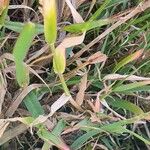
Panicum coloratum
Klein grass · White buffalo grass · Coolah grass · Small buffalo grass · Small buffalograss
Description
Source: leafsnapPanicum coloratum is a species of grass known by the common names kleingrass, blue panicgrass (USA), white buffalograss (southern Africa); Bambatsi panic, makarikari grass, and coolah grass (Australia). It is native to Africa, and it has been introduced elsewhere, such as the United States and Australia, and bred into many cultivars.This plant is variable in appearance. In general, is a perennial bunchgrass which usually has rhizomes. The firm, mostly upright stems grow up to 1.4 m (4.6 ft) tall. The leaf blades are 10 to 30 cm (3.9 to 11.8 in) long. They are green to a waxy blue-green color. The panicles are variable in length. The spikelets are green and purple.This grass is used as a pasture grass and to make hay. It produces a large amount of forage for animals. It is drought-tolerant and does well in hot climates. This C4 plant can grow on saline soils and requires some of sodium for effective photosynthesis. Different cultivars have varying tolerances of sodium. While it makes a good graze for most animals, the grass has occasionally been associated with liver damage and photosensitivity in young ruminants and horses. This photosensitivity can lead to sunburn, which causes swelling of the head and ears of the animal, a condition commonly called "swellhead".Cultivars include 'Pollock', 'Bambatsi', 'Bushman Mine', 'Verde', and 'Kabulabula'.
🌳 Besides enhancing the appearance of prairies, switchgrass is important for renewable energy. As a leading biofuel crop, it produces large quantities of biomass essential for biofuel production. This "energy grass" reduces reliance on fossil fuels by transforming part of our everyday waste into sustainable energy.
Care Guide
💧 Water
Klein grass, which comes from regions with periodic rainfall, is drought-tolerant and needs less frequent watering, usually just once a week. It thrives in outdoor environments, thanks to its deep root system that allows it to access moisture during dry spells. This ability is crucial for maintaining its lush greenery throughout the growing season.
☀️ Light Full sun
Switchgrass does best with abundant sunlight and can also tolerate less sunny conditions, reflecting its origin in open fields. Ample sunlight is necessary for healthy growth, although too much can hinder development. The level of sun exposure it needs remains the same across its different growth stages.
🌡️ Temperature 5–35°C
Switchgrass is a perennial crop that performs well across a broad spectrum of temperatures. Its native range extends from subtropical to temperate zones, with optimal temperatures between 41 and 95 ℉ (5 to 35 ℃). During the growing season, conditions of 68 to 77 ℉ (20 to 25 ℃) are most favorable. In winter, switchgrass can withstand temperatures down to 23 to 28 ℉ (-5 to -2 ℃) and continue to grow. It is advised to modify temperatures during this time to avoid frost damage.
💨 Humidity
🪴 Soil 5-7
🌱 Fertilizer
Switchgrass needs extra nutrients to encourage healthy new growth. In spring, putting some compost around the plant’s base can effectively supply the nutrients it requires. Fertilizing helps support vigorous growth and boosts the plant’s ability to resist diseases and pests.
🪴 Pot & Repot
✂️ Pruning
Klein grass is a hardy perennial that thrives best when pruned in early spring. To encourage new growth and improve air circulation, cut the dead foliage back to ground level during this time. This practice also helps reduce the risk of disease. Be sure to avoid heavy pruning at other times of the year. Always use sharp, clean tools to prevent spreading diseases.
🌿 Propagating
🐛 Diseases & pets
☠️ Toxicity
Characteristics
- Plant Type
- Grass
- Life Cycle
- Perennial
- Genus
- Panicum
- Family
- Poaceae
- Hardiness Zone
- 5-9
- Mature Height
- 0.91 m to 2.44 m
- Mature Spread
- 61 cm to 91 cm
- Leaf Color
- Green, Blue, Yellow, Brown, Red, Purple
- Leaf Type
- Deciduous
- Flower Color
- Pink, Green, Purple, Brown, Yellow
- Flower Size
- 2.54 cm
- Bloom Time
- Early summer, Mid summer
- Planting Time
- Spring, Summer
- Harvest Time
- Mid summer, Late summer, Early fall
- Native Area
- Cuba, Honduras, Mexico, El Salvador, Nicaragua, Costa Rica