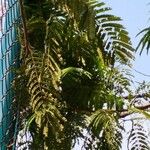
Parkia speciosa
Nitta Tree · Twisted Cluster Bean · Parkia · Pete bean · Stink bean
Description
Source: leafsnapParkia speciosa, the bitter bean, twisted cluster bean or stink bean, is a plant of the genus Parkia in the family Fabaceae. It bears long, flat edible beans with bright green seeds the size and shape of plump almonds which have a rather peculiar smell, similar to, but stronger than that of the shiitake mushroom, due to sulfur-containing compounds also found in shiitake, truffles and cabbage.
Care Guide
💧 Water
The bitter bean plant shows moderate tolerance to drought and thrives best in conditions of balanced humidity. Originating from tropical regions, it can withstand periods of less rainfall and typically requires watering every 2 to 3 weeks. As a deciduous plant, the bitter bean's water needs decrease during its dormant period.
☀️ Light Full sun
Bitter bean is native to habitats that receive abundant sunlight, such as open fields and sunny meadows. It favors full sun but can also tolerate partial sun.
What are the sunlight requirements for Bitter Bean (Parkia speciosa)?
Bitter Bean (Parkia speciosa) thrives in environments that provide ample light. It originates from open environments such as sunny meadows and forest edges. These plants do well in Full Sun, which means they require above 6 hours of sunlight, but can also tolerate Partial Sun, equating to about 3-6 hours of sunlight. It's important to observe the sunlight movement in your garden to spot the perfect balance for your plant, promoting its overall well-being and preventing issues associated with improper sunlight exposure.
How can artificial lighting be used for Bitter Bean indoor plants?
For Bitter Bean plants grown indoors, artificial lighting can significantly support their growth, especially when natural sunlight is insufficient. LED lights are recommended for their efficiency and ability to mimic the natural light spectrum needed by the plant. Full sun plants require 30-50 Watts per square foot of artificial light, while partial sun plants need 20-30 Watts per square foot. The light source should be placed 12-36 inches above the plant and kept on for 8-12 hours daily to mimic natural daylight hours. This approach helps in promoting faster, healthier growth even indoors.
What are some common symptoms of light deficiency or overexposure in Bitter Bean plants?
Bitter Bean plants may show several symptoms when faced with suboptimal lighting conditions. Light deficiency can lead to small leaves, leggy or sparse growth, faster leaf drop, slower or no new growth, and lighter-colored or chlorotic leaves. On the other hand, excessive sunlight can cause chlorosis, sunscald, leaf curling, wilting, and leaf scorching. These symptoms demonstrate the plant's struggle with the lighting conditions, indicating the need for adjustments in its environment.
What solutions can aid Bitter Bean plants with insufficient sunlight?
To aid Bitter Bean plants suffering from insufficient sunlight, gradually moving them to sunnier locations each week until they receive at least 6 hours of direct sunlight is recommended. Indoors, using a south-facing window or artificial light, like a desk or ceiling lamp on for at least 8 hours daily, can help. Outdoors, it is vital to transition the plants gradually to prevent sunburn. Pruning obstructions and possibly transplanting to locations with better sunlight exposure are practical solutions for ensuring the plant receives adequate sunlight for healthy growth.
🌡️ Temperature 20–37.8°C
Bitter bean does best in moderate temperatures — similar to the range people generally find comfortable. It fares well in conditions that are neither too warm nor too cold. The primary problem with high temperatures is the increased risk of sunburn, so giving it some shade in summer is advisable to prevent excessive heat. When temperatures fall, Bitter bean becomes dormant. If you want it to keep growing, you need to maintain warmer conditions through the winter. Frost can injure the plant and should be avoided.
💨 Humidity
🪴 Soil 5-6
🌱 Fertilizer
To feed Bitter bean, use natural or commercial fertilizer rich in nitrogen for leaf growth, phosphorus for roots and blossoms, and potassium for photosynthesis and maximum fruit production. Plant in spring, enrich the soil with compost or manure, and fertilize seedlings when they reach a height of 2–4 inches (5.1–10.2 cm). Insufficient macronutrients lead to slow growth, wilting, and fruit quality issues.
🪴 Pot & Repot
✂️ Pruning
Bitter bean plants have large, twisted pods and distinct petai beans. Essential pruning includes removing dead wood and thinning branches to improve air circulation. This is best done in early spring, as it encourages flowering, allows more sunlight to reach the plant, and leads to healthier growth. Therefore, pruning is vital for optimal cultivation.
🌿 Propagating
🐛 Diseases & pets
☠️ Toxicity
Characteristics
- Plant Type
- Tree
- Life Cycle
- Perennial
- Genus
- Parkia
- Family
- Fabaceae
- Hardiness Zone
- 9-11
- Mature Height
- 29.87 m
- Mature Spread
- 49 cm to 91 cm
- Leaf Color
- Green
- Leaf Type
- Deciduous
- Flower Color
- White
- Flower Size
- 2.03 cm to 5.08 cm
- Bloom Time
- All year round
- Planting Time
- Spring, Summer
- Harvest Time
- All year round
- Native Area
- Malaysia, Indonesia, Philippines, Singapore, Brunei, Thailand