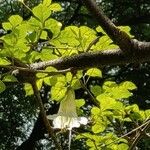
Parmentiera cereifera
Candletree · Panama candle tree
Description
Source: leafsnapParmentiera cereifera, the candle tree, is a species of tree in the family Bignoniaceae. It is endemic to Panama, but it is also a commonly cultivated specimen in botanical gardens.This tree grows up to 6 meters tall. The oppositely-arranged leaves are each made up of three leaflets. They are borne on winged petioles up to 5 centimeters long. The flower is solitary or borne in a cluster of up to four. The five-lobed corolla is greenish white. The fruit is a taper-shaped berry up to 60 centimeters long. It is green, ripening yellow, and waxy in texture. The fleshy fruit is edible.
Care Guide
💧 Water
The Panama candle tree is well-suited for dry habitats and demonstrates strong drought tolerance. It thrives in warm climates and should be watered every 2–3 weeks. To prevent waterlogging, which can lead to stress and disease, it requires well-draining soil.
☀️ Light Full sun
Originating from sunlit habitats, the Panama candle tree is a woody tropical species that does best in full sun yet can tolerate partial sun. It frequently occurs in open, brightly lit places with little shade.
What sunlight requirements do Panama candle trees have?
Panama candle trees are native to bright, sun-drenched environments and thrive in locations that receive full sun, which is defined as above 6 hours of direct sunlight daily. They can also tolerate partial sun, meaning about 3-6 hours of sunlight. It's beneficial to watch how sunlight moves through your garden, choosing spots that offer the right balance of light and shade to ensure your Panama candle tree remains healthy.
How do I use artificial lighting for indoor Panama candle trees?
For indoor Panama candle trees, adequate lighting is essential for optimal growth, especially when natural sunlight is insufficient. Artificial lights, such as LED lights, can be customized to provide specific wavelengths needed by your plants. Full sun plants require 30-50W/sq ft, partial sun plants need 20-30W/sq ft, and full shade plants 10-20W/sq ft of artificial light. The light source should be placed 12-36 inches above the plant to mimic natural sunlight and should be on for 8-12 hours per day to simulate the length of natural daylight hours for your plant species.
What are common symptoms of light deficiency in Panama candle trees?
Common symptoms of light deficiency in Panama candle trees include smaller new leaves, leggy or sparse growth, faster leaf drop, slower or no new growth, lighter-colored new leaves, chlorosis (yellowing leaves), sunscald, leaf curling, wilting, and leaf scorching. These symptoms indicate that the plant is not receiving adequate sunlight, which is crucial for its photosynthesis and overall health.
How can I address insufficient sunlight for my Panama candle tree?
To address insufficient sunlight for Panama candle trees, you can gradually move the plants to a sunnier location each week to receive at least 6 hours of direct sunlight daily. Use a south-facing window for indoor plants and keep curtains open during the day. For large or non-movable indoor plants, consider using artificial light for at least 8 hours daily or invest in professional plant grow lights. For outdoor plants, avoid sudden changes in light intensity to prevent sunburn. Pruning obstructions or transplanting to sunnier locations with good drainage can also support healthier growth. Note that parts of the plant affected by insufficient sunlight may not recover, but new growth after increasing light exposure should be healthy.
🌡️ Temperature 20–35°C
Panama candle tree originates from tropical climates and flourishes in temperatures of 68 to 95 °F (20 to 35 ℃). In colder seasons, it is recommended to provide heat indoors or to use protective covers outdoors.
What is the optimal temperature range for the Panama candle tree?
The Panama candle tree, or Parmentiera cereifera, thrives in a tropical climate with optimal temperatures ranging between 68 to 95 °F (20 to 35 °C). To ensure healthy growth, it is essential to maintain a warm environment for the tree, especially during colder seasons. Implementing measures such as providing heat indoors or using protective covers outdoors can be beneficial. When outdoor temperatures drop, it's advisable to bring the tree indoors, placing it near a bright window yet at a safe distance from heaters to avoid damage from excessive heat.
How should I care for my Panama candle tree during winter?
During the winter months, it is crucial to protect your Panama candle tree from cold temperatures. Keeping the environment above 20°C (68°F) and ensuring that temperatures do not approach 5°C (41°F) is key to preventing harm to the plant. If you are growing the tree outdoors and live in a region where temperatures drop significantly, it is recommended to bring the tree indoors. Once inside, place it near a south-facing window to provide ample sunlight but keep it away from direct heat sources like heaters, as this can cause the air to become excessively dry and negatively affect the plant.
What should I do if my Panama candle tree is affected by low temperatures?
If your Panama candle tree suffers from low temperature exposure, the first step is to trim off the frost-damaged parts to prevent further deterioration. Immediately move the plant to a warmer indoor environment for protection against the cold. Choosing a location near a south-facing window will ensure the tree receives enough sunlight while avoiding direct contact with heaters or air conditioning vents to maintain optimal humidity levels. This care approach helps your plant recover from frost damage by providing a stable, warm environment.
How do I protect my Panama candle tree from high temperatures?
To shield your Panama candle tree from the stress of high temperatures, particularly during the summer when temperatures can exceed 35°C (95°F), it is essential to monitor and manage its exposure to heat. If the temperature climbs above 41°C (105.8°F), the risk of sunburn increases, causing the leaves to lighten and making the plant more susceptible to damage. Trim away any sunburned or dry parts of the plant and consider moving it to a shaded area, especially during the peak sun of midday and afternoon. Additionally, maintaining soil moisture by watering the plant in the morning and evening will help alleviate the stress from high temperatures.
💨 Humidity
🪴 Soil 6-7
🌱 Fertilizer
The best time to fertilize a Panama candle tree is in early spring as it breaks dormancy. This encourages overall growth and supports flower development. Fertilizing improves the foliage, stems, and branches, while encouraging large, colorful, and longer-lasting blooms. It helps transport nutrients from the roots to the flowers and enhances the plant's health and resistance to disease.
🪴 Pot & Repot Every 12 months
✂️ Pruning
To ensure the healthy growth of a Panama candle tree, it's important to prune it early in the spring while it is still dormant. Focus on removing any dead or diseased branches, as this will improve air circulation around the tree. Additionally, trim any branches that cross each other to maintain balance and allow light to reach all parts of the tree. Make sure that your cuts are clean to prevent infections. Consulting with a professional for optimal care is also recommended.
🌿 Propagating
🐛 Diseases & pets
☠️ Toxicity
Characteristics
- Plant Type
- Tree
- Life Cycle
- Perennial
- Genus
- Parmentiera
- Family
- Bignoniaceae
- Hardiness Zone
- 10
- Mature Height
- 6.1 m
- Mature Spread
- 3.05 m to 4.88 m
- Leaf Color
- Dark Green
- Leaf Type
- Deciduous
- Flower Color
- White
- Flower Size
- 5.08 cm
- Bloom Time
- All year round
- Planting Time
- Spring, Summer, Autumn
- Harvest Time
- All year round
- Native Area
- Panama