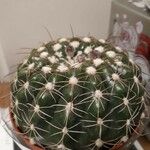
Parodia crassigibba
Green tomato cactus · Ball cactus
Description
Source: wikipedia (CC BY-SA)Parodia crassigibba, the green tomato cactus, is a species of cactus in the genus Parodia, native to Rio Grande do Sul state in southern Brazil. It has gained the Royal Horticultural Society's Award of Garden Merit as a houseplant.
Care Guide
💧 Water
Originating from arid regions, the green tomato cactus thrives with minimal moisture and exhibits strong drought tolerance. Watering it once every three weeks aligns well with its preference for dry conditions. This cactus is commonly found in outdoor rock gardens or desert landscapes, efficiently using scarce rainfall to maintain its succulent form.
☀️ Light Full sun
Green tomato cactus favors environments with unobstructed sunlight, similar to the light conditions of its native habitat, which support healthy growth. It is fairly tolerant of reduced sun exposure. However, too little or too much sunshine can hinder its vigor.
What are the sunlight requirements for Green tomato cactus?
Green tomato cactus requires full sun, defined as above 6 hours of sunlight a day, or partial sun, about 3-6 hours of sunlight, to thrive optimally. It's important to watch how sunlight moves through your garden, choosing spots that offer a perfect balance of light and shade. This plant prefers environments where the sun's rays aren't blocked, similar to its native habitat, allowing for healthy growth. Although it can tolerate some variation in light exposure, too little or excessive sunlight can hinder its vitality.
How can artificial lighting support Green tomato cactus indoors?
Indoor Green tomato cactus plants require adequate lighting for optimal growth. When natural sunlight is insufficient, artificial lights provide a crucial solution, promoting faster, healthier growth. LED lights are a preferred choice because they can offer the specific wavelengths of light that plants need. Full sun plants need 30-50W/sq ft, partial sun plants 20-30W/sq ft, and full shade plants 10-20W/sq ft of artificial light. The light source should be placed 12-36 inches above the plant to mimic natural sunlight and be kept on for 8-12 hours per day to mimic natural daylight hours.
What are the common symptoms of inadequate light in Green tomato cactus, and how can they be addressed?
When Green tomato cactus is exposed to suboptimal lighting, it may display several symptoms such as smaller new leaves, leggy or sparse growth, faster leaf drop, slower or no new growth, lighter-colored new leaves, chlorosis, sunscald, leaf curling, wilting, and leaf scorching. Solutions vary based on the setting: indoors, plants can be gradually moved to sunnier locations or supplemented with artificial light; outdoors, adjusting plant placement gradually to avoid sunburn is key; for ground plants, reducing obstructions or transplanting to sunnier spots can help. However, parts of the plant affected by insufficient light may not recover, though new growth should be healthy with improved light conditions.
🌡️ Temperature 20–37.8°C
Green tomato cactus originates from a warm climate and grows best at temperatures between 68 to 100.4 °F (20 to 38 ℃). In colder periods, it's recommended to keep the temperature no lower than 68 °F (20 ℃) for optimal growth.
What is the optimal temperature range for the Green tomato cactus?
The Green tomato cactus, botanically known as Parodia crassigibba, thrives in a warm climate with an optimal temperature range between 68 to 100.4 °F (20 to 38 °C). It's important to ensure that the temperature does not fall below 68 °F (20 °C) during cooler seasons to maintain optimal growth conditions.
How should I care for my Green tomato cactus during winter?
During winter, the Green tomato cactus enters a dormant state and requires special care. It's vital to move the cactus indoors if the outdoor temperature drops below 32°F (0°C) to avoid frost damage. Choose a south-facing window for maximum sunlight exposure. If natural light is insufficient, consider using supplemental lighting. Additionally, reduce or stop watering the plant to prevent root rot, especially when temperatures fall below 68°F (20°C). If outdoors, completely halt watering and consider wrapping the plant with plastic film or fabric for insulation.
What are the symptoms of low temperature exposure in Green tomato cactus, and how can they be addressed?
Exposure to low temperatures below 20°C can lead the Green tomato cactus to become weak, wilt, and be at risk of root rot, especially if temperatures fall below -5°C. Mild frost damage might not show immediate symptoms, but the plant could gradually wither after a week. To address this, trim off the frostbitten parts, check for root rot, and if present, cut off the rotted roots. The plant can then be propagated through cuttings. Move the plant indoors to a warm environment near a south-facing window for ample sunlight, using supplemental lighting if needed.
How should I manage high temperatures for my Green tomato cactus?
In instances of high temperatures exceeding 100.4°F (38°C), particularly above 109.4°F (43°C), the Green tomato cactus can cease growing, experience water loss, wilting, and become vulnerable to sunburn. Address this by removing any sunburned or rotten parts of the plant, providing shade from the harsh afternoon sunlight until the plant recovers, and refraining from watering the plant until new roots develop, especially in cases of root rot.
💨 Humidity
🪴 Soil 6-7
🌱 Fertilizer
For Green tomato cactus, light applications of fertilizer once or twice a year during the growing season are enough. Do not fertilize in winter or in summer while it is dormant. Use less fertilizer for repotted plants and wait a couple of months after repotting before you start feeding. Fertilizing helps maintain healthy growth and promotes blooms.
🪴 Pot & Repot 2-3 years
Repot the Green tomato cactus in spring or summer, choosing a pot slightly larger than the current one with good drainage. Use a well-draining, sandy or gritty cactus mix. Handle it carefully to avoid the spikes. Allow the cactus to dry out before repotting to prevent root rot. After repotting, wait one week before watering to allow the roots to heal.
✂️ Pruning
The green tomato cactus requires minimal pruning. It's a good idea to remove any wilted flowers and branches so the plant can focus its nutrients on healthy growth.
🌿 Propagating
🐛 Diseases & pets
☠️ Toxicity
Characteristics
- Plant Type
- Succulent
- Life Cycle
- Perennial
- Genus
- Parodia
- Family
- Cactaceae
- Hardiness Zone
- 9-11
- Mature Height
- 10 cm to 15 cm
- Mature Spread
- 15 cm to 23 cm
- Leaf Color
- Dark Green
- Leaf Type
- Evergreen
- Flower Color
- Yellow
- Flower Size
- 4.06 cm to 6.35 cm
- Bloom Time
- Late spring, Early summer, Mid summer
- Planting Time
- Summer
- Harvest Time
- Mid summer