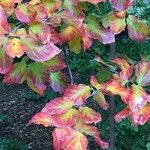
Parrotia subaequalis
Description
Source: wikipedia (CC BY-SA)Parrotia subaequalis commonly called Chinese ironwood, is a species of flowering plant in the family Hamamelidaceae. It is a tree native to Anhui, southern Jiangsu, and northern Zhejiang provinces in southeastern China. There are five disjunct populations of P. subaequalis in eastern China: two each in Jiangsu and Zhejiang provinces and one in Anhui.
Care Guide
💧 Water
The Chinese parrotia thrives in moderately moist environments and should be watered every 2-3 weeks. As a deciduous outdoor plant, its growth and leaf shedding are influenced by how much water it receives, so maintaining a consistent watering schedule is essential.
☀️ Light Full sun
Chinese parrotia grows well in locations where it gets ample sunlight each day. Partial sun exposure can also support its growth. In its natural setting, it does best under open skies. However, too much sun or a severe lack of it can negatively affect the plant's health and development.
What are the sunlight requirements for Chinese parrotia?
Chinese parrotia thrives in areas exposed to full sun, requiring above 6 hours of sunlight daily. However, it can also sustain growth with partial sun, receiving about 3-6 hours of sunlight. This plant flourishes under open skies in its natural environment, but both overabundance and severe lack of sunlight can impact its health negatively. Artificial lighting can be a vital solution for indoor plants that don't get enough natural sunlight, especially during winter or in less sunny spaces.
What are the symptoms of improper light exposure in Chinese parrotia?
When Chinese parrotia is exposed to suboptimal lighting conditions, it may show symptoms like small or lighter-colored new leaves, leggy growth, faster leaf drop, and slower or halted growth. Chlorosis, sunscald, leaf curling, wilting, and leaf scorching are other signs indicating either too much direct sunlight or not enough. These symptoms highlight the importance of monitoring and adjusting the plant's exposure to sunlight to maintain its health.
What can be done to address lighting issues for Chinese parrotia?
To address lighting issues, gradually move your Chinese parrotia to a location where it can receive at least 6 hours of direct sunlight daily. For indoor plants, use a south-facing window or artificial lights such as professional grow lights for about 8 hours daily. Outdoors, avoid sudden changes in light intensity to prevent sunburn. If sunlight is blocked, consider pruning trees or relocating the plant to a sunnier spot. While affected parts may not recover, new growth will be healthy with proper light exposure.
🌡️ Temperature 5–32.2°C
Chinese parrotia is native to habitats with temperatures between 41 and 90°F (5 to 32℃). Favoring a temperate climate, the plant adapts well to modest seasonal temperature variations.
What is the native climate for Chinese parrotia?
Chinese parrotia is native to environments that experience a temperature range of 41 to 90°F (5 to 32°C). It prefers a temperate climate and adapts well to mild seasonal temperature fluctuations. This plant is highly cold-tolerant and does not require special frost protection measures during the winter. However, it is advisable to water the plant generously before the first freeze of autumn to keep the soil moist and help prevent drought and water scarcity for the plant during the colder months.
How should Chinese parrotia be cared for during cold winters?
Chinese parrotia is extremely cold-tolerant, capable of withstanding winter temperatures above -25°C without the need for additional frost protection measures. Nonetheless, it is recommended to water the plant generously before the first winter freeze to ensure the soil remains moist. If the temperature drops below -25°C, while the plant may not show immediate damage, the branches can become brittle and dry by spring, and it may fail to produce new shoots. In such cases, it is advisable to prune away any dead branches in spring to promote new growth.
What are the symptoms and solutions for Chinese parrotia exposed to high temperatures?
Chinese parrotia struggles with high temperatures, particularly when conditions exceed 32°C. Symptoms of high temperature stress include significant leaf drop and, in severe cases, the plant may wither and die. To mitigate damage from high temperatures, trim away any sunburned and dried-up parts of the plant. Relocating the plant to a shaded area during the midday and afternoon sun, or using a shade cloth, can also be beneficial. Additionally, watering the plant in the morning and evening helps keep the soil adequately moist under high temperature conditions.
💨 Humidity
🪴 Soil 5-6
🌱 Fertilizer
The timing of fertilizing Chinese parrotia is important. Begin feeding in early spring and continue monthly through early summer. Fertilizer promotes attractive blooms and supplies energy both during dormancy and in active growth.
🪴 Pot & Repot
✂️ Pruning
The Chinese parrotia is known for its beautiful foliage and peeling bark. To maintain its health and appearance, prune it in early spring by removing any dead or crossing branches. This helps improve airflow and shape the plant. By selectively thinning the branches, you can encourage growth and reduce the risk of disease, all while preserving the plant’s natural form and minimizing stress.
🌿 Propagating
🐛 Diseases & pets
☠️ Toxicity
Characteristics
- Plant Type
- Tree
- Life Cycle
- Perennial
- Genus
- Parrotia
- Family
- Hamamelidaceae
- Hardiness Zone
- 5-7
- Mature Height
- 3.96 m to 4.88 m
- Mature Spread
- 4.57 m to 6.1 m
- Leaf Color
- Dark Green, Orange Red, Gold
- Leaf Type
- Deciduous
- Flower Color
- Red
- Flower Size
- 0.76 cm to 1.27 cm
- Bloom Time
- Late winter, Early spring
- Planting Time
- Spring, Summer, Autumn, Winter
- Harvest Time
- Late summer, Early fall, Mid fall
- Native Area
- China