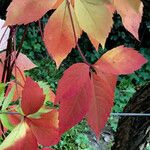
Parthenocissus inserta
False Virginia-creeper · Grape Woodbine · Thicket-creeper · Woodbine · Virginia creeper
Description
Source: leafsnapParthenocissus inserta, commonly known as the False Virginia Creeper, is a deciduous climbing vine belonging to the Vitaceae family. Native to North America, this plant thrives in diverse habitats, including forests, woodlands, and rocky slopes. It features a woody stem that can extend up to 20 meters in length and uses tendrils for climbing. The leaves of Parthenocissus inserta are palmately compound, consisting of five leaflets. These leaves are dark green in the summer months but transition to red or purple in the autumn before they fall. The plant blooms in late spring or early summer, producing small greenish-white flowers that are followed by tiny blue-black berries. Due to its vigorous growth and ability to cling tightly with its tendrils, Parthenocissus inserta is an excellent choice for covering walls or trellises. It prefers full sun but can tolerate partial shade and various well-drained soil types. Though generally pest-resistant, Parthenocissus inserta may be prone to powdery mildew if grown in humid conditions without proper air circulation. Overall, Parthenocissus inserta is an attractive climbing vine that offers beautiful foliage throughout the growing season. It is easy to grow and requires minimal maintenance, making it a valuable addition to any garden or landscape project.
🌳 Concealed in the green leaves of woodbine is an unexpected use that goes against assumptions: not scent-laden oils or succulent fruit, but a natural cleansing agent. Ancient tribes used crushed woodbine leaves as a gentle, eco-friendly soap. Although it won't replace modern cleaning products, the leaf's mild saponins are appealing as a sustainable alternative.
🎭 Cognitive achievement, fertility
Care Guide
💧 Water Every 7 days
Due to the complete unpretentiousness with watering of Parthenocissus Inserta, there are no problems if there is enough rainfall moisture. But if the weather is hot and dry for a long time, it is worth watering it. This means Parthenocissus Inserta should be watered twice a week during high temperatures. With a decrease in outside temperatures, watering is significantly reduced, but it is necessary to prevent the soil in the pot from completely drying out.
☀️ Light Full sun
Woodbine performs best with wide or uninterrupted sunlight all day, yet it can also grow satisfactorily where sunlight is present only for a limited time. Its development in both open and partly shaded settings accounts for this flexibility. Excessive sun or too little light can reduce growth or cause leaves to fade in color.
🌡️ Temperature 0–35°C
Woodbine is a temperate woody plant that prefers temperatures between 32 and 95 ℉ (0 to 35 ℃). It is native to North America and occurs in various habitats, including woodlands, meadows, and along streams. In hot summer months, it may benefit from some partial shade to help prevent stress.
💨 Humidity
🪴 Soil 5-7
🌱 Fertilizer
Apply fertilizer to your Woodbine in early spring to encourage healthy growth. Regular feeding improves overall health, producing vigorous growth, increased tolerance to difficult conditions, and enhanced resistance to pests and diseases. Follow a consistent fertilization schedule for your Woodbine to keep foliage vibrant, deeply colored, and lush in appearance.
🪴 Pot & Repot 2-3 years
Repot Woodbine in early spring, selecting a pot only slightly larger than the current one that provides proper drainage. Use a well-draining potting mix and position the root ball at the same level as before. Gently tease apart any root-bound roots. After repotting, water thoroughly and place the plant in a warm, shady spot. Regular pruning helps control size and encourages new growth.
✂️ Pruning
🌿 Propagating
🐛 Diseases & pets
☠️ Toxicity
The berries are poisonous, as they contain a high concentration of oxalic acid, which is moderately toxic to humans and dogs.
Characteristics
- Plant Type
- Vine
- Life Cycle
- Perennial
- Genus
- Parthenocissus
- Family
- Vitaceae
- Hardiness Zone
- 3-9
- Mature Height
- 20.12 m
- Mature Spread
- 14.94 m to 20.12 m
- Leaf Color
- Green, Blue, White
- Leaf Type
- Deciduous
- Flower Color
- Yellow, Green
- Flower Size
- 6.35 cm to 12.70 cm
- Bloom Time
- Early summer, Mid summer
- Planting Time
- Autumn, Winter
- Harvest Time
- Mid summer