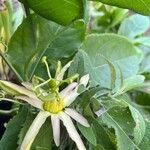
Passiflora herbertiana
Yellow passionflower · White passionflower
Description
Source: leafsnapPassiflora herbertiana, or native passionfruit, is a widespread climbing twiner native to moist forests on the coast and ranges of eastern Australia. The subspecies P. h. insulae-howei P.S.Green is endemic to Lord Howe Island in the Tasman Sea.
Care Guide
💧 Water
☀️ Light Partial sun
Australian Native Passionfruit is native to habitats like forest understories and rocky areas, where it grows under natural shade. It prefers partial sun but can tolerate full sun or full shade, illustrating its versatile, hardy nature.
🌡️ Temperature 20–37.8°C
Australian Native Passionfruit has good temperature adaptability, able to endure higher heat and greater temperature fluctuations. In hot conditions, care should be taken with watering and providing suitable shade to avoid sunburn. However, it is relatively intolerant of low temperatures—while it can handle some cold, very low temperatures may cause frost damage.
💨 Humidity
🪴 Soil 6-8
🌱 Fertilizer
A single application of fertilizer in spring is generally adequate for Australian Native Passionfruit, though multiple feedings can enhance growth. Feed once every month to a month and a half. Fertilization improves leaf appearance and function, supporting even color and a healthy texture. It also encourages root growth and nutrient uptake for long-term plant health.
🪴 Pot & Repot
✂️ Pruning
🌿 Propagating
🐛 Diseases & pets
☠️ Toxicity
Characteristics
- Plant Type
- Herb, Vine
- Life Cycle
- Perennial
- Genus
- Passiflora
- Family
- Passifloraceae
- Hardiness Zone
- 9-11
- Mature Height
- 3.05 m to 4.88 m
- Mature Spread
- 2.13 m to 3.05 m
- Leaf Color
- Green, Dark Green
- Leaf Type
- Evergreen
- Flower Color
- Pink, Lavender
- Flower Size
- 5.08 cm to 6.35 cm
- Bloom Time
- Mid spring, Late spring, Summer
- Planting Time
- Autumn, Winter
- Harvest Time
- Mid summer, Late summer, Fall