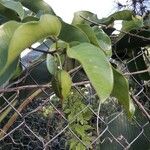
Passiflora laurifolia
Water-lemon · Yellow granadilla · Bell-apple · Jamaica-honeysuckle · Sweetcup
Description
Source: leafsnapPassiflora laurifolia, commonly known as the water lemon, Jamaican honeysuckle, golden bellapple, pomme liane on Martinique & Guadeloupe and orange lilikoi (yellow lilikoi, or simply lilikoi, is the name given to passiflora edulis v. flavicarpa for the valley where it first grew in Hawai'i), is a species in the family Passifloraceae. It is native to tropical Americas, and has spread to other parts of the world. As a tropical species, water lemon will not tolerate any frost. Water lemon is only occasionally cultivated, but the fruits are usually available in markets wherever the vine grows in wild. It is not widely known outside those regions. The fruit is medium-sized, ovoid in shape, about 2 in (5.1 cm) long with a diameter of 3 in (7.6 cm), with a green or deep orange skin and white-yellow, extremely juicy pulp. The water lemon has an excellent mild, perfumed taste, without the tartness of the common Passionfruit. It grows on a vigorous vine up to 30 feet long. Growing better in slightly humid climates, the vine is not particular about soil or water requirements, other than liking ground moisture year-round. It is almost always grown from seeds, but can be propagated by cuttings. Bottom-heating the seeds at 70-80 °F (21-27 °C) can result in germination at 1–2 weeks; at lower temperatures, seeds can take up to 10 weeks to germinate. The fruits are eaten fresh, or used in drinks and beverages. Waterlemon Cay in the Virgin Islands is named after the fruit.
Care Guide
💧 Water
The golden bellapple needs consistent moisture during its germination period. However, once the plant matures, it should be watered only twice a week, particularly in regions where rainfall is less than 1.5 inches weekly. Be careful not to overwater, as overly damp soil can damage the golden bellapple. Additionally, keep in mind that soil in containers tends to dry out more quickly, and therefore, may require more frequent watering.
☀️ Light Full sun
Golden bellapple comes from open habitats like sunlit meadows and the margins of forests, where light is plentiful. It prefers full sun but can also tolerate partial sun, adapting well to a range of sunlight conditions.
What are the sunlight requirements for Golden bellapple (Passiflora laurifolia)?
The Golden bellapple, known botanically as Passiflora laurifolia, thrives under specific sunlight conditions to ensure its happiness and health. For 'Full sun' exposure, it requires above 6 hours of sunlight daily, ideal for plants that flourish under direct light for most of the day. For 'Partial sun' exposure, about 3-6 hours of sunlight daily is suitable, accommodating plants that prefer a balance of sun and shade. It's essential to observe how sunlight moves through your garden throughout the day to find spots that offer the perfect light and shade balance.
🌡️ Temperature 20–37.8°C
Golden bellapple comes from tropical areas, where the climate is generally warm and humid. As a result, it is adapted to high temperatures and humidity. It does not tolerate sudden temperature changes and prefers a stable thermal environment, so avoiding temperature fluctuations indoors is important. It usually cannot withstand cold and needs higher temperatures to grow. If the surrounding temperature drops too low, the plant may stop growing or even die.
What is the botanical name of the Golden Bellapple?
The botanical name of the Golden Bellapple is Passiflora laurifolia.
💨 Humidity
🪴 Soil 6-7
🌱 Fertilizer
Use organic fertilizers (for example, fish emulsion or compost) instead of chemical ones for Golden bellapple. Give young plants extra nitrogen and phosphorus in spring. Work compost or fertilizer into the soil before or after planting. For mature plants, apply a balanced fertilizer or one addressing specific deficiencies in spring. Nutrient deficiency results in small leaves, short branches, yellow or bronze foliage, acidic fruit, premature fruit drop, and splitting.
🪴 Pot & Repot
✂️ Pruning
To help the golden bellapple thrive, it is important to prune it early in the spring. This includes removing dead stems, thinning out crowded areas, and cutting back vigorous growth. Pruning in this way enhances air circulation, reduces the risk of pests, and promotes healthier development. Be sure to use sterilized tools to prevent the spread of diseases.
🌿 Propagating
🐛 Diseases & pets
☠️ Toxicity
Characteristics
- Plant Type
- Vine
- Life Cycle
- Perennial
- Genus
- Passiflora
- Family
- Passifloraceae
- Hardiness Zone
- 10-12
- Mature Height
- 6.1 m to 9.14 m
- Mature Spread
- 3.05 m to 4.88 m
- Leaf Color
- Dark Green
- Leaf Type
- Evergreen
- Flower Size
- 6.35 cm to 10.16 cm
- Bloom Time
- All year round
- Planting Time
- Spring, Summer, Autumn
- Harvest Time
- All year round
- Native Area
- Colombia, Cuba, Venezuela, Peru, Guyana, Brazil, Jamaica