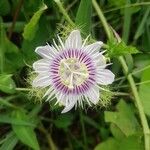
Passiflora morifolia
Woodland passionflower · Woodland passion-flower · Blue sweet calabash
Description
Source: leafsnapPassiflora morifolia, the blue sweet calabash or woodland passionflower, is a white and purple flowered passion flower with blue or purple fruit. The very fast-growing vine that can grow a few dozen feet in a season. Flowers are ornate, white, blue and purple fruits follow, which ripen to blue or purple. The orange pulp might be edible. The hardiness of P. morifolia is to at least 32 °F, some sources claim as low as 15-20 °F. It grows well in full sun or filtered sun. The vine is fast growing and once established it is quite vigorous. Its propagation is by seed or by cuttings. It is grown as an ornamental. It is not cultivated for its fruit. It is native to the parts of Central and South America.
Care Guide
💧 Water Every week
The woodland passionflower flourishes in tropical environments and needs regular moisture without becoming waterlogged. While it can tolerate some drought, it benefits from weekly watering to stay well-hydrated. As an evergreen plant, its lush foliage and adaptability to different climates rely significantly on having a consistent water supply.
☀️ Light Full sun
The woodland passionflower thrives on a substantial amount of light, reflecting the conditions of its native habitat where it grows under uninterrupted sunlight. Such strong illumination is essential to its success. Yet excessive exposure can compromise its well-being, reducing plant vigour and overall health.
What are the sunlight requirements for a Woodland passionflower?
Woodland passionflower requires full sun, meaning it thrives in conditions where it receives more than 6 hours of sunlight daily. However, it can also tolerate partial sun, which is about 3-6 hours of sunlight each day. It's important to observe how sunlight moves through your garden to find spots that offer the right mix of light and shade, ensuring the plant's growth and happiness.
Why is the intensity of light important for the health of a Woodland passionflower?
The intensity of light is critical for the health of a Woodland passionflower because it originates from environments where it is exposed to direct, strong sunlight. Proper light exposure is essential for its growth and vigor. However, too much direct sunlight can harm the plant, leading to reduced strength and overall health.
How can artificial lighting be used for Woodland passionflowers?
Artificial lighting is a great solution for Woodland passionflowers when natural sunlight is insufficient, especially in winter or less sunny areas. LED lights are ideal as they can be tailored to provide specific light wavelengths needed by the plant. Full sun plants require 30-50W per square foot, partial sun plants 20-30W, and full shade plants 10-20W. The light source should be placed 12-36 inches above the plant for 8-12 hours per day to mimic natural sunlight conditions.
What are some symptoms of light deficiency in Woodland passionflowers?
Symptoms of light deficiency in Woodland passionflowers include the growth of smaller than usual new leaves, leggy or sparse growth, faster leaf drop, slower or no new growth, pale or lighter-colored new leaves indicating a lack of chlorophyll and essential nutrients. There's also risk of chlorosis where leaves lose their green color, sunscald from intense light exposure, leaf curling as a defense against excessive sunlight, wilting due to increased water loss, and leaf scorching characterized by brown, dry edges on leaves.
How can you address insufficient light for indoor and outdoor Woodland passionflowers?
To address insufficient light for indoor Woodland passionflowers, gradually move them each week to a sunnier spot until achieving at least 6 hours of sunlight daily. Using a south-facing window helps maximize sunlight exposure. Artificial lighting, like desk or ceiling lamps for at least 8 hours daily or professional grow lights, can also supplement light. For outdoor plants, gradually acclimate them to sunnier spots to prevent sunburn. If sunlight is blocked, consider pruning obstructions or transplanting smaller plants during their dormant period to more sunlit areas with good drainage. Note that parts of the plant that have suffered from light deficiency may not recover, but new growth will be healthy with increased light exposure.
🌡️ Temperature 15–37.8°C
Woodland passionflower comes from tropical areas where the climate is generally warm and humid. Consequently, it is well suited to high temperatures and humidity. It does not tolerate sudden temperature changes and prefers a stable temperature environment, so avoiding indoor temperature fluctuations is important. It usually cannot withstand cold conditions and needs higher temperatures to grow. If the environmental temperature falls too low, the plant may stop growing or even die.
💨 Humidity
🪴 Soil 6-7
🌱 Fertilizer
Proper fertilization is essential for the health and appearance of Woodland passionflower. Fertilize the Woodland passionflower in summer, repeating the application monthly throughout the season. Nutrients fuel its growth and help maintain the plant's parts. Fertilizing improves the passionflower's floral display, ensuring its best blooms.
🪴 Pot & Repot
✂️ Pruning
To ensure optimal health and aesthetics of the woodland passionflower, regular pruning from early spring to late winter is essential. Remove dead stems to improve airflow and trim overgrown areas to maintain the plant's shape. This practice promotes vigorous flowering, prevents disease, and revitalizes the plant for the growing season.
🌿 Propagating
🐛 Diseases & pets
☠️ Toxicity
Characteristics
- Plant Type
- Herb, Vine
- Life Cycle
- Perennial
- Genus
- Passiflora
- Family
- Passifloraceae
- Hardiness Zone
- 8-11
- Mature Height
- 6.1 m
- Mature Spread
- 2.13 m to 3.05 m
- Leaf Color
- Red
- Leaf Type
- Evergreen
- Flower Color
- Lavender, White
- Flower Size
- 5.08 cm to 6.35 cm
- Bloom Time
- Summer, Early fall, Mid fall
- Planting Time
- Spring, Summer, Autumn
- Harvest Time
- Late summer, Fall, Early winter
- Native Area
- Colombia, Mexico, Guatemala, Bolivia, Venezuela, Peru, Brazil, Ecuador