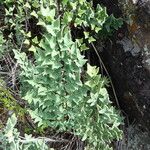
Pellaea calomelanos
Hard fern · Lehorometso
Description
Source: leafsnapPellaea calomelanos, commonly known as the cliff brake fern, is a species of fern in the family Pteridaceae. Native to North America, it thrives in rocky habitats such as cliffs, ledges, and rocky slopes. The plant features distinct fronds that are triangular in shape, growing up to 30 cm long. These fronds are dark green with a glossy texture on the upper surface, while the lower surface is adorned with small scales. This evergreen fern can reach a height of up to 60 cm and prefers well-drained soil with moderate moisture levels. It flourishes in partial shade to full sun but requires protection from strong winds. Native Americans have used the cliff brake fern for medicinal purposes to treat ailments such as fever, coughs, colds, and stomach problems. Additionally, it serves as an essential food source for wildlife, including deer, elk, and rabbits. In summary, Pellaea calomelanos is a unique fern species that enhances rocky habitats with its beauty while offering significant ecological benefits.
Care Guide
💧 Water Every 7 days
The hard fern, which originates from rocky outcrops, is drought-tolerant and thrives with watering about twice a week, ensuring it doesn’t become waterlogged. As an epiphytic fern, it efficiently absorbs water and prefers higher humidity levels indoors to mimic its natural microclimate.
☀️ Light Full shade
Hard fern is native to habitats like forest understories or rocky locations, which provide natural shade. It favors Full Shade but can tolerate Partial Sun.
What are the sunlight requirements for Hard fern?
Hard fern (Pellaea calomelanos) thrives in full shade, requiring less than 3 hours of sunlight daily. It's important to observe the movement of sunlight through your garden meticulously, selecting locations that offer an ideal mixture of light and shade. This careful placement ensures the plants' wellbeing and promotes their growth.
🌡️ Temperature 20–37.8°C
Hard fern grows best in forest undergrowth. It is very sensitive to temperature and humidity; high heat, dry conditions, and strong sunlight all stress Hard fern. In summer it needs adequate shade and a humid atmosphere. Generally, Hard fern does not require special care in winter, but an extended winter drought can still be fatal to the plant.
What is Hard Fern?
Hard Fern, scientifically known as Pellaea calomelanos, is a species of fern belonging to the botanical nomenclature. While the provided data does not include specifics about its characteristics, habitat, or care requirements, the name itself suggests it's a type of fern, possibly known for its resilience or specific texture.
💨 Humidity
🪴 Soil 6-7
🌱 Fertilizer
🪴 Pot & Repot
✂️ Pruning
For optimal growth and to prevent disease, prune hard ferns in early spring by removing dead fronds. Regular thinning improves airflow and light penetration, which are essential for the plant's health. Be sure to use clean, sharp tools to enhance both its vitality and appearance.
🌿 Propagating
🐛 Diseases & pets
☠️ Toxicity
Characteristics
- Plant Type
- Fern
- Life Cycle
- Perennial
- Genus
- Pellaea
- Family
- Pteridaceae
- Hardiness Zone
- 9-11
- Mature Height
- 20 cm to 61 cm
- Mature Spread
- 30 cm to 49 cm
- Leaf Color
- Dark Green, Olive Drab
- Leaf Type
- Evergreen
- Planting Time
- Spring, Summer, Autumn
- Native Area
- Nepal, Malawi, Somalia, Lesotho, India, Angola, Namibia, South Africa, Madagascar, Rwanda, Pakistan, Zambia, Sudan, Kenya, Uganda, Tanzania, Zimbabwe, China, Spain, Burundi, Mozambique, Eswatini, Ethiopia, Congo (DRC), Botswana